
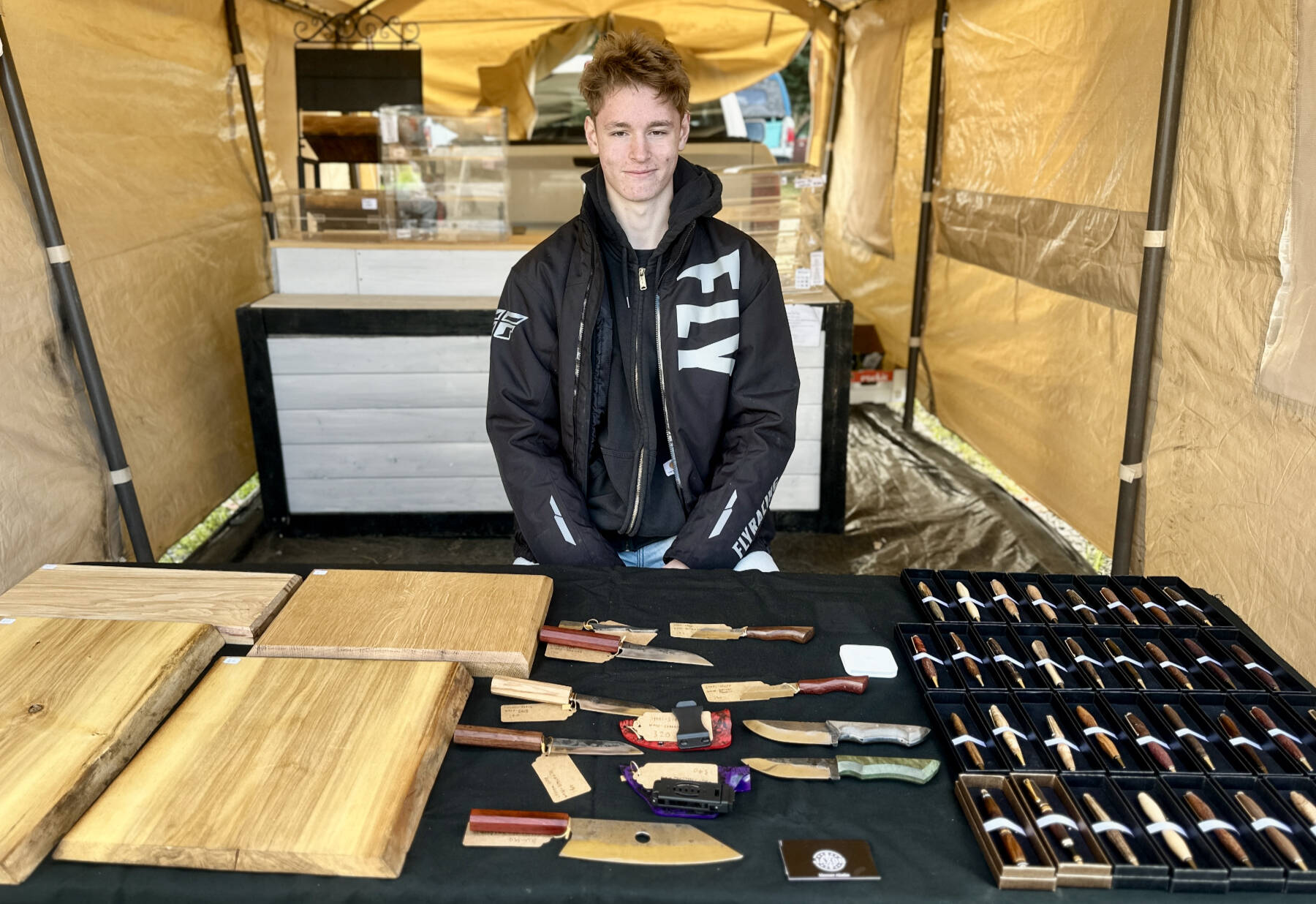
Homer youth Jaxon Bourne’s knifemaking journey began three years ago when he wanted to make a knife for his father’s birthday.
“The karambit is a scythe-looking knife and I’d picked that style because I found a template online that I wanted to replicate,” he said. “The one I made for my dad was rough and had a million things wrong with it, but my parents were supportive and that brought me to where I am today.”
Today, Bourne is handcrafting knives with blades from recycled saws and other metals and handles from a variety of woods from local sources, like family, friends and retired woodworkers happy to support his growing business.
The first knife he ever sold was a small skinner knife with an oak handle, sold at a church auction. This summer he has been setting up at the Homer Farmers Market on Saturdays.
“I joined the farmers market mid-way through this summer, and the sales have been pretty good,” he said. “I’ve sold around 30 knives there and have been getting a lot of people saying they’d commission a knife or two during the winter. The money from selling what I make is paying for my supplies and allowing me to save up for bigger tools in the future.”
Bourne crafts the blades of his kitchen knives from old circular saw blades he gets from scrap metal that he sources locally.
“These are the perfect thickness and high carbon steel that are found in traditional Japanese kitchen knives,” he said. “My other knives, like choppers and skinners, are made from a variety of scrap pieces of high carbon steel, things like leaf springs, hand files, lawn mower blades, chisels, gears and other things.”
Bourne’s kitchen knives have a carnauba wax finish, which helps resist rust, and he recommends purchasers visit his Instagram where he shares a care instruction video.
The time it takes him to create each knife varies based on the individual knife.
“For smaller and medium-sized kitchen knives, it takes about a day, with larger kitchen knives and smaller skinner knives, it will take me two to three days, and more complex kitchen knives and chopper knives can take up to nearly a week,” he said. “During the winter months, this time goes way up, sometimes doubles because I get to focus on higher quality rather than quantity, which I really enjoy.”
When Bourne began his knifemaking journey, he copied instructions and others’ knives that he liked. As time went on, he developed his own style and mixed it with styles he likes. His kitchen knives, for example, are largely traditional Japanese styles, but with his own design elements, while his other knives are simply what he thinks looks cool and fits his style.
“Knifemaking is like handwriting — everyone has their own unique style with their own methods and styles,” he said. “There are a thousand different ways to do one thing and because of that, it’s allowed the knifemaking community to become such a supportive and helpful community that’s always inviting to beginners.”
Bourne’s sujihiki knife, that knife he made for his dad, is a flat grind.
“This means that the whole sides of the knife are flat like an incredibly thin triangle,” he said. “For this one, the handle was a traditional octagonal design made from desert ironwood and a black walnut crotch wood spacer.”
Last year he made a set of two railway spike knives.
“These were forged down from railroad spikes, with the bevels sanded to a 3,000-grit finish, which gives them a perfect, mirror-like finish,” he said.
One of his small choppers, also referred to as a large skinner knife, was fashioned from an old lawnmower blade, with the handle made of stabilized curly maple.
“Stabilizing wood means soaking it in resin in a vacuum chamber and filling the grain with resin,” he said. “With this knife, the resin was dyed green, so it gave the wood a green zebra-like pattern.
“This is something I’ve been experimenting with. Under a microscope, wood looks like millions of straws and by sucking resin into those straws inside a vacuum chamber, it can make soft woods hard and waterproof. When you add dye to the resin, it gives the wood vibrant and unreal colors.”
Working out of a shop on his family’s property, the space he occupies within it is about 20 feet by 40 feet, split into various areas including a metal area, a wood area and storage space.
“Some of my most used tools are a hardwood belt sander that’s not as powerful as metal belt sanders, but works plenty, a small drill press, my hand-built forge and anvil, a bench buffer and endless amounts of sandpaper,” he said. “This is a small part of the many tools I use, but you don’t need a ton of expensive tools to start.”
The seventeen-year-old bladesmith was born in Arizona and has lived in Homer with his family since he was seven. A senior in high school, he divides his schooling between attending half the time in person and the other half at home.
“With my schedule, I get home from in-person around lunch time and then do my online schooling on the weekends,” he said.
After making knives for a year, Bourne started making cutting boards and then pens, all items he shares on his Instagram platform.
“Cutting boards are always fun to make, but require a lot of wood to make, so it’s more of a treat to make rather than something I make in bulk,” he said. “About a year ago I saw a video of a guy making a pen and decided I wanted to try it. This was surprisingly easy to learn after two years of knife handle making, which cut out a lot of the learning curve.”
Juggling school and his craft, Bourne is very intentional in balancing his creative time with time with family and friends.
“Oftentimes, it’s easy to let knifemaking consume my family and friend time, but I’ve worked on finding a healthy balance,” he said. “I am constantly thinking about the knife I’m actively making or ones I want to make in the future, which makes it easy to let my creativity flow freely.”
Self-taught, with the added help of YouTube tutorial videos, Bourne strives to learn something new with every knife he creates. While he used to be heavily inspired by a variety of YouTube knife makers like Kyle Royer, Will Stelter and Tyrell Knifeworks, he met several local bladesmiths this summer, including Wilson’s Proper Edge, High Tide Arts artists and If_Customs_Blades, and these individuals have become makers he has grown to admire.
For this young craftsman, the joy in bladesmithing comes from being able to watch the knife look more and more like he imagined and to be able to make something that he likes by hand.
“Each knife is different and requires you to do something different each time, which never gets old, seeing your progress,” he said.
Bourne’s short-term goals include continuing to make knives when he goes to college next year. Becoming a journeyman with a certificate for very advanced bladesmiths is one of his longer-term goals. A constant goal he has always had is to make each knife better than the last, which he believes has helped him grow his skill over time.
Find Bourne at the Saturday Market through the remainder of the season and on Instagram @jjb.knives, where he can be contacted for commission work.
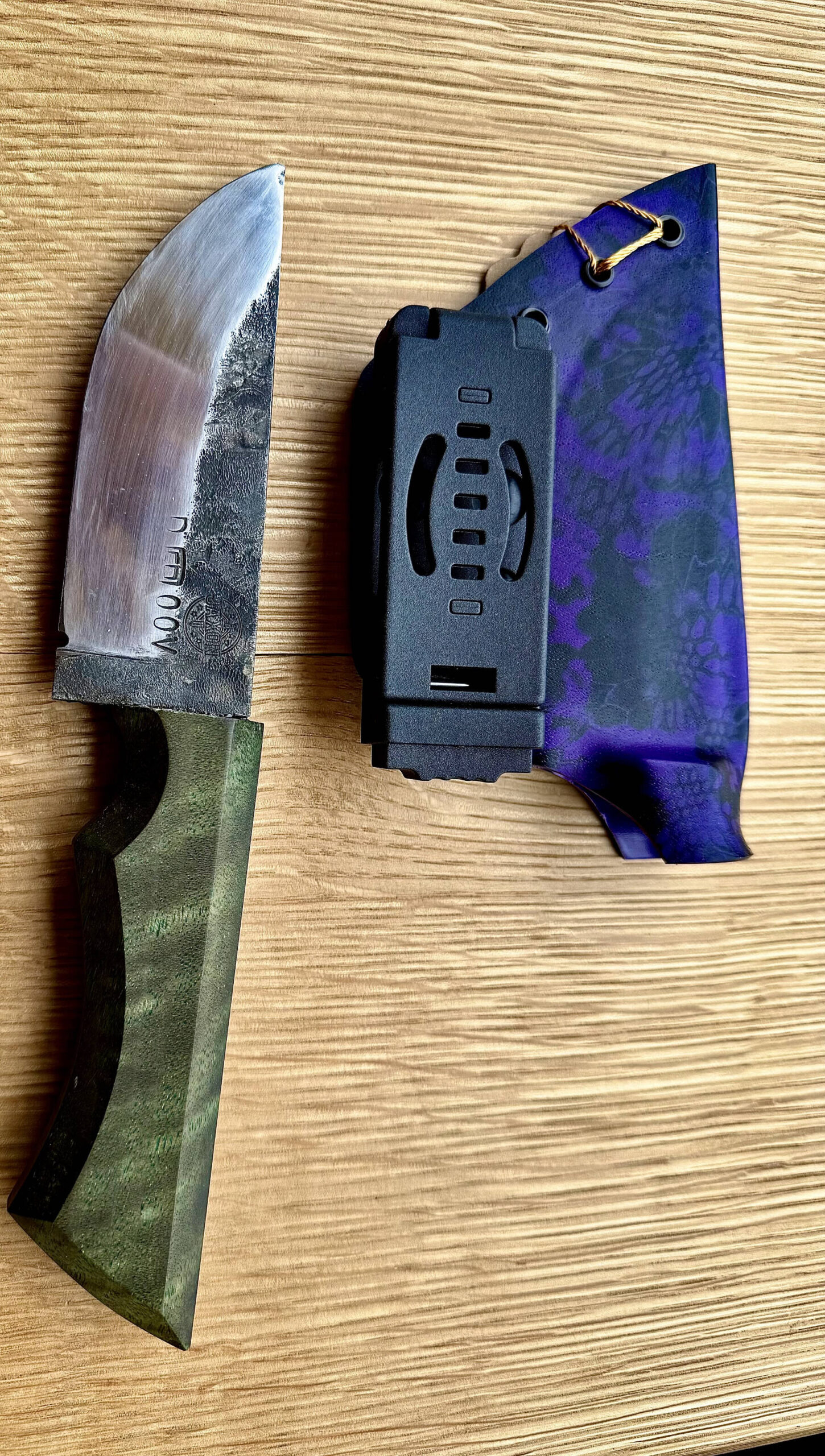
A small chopper or large skinner knife crafted by Jaxon Bourne is made from an old lawnmower blade, with a handle made from stabilized curly maple. Photo provided by Jaxon Bourne
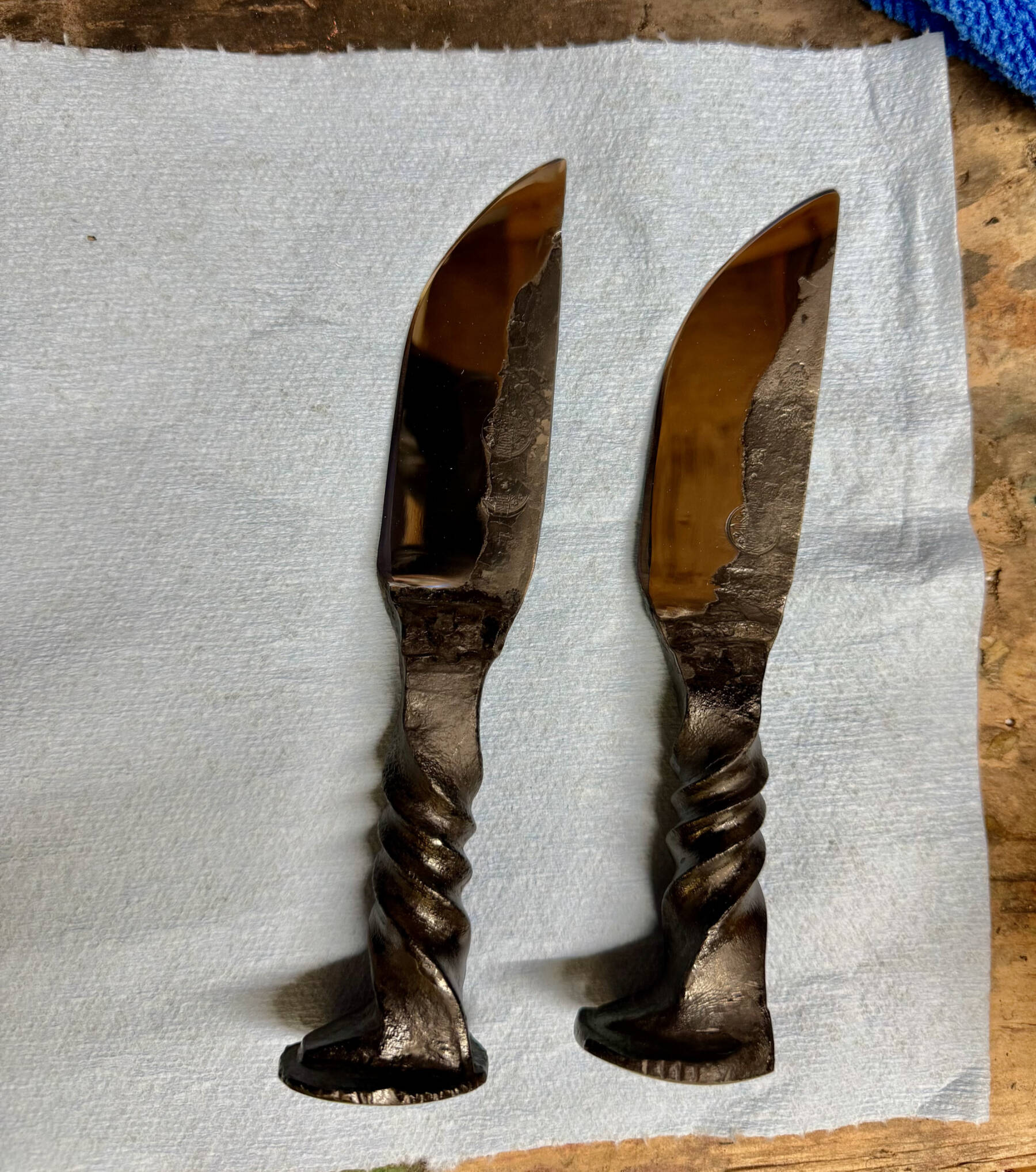
A set of two knives made by Homer youth Jaxon Bourne have been forged out of railway spikes. Photo provided by Jaxon Bourne
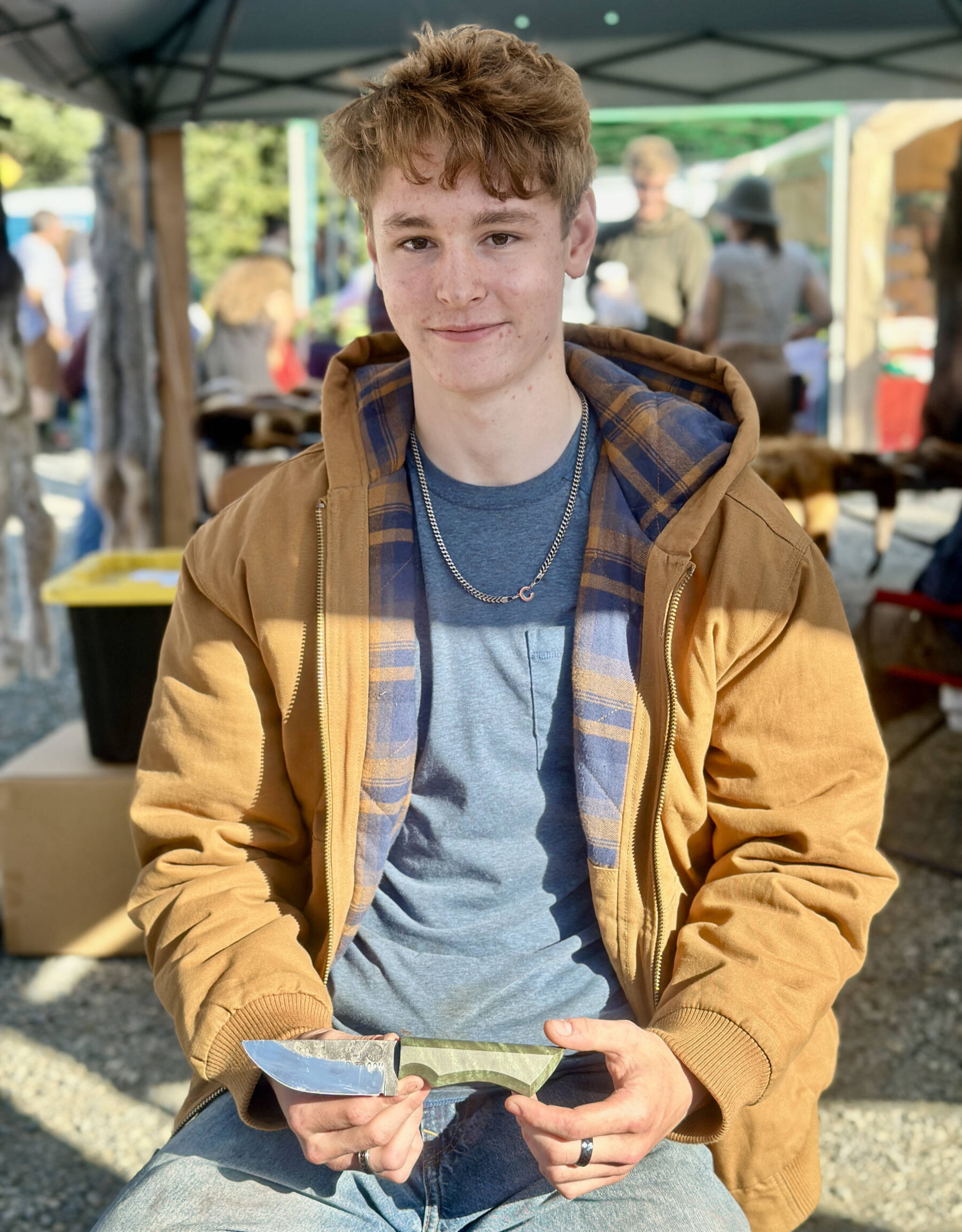
Jaxon Bourne holds one of his handmade knives at the Homer Farmers Market on Saturday, Sept. 13, 2025, in Homer, Alaska. Photo by Christina Whiting
