
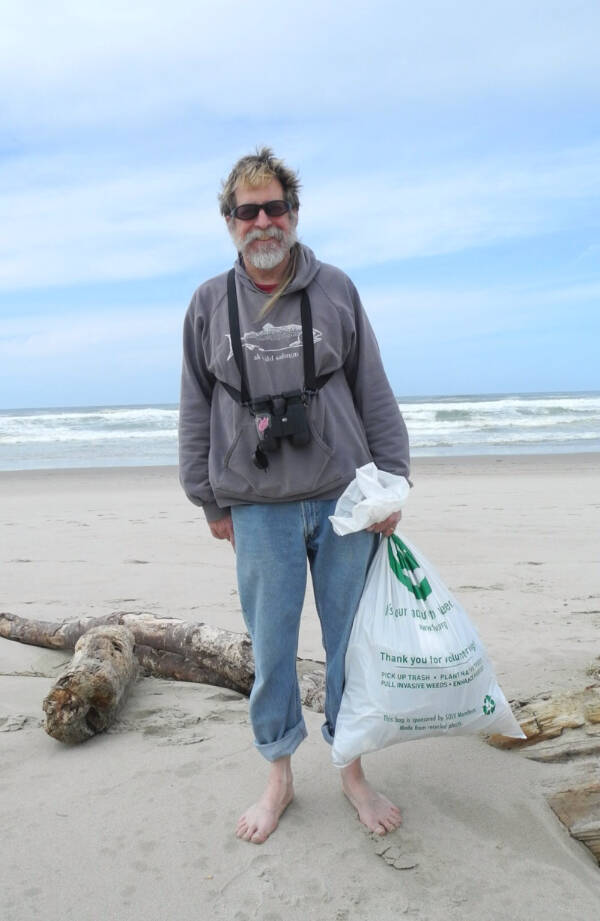
Since his retirement from the Homer News last year, former editor Michael Armstrong has even more fully immersed himself in his creative life.
“Creativity is the lens through which I examine the world,” Armstrong said. “Art has guided my life in almost every way, especially writing.”
A writer and mixed media artist who also dabbles in other pursuits that capture his imagination, like music, Armstrong has five published science fiction novels to his credit, including “After the Zap.” Written as his Master of Fine Arts in writing thesis at the University of Alaska Anchorage, it was sold in 1986, a month after he graduated.
“This is a goofy post-nuclear holocaust novel,” he said.
“Agvig, or, The Whale” was published in 1991 and is also a post-nuclear holocaust novel, though Armstrong describes it as more serious.
“The Hidden War” was published in 1994 and, Armstrong said, is the kind of science fiction novel he dreamed of writing as a young boy.
“Bridge Over Hell” is a fantasy set in the “Heroes in Hell” shared universe created by Janet and Chris Morris with Perseid Press and was published in 2012.
“Truck Stop Earth” was published in 2016, referred to as magic realism by Armstrong and his publishers with Perseid Press.
“It’s about a guy who believes he has been abducted by aliens and comes to Alaska thinking he can escape them, but that doesn’t work out,” Armstrong said.
Armstrong’s journey into creative writing began in 1965 in Tampa, Florida, when at the age of 9 and in the fourth grade, a teacher took note of his writing and encouraged him.
“Gloria Parrino, my fourth grade teacher would assign spelling exercises where you had to use each of that week’s 10 words in a sentence,” he said. “As an option, we could use those 10 words in a short story. I jumped at the chance and wrote these weird little stories about spies on trains and such. She read them aloud in class and that was an early affirmation that maybe I could be a writer.”
Armstrong continued writing on and off through his school years, once again encouraged when his ninth grade English teacher asked if he’d ever considered being an author and that if I hadn’t, he should.
During the summer of 1975 while attending a small liberal arts college, Armstrong attended a six-week writer’s workshop in Michigan State where he lived and workshopped his stories with other writers, including science fiction writers he admired, an experience that confirmed he was on the right path in pursuing his writing.
Introduced to science fiction by an older family friend when he was 10 years old, Armstrong fell in love with the genre for its particular way of looking at things.
“The best quote I have is ‘science fiction lets us examine the futures we’re making to see if we want to live there’,” he said. “I like the weirdness of the genre and that you can look at the world in strange and bizarre ways. I’m kind of weird, but in Homer, you can get away with that.”
Raised in Florida, Armstrong moved to Anchorage in 1979 working as an adjunct professor for the University of Alaska Anchorage and to Homer in 1994 with his wife, Jenny Stroyeck, after the two connected with the Post family who had ties in Anchorage and Homer. At the time, Stroyeck worked with Sue Post at the Huffman Book Cache in Anchorage and through her, the couple met her mom, Joy, and her brother, Lee, who were then partners in the Homer Bookstore. They visited Homer so often that when his book “After the Zap” was published, the Homer Bookstore placed it in the Local Author’s section.
In Homer, Armstrong continued his work with UAA and taught a few courses at Kachemak Bay Campus and through the distance education program. When a position opened at the Homer News for an editorial assistant, Armstrong applied and got the job.
“That proved to be a good entry for the Homer News since I learned to do everything,” he said. “I took ads, answered phone calls, kept the circulation accounts updated, typed letters to the editor, scanned photographs and compiled the Town Crier and Cops and Courts sections.”
A few years into the job, Armstrong was promoted to a reporter position and worked as a general assignment reporter until 2017 when he was promoted to editor. During this time, he continued his own writing, writing dozens of short stories and a novel. In December 2022, Armstrong retired from Homer News after having prostate cancer surgery a few months earlier. He is currently working to finish a novel and revise a short story that is set on Longboat Key, Florida, where his family used to vacation.
Armstrong credits the Homer community for inspiring his writing and encouraging his other creative pursuits. Those include he and his wife’s longtime involvement with local marimba group, Shamwari, as well as his mixed media art — collages and other work made from items he finds on beaches, around town and during his travels.
“I don’t think I seriously got into art until I moved to Homer,” he said. “Over the decades I volunteered for the Center for Alaskan Coastal Studies CoastWalk cleanup project where I walked a section south of Diamond Creek and collected marine debris. I got fascinated by the shapes, colors and textures of plastic in particular.”
Creating two- and three-dimension pieces, encaustics and collages, Armstrong has shown his work in numerous local exhibits, including his first exhibit and solo show at Homer Council on the Arts titled “What the sea gives back,” art made from marine debris.
He has participated in numerous community art call exhibits at the Pratt Museum & Park, creating encaustic pieces using driftwood and wax for “Facing the Elements”. For an exhibit on tides, he created a long squiggly line carved into a barrel stave he found on the beach. For a plankton-themed show, he made a piece mixing poetry and photography, where he took photos of plankton through a microscope using a digital camera, printed the photos, strung the photos together on cards and wrote haikus inspired by the images.
For one of Bunnell Street Arts 10×10 shows, he created “Asystole II,” an encaustic collage using an image from an X-ray of his chest showing his pacemaker. For an exhibit co-hosted by HCOA and Hospice of Homer, Armstrong created “My Father’s Camera,” mounting the 35mm camera his father gave him onto a cedar buoy and creating a collage of photos his father had taken, an homage to his dad.
Armstrong has also created pieces for Burning Basket held at Mariner Park each September.
“Mavis Muller encourages people to make offerings to be placed on the basket on the idea of letting go and I’ve often made pieces honoring people I know who have died,” Armstrong said. “One year I made an offering for my mom and her two brothers, all who died in 2015. Last year after I was diagnosed with prostate cancer and was facing my surgery, I made a piece that said, ‘Farewell my prostate; be gone, cancer’.”
Considering himself more of a writer than an artist even while he has exhibited and sold his art, Armstrong does not have professional aspirations in that regard. What he does have is immense gratitude for the local organizations that provide opportunities for community members of all ages and artistic backgrounds.
“Most of my art career has been responding to calls for art and I’m grateful to these organizations and especially to HCOA for supporting new and emerging artists,” he said. “Through the work they do and these open art calls, they enrich the arts in this town by inspiring creativity and providing a place to share what has come out of that inspiration.”
Several of his found art creations are on display at HCOA through December as part of their “Fun with 5×7” exhibit, including one titled “Specific Gravity.”
“I used a cedar buoy sliced in half as the base and then added elements to make a face — a metal tube top, eyeglasses, a spoon, fork, wire and a bottle cap,” he said. “The fun thing about plastic is that stuff will float, but certain things like metal won’t, but are light enough they get tossed around. The title is a reference to that.”
Armstrong’s first three novels are available as e-books and the last two are available through the Homer Bookstore and Perseid Press.
This story has been updated to correct the date “After the Zap” was published. It was published in 1986, not 1987.
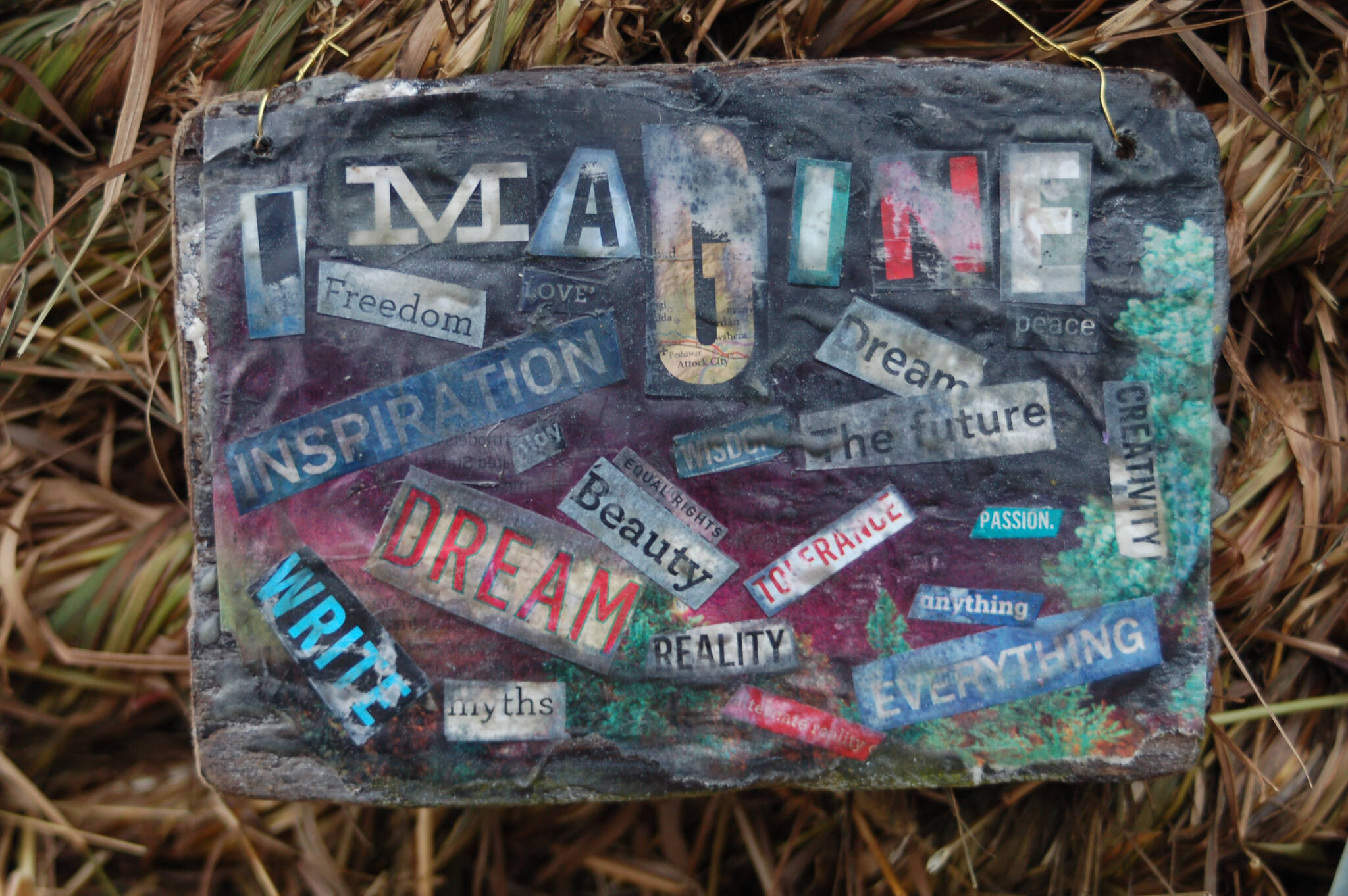
An encaustic collage for the September 2010 Burning Basket “Imagine” is shown in this undated photograph. Photo by Michael Armstrong
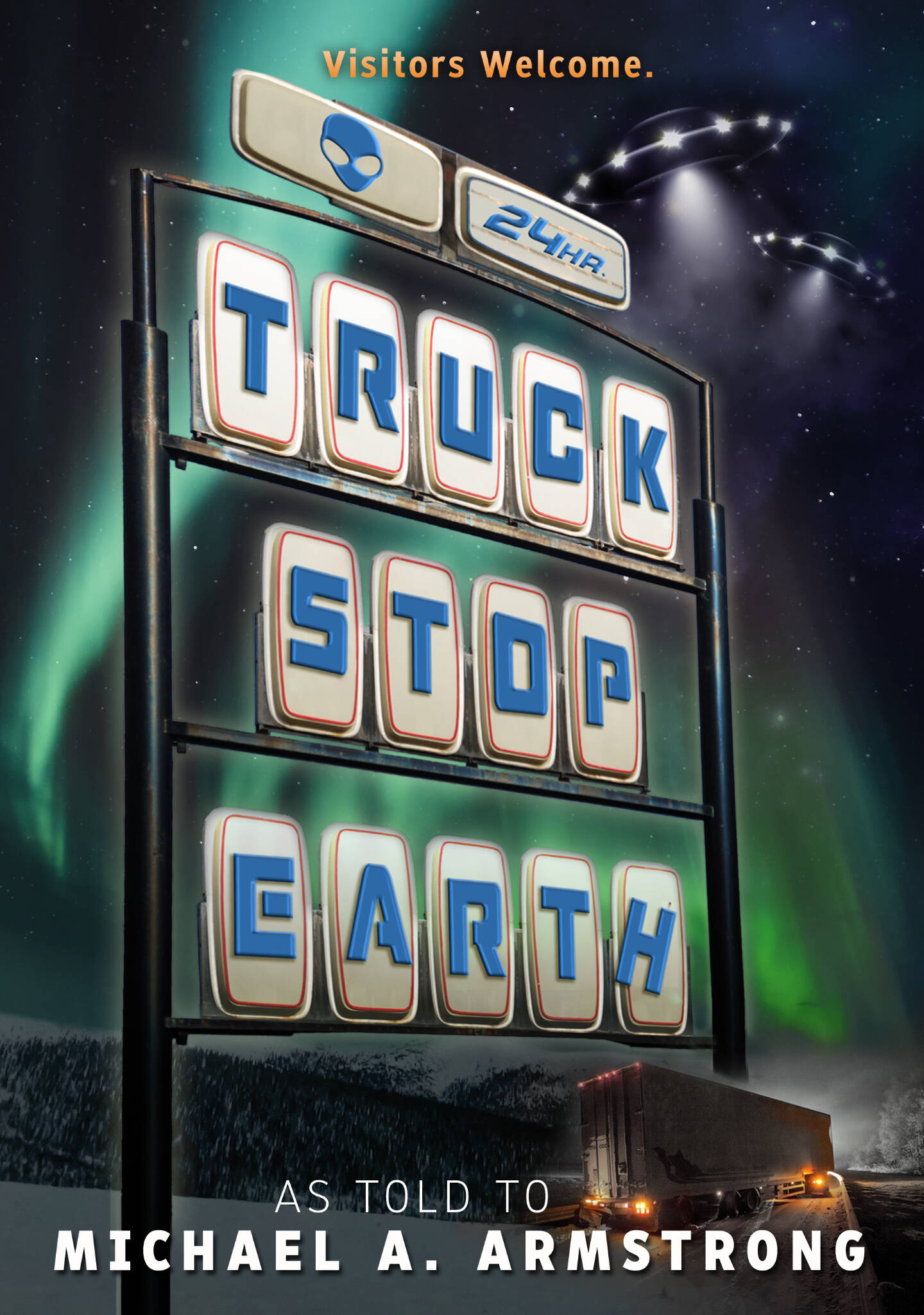
The cover of Michael Armstrong’s novel, “Truck Stop Earth,” published in 2016 by Perseid Press, is shown here. Photo provided by Perseid Press
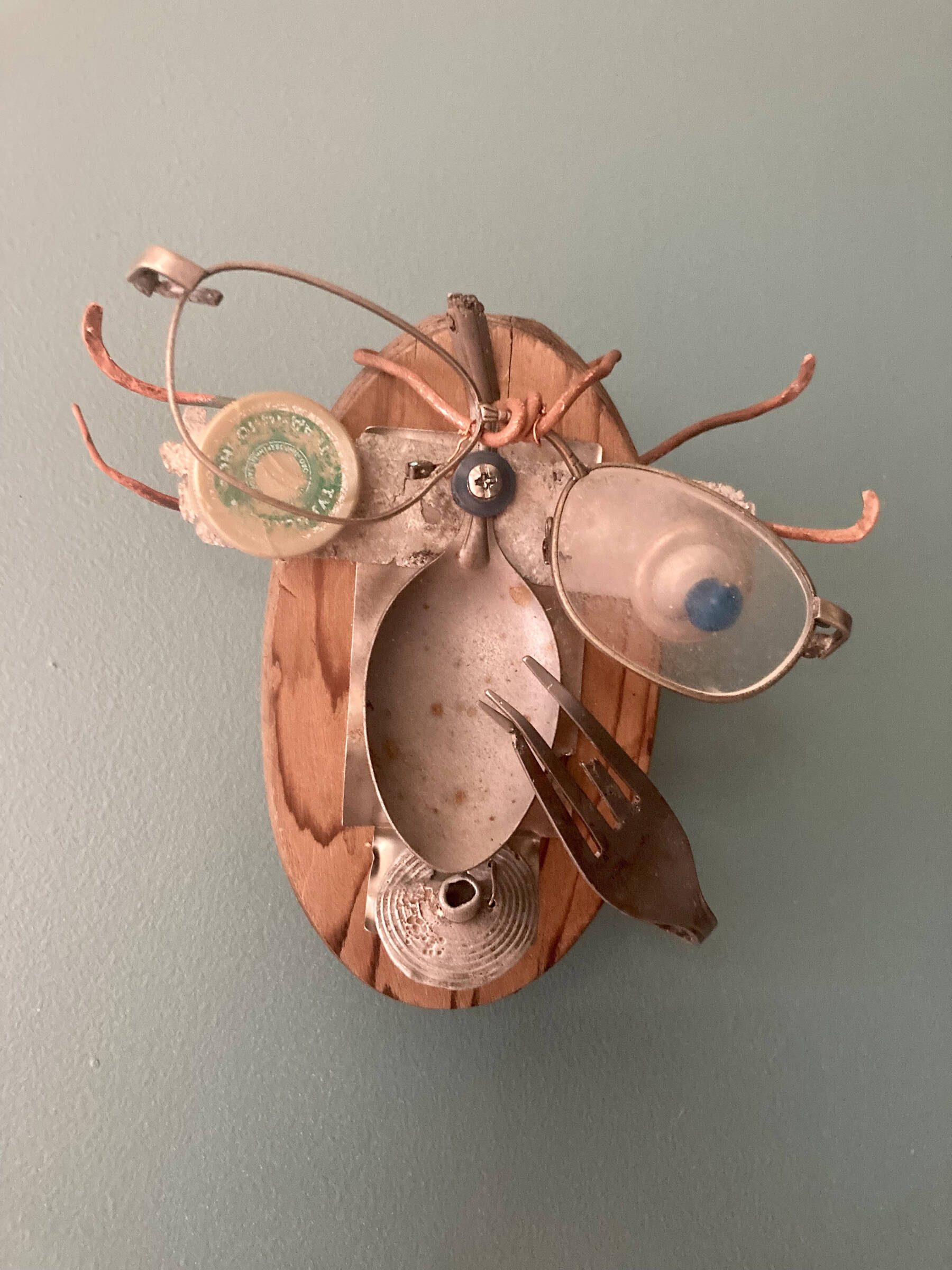
“Specific Gravity,” a multimedia work by Michael Armstrong is on display in Homer Council on the Arts’ “Fun with 5×7” show in November and December 2023. Photo by Michael Armstrong
