
By Clark Fair
For the Peninsula Clarion
Author’s note: This is the third part of a multi-part series about the origins of Central Peninsula Hospital, which celebrates its 50th anniversary in June. In the first two parts, a public effort began in 1961 to build a hospital to serve the central Kenai. Soon, despite the existence of new medical clinics in the two largest communities, squabbles between groups in Kenai and Soldotna began to derail good intentions.
TUG-OF-WAR
On July 17, 1964, Kenai’s only resident physician, Dr. Allen W. Barr, hitched a ride on the bulldozer turning the first earth during a groundbreaking ceremony for what was being billed as a new 11-bed hospital for Kenai.
The new one-story hospital, a first of its kind for the central Kenai Peninsula, was planned as a 90-by-120-foot, wing-like addition — plus a 60-by-32-foot basement — to the Kenai Community Clinic, which had opened only 16 months earlier.
At the controls of the dozer was local developer Morris Killen, who was also creating a large subdivision nearby. If all went as planned, the new hospital would become an integral part of a thriving neighborhood, and Dr. Barr would become part of a larger medical staff that would outclass the concrete-block medical-dental center in Soldotna.
All did not go as planned.
The new Kenai hospital was never finished, and it appeared, even at the outset, to be a direct reaction to an ongoing back-and-forth dispute between the rival communities.
In the summer of 1961 there had been a unified effort to create a central peninsula hospital for all area communities, but a Kenai contingent had usurped control of the project and moved to have the facility built in Kenai. An opposing contingent, led by Soldotna physician Dr. Paul Isaak, maneuvered to have the hospital built closer to Soldotna.
For a while, two separate corporations battled for funding and public support. Few community leaders crossed lines to promote the efforts of a rival. By late 1964, however, it seemed that Soldotna had won. Funding appeared imminent, as did construction. Then, as the Kenai-centric Central Kenai Peninsula Hospital Association was on the verge of disbanding, the board for the Kenai Community Clinic had produced a sudden, bold plan to create a hospital on its own.
Dr. Isaak, who had been affiliated with Seward General Hospital for eight years at this point, viewed the Kenai clinic’s hospital plan with disdain. In a letter written a week after the groundbreaking, he asserted that the Kenai project lacked community support, would be too small to serve the area population, would be financially unsound, would not be licensed, and could not support major surgeries.
“I doubt that the people involved have any idea what they are doing,” he wrote. “[Their effort] should not lessen — and may even help — our chances for a good hospital.”
Before this, hospital facilities available to central peninsula residents were scattered and limited in their ability to respond to medical need. Seldovia had a six-bed hospital with no surgical facilities; occasionally the hospital had a resident physician but often had to resort to flying in part-time doctors from elsewhere, such as Soldotna.
Homer had a seven-bed hospital with no surgical facilities; its resident physician delivered babies but sent nearly everything more complex to Anchorage.
Seward had two hospitals standing side by side — one of 30 beds for chronic diseases (mostly tuberculosis at this time, and polio before that); the other, the 30-bed Seward General Hospital, a modern, fully equipped and staffed facility.
Beyond these offerings, the nearest medical establishment lay in Anchorage, primarily with Providence Hospital.
For emergencies — in an area of increasing industry and construction — the difference between going to a local hospital and reaching Seward or Anchorage in time could be the difference between life and death.
In 1962, during the first full year of operation at the Central Kenai Peninsula Medical Clinic in Soldotna, Drs. Gaede and Isaak performed 92 obstetrical deliveries, an average of nearly eight per month. During this same year, the U.S. Air Force and the Civil Air Patrol recorded 40 emergency rescue missions from the Soldotna-Kenai area, an average of 3.3 per month.
Those numbers held fairly steady in 1963, the same year that Dr. Barr arrived to establish a medical practice in the new Kenai clinic. But the area population, estimated at 5,000 residents and fueled by oil and natural gas discoveries, was growing rapidly.
It was inevitable that the demand for medical services would intensify, as would the number of emergencies requiring hospitalization.
In the fall of 1964 — about two months after the groundbreaking for the Kenai hospital — Dr. Barr moved his practice to Anchorage, once again leaving Kenai with no resident physician.
For a time, Barr returned to the Kenai clinic on weekends to consult with and treat patients. Meanwhile, the clinic board was using its planned new hospital as a lure to interest prospective full-time replacements. The lure was unconvincing.
The effort took almost two full years.
In June 1966, Dr. Robert Alden Struthers, a surgeon from Portland, Oregon, arrived in Kenai with his nurse, Gloria Crandall (later Wisecarver). Struthers — father of Emmy-winning television actress Sally Struthers — had replied to an advertisement calling for a doctor in Kenai.
According to Wisecarver, Struthers flew north for an interview in Kenai, where he learned that a hospital was in the works and that he could become its head doctor.
“I just remember him coming back … and saying, ‘Ah! I have the greatest deal!’” Wisecarver recalled in 2009. “And I was going to be the chief nurse.”
In the end, despite new attempts in 1966 and 1967, no Kenai or Nikiski hospital was ever completed, and Dr. Struthers gave up. He returned to Portland, where he died, at age 51, in May 1968.
“When it looked as if nobody was going to ever get this hospital built,” Wisecarver said, “he just lost heart and left. He just said, ‘I can’t do this anymore. I want to go someplace where I can practice.’”
For Isaak, too, however, hospital plans soon were about to go awry. Although his group, brimming with new confidence in early 1965, had secured a Soldotna location for its hospital and appeared to have the funding squared away, the project was, in truth, a house of cards.
By mid-967 it would collapse, leaving the growing population of the central peninsula without a hospital for another four years.
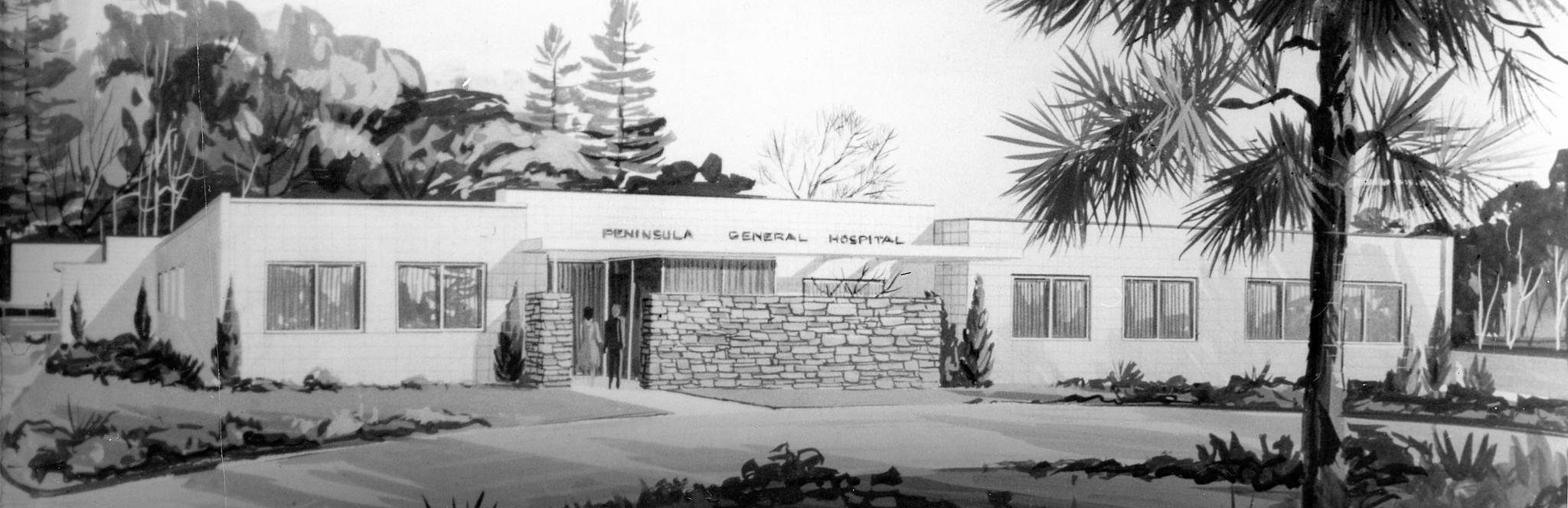
Document courtesy of the Isaak family) In about 1963, the Central Kenai Peninsula Hospital Association hired the well-respected architectural firm Edwin Crittenden & Associates. This concept drawing for a new central peninsula hospital was created by the firm’s Lucian Cassetta.
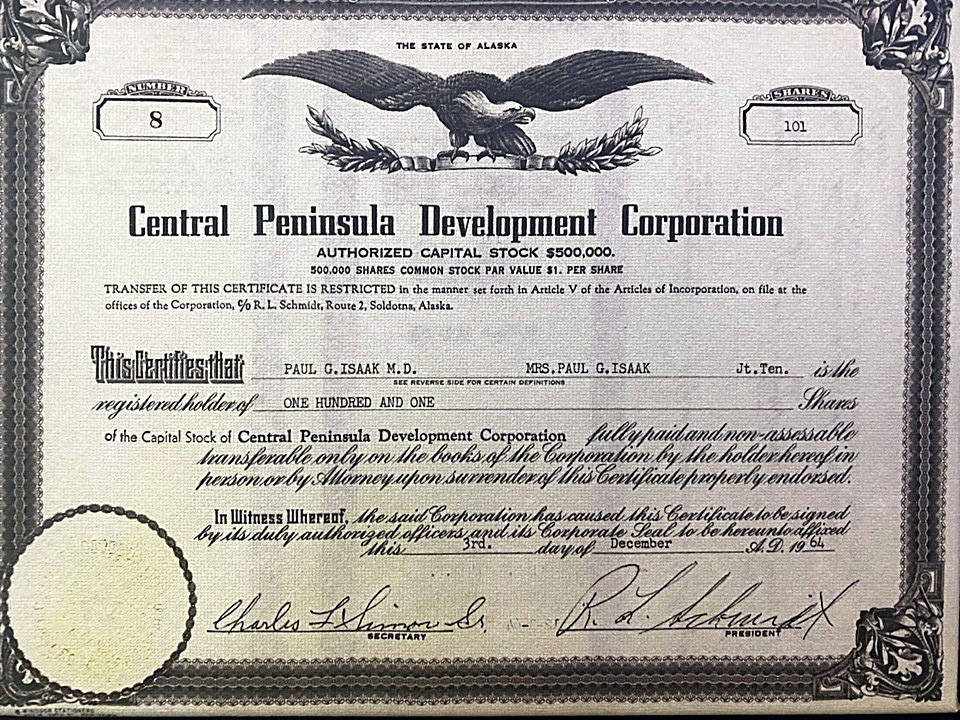
(Photo of certificate provided by Peninsula General Hospital) Selling shares in the hospital-construction efforts was one of the many attempts to raise funds for the project. This certificate for 101 shares in the Central Peninsula Development Corporation was owned by Paul and Amy Isaak.
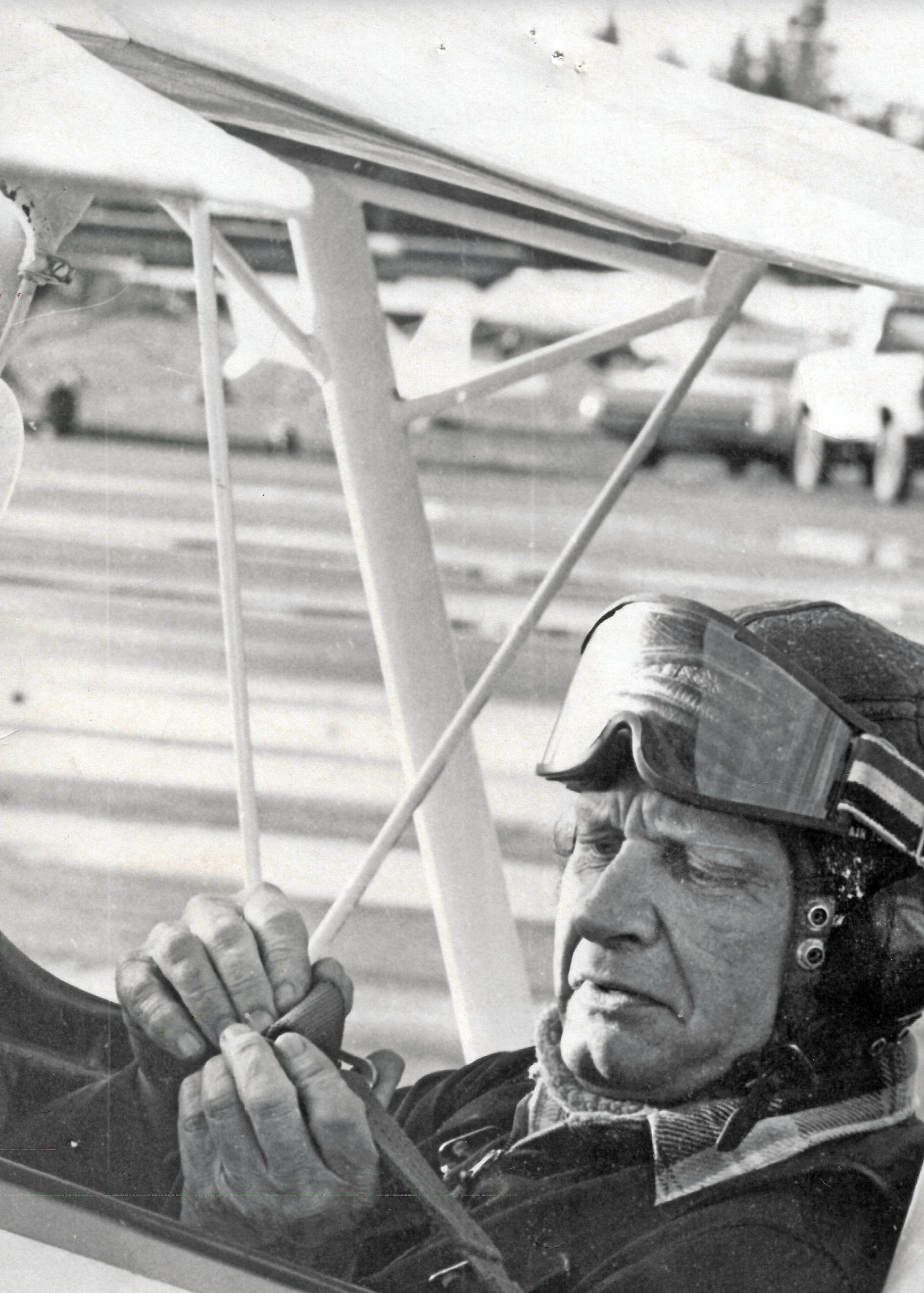
Ruralite photo courtesy of the Isaak family Dr. Paul Isaak excelled as a pilot as well as a physician. Here he prepares to take off in his open-cockpit airplane that he used for stunt-flying, particularly at the annual Fly-In Breakfast in Soldotna.
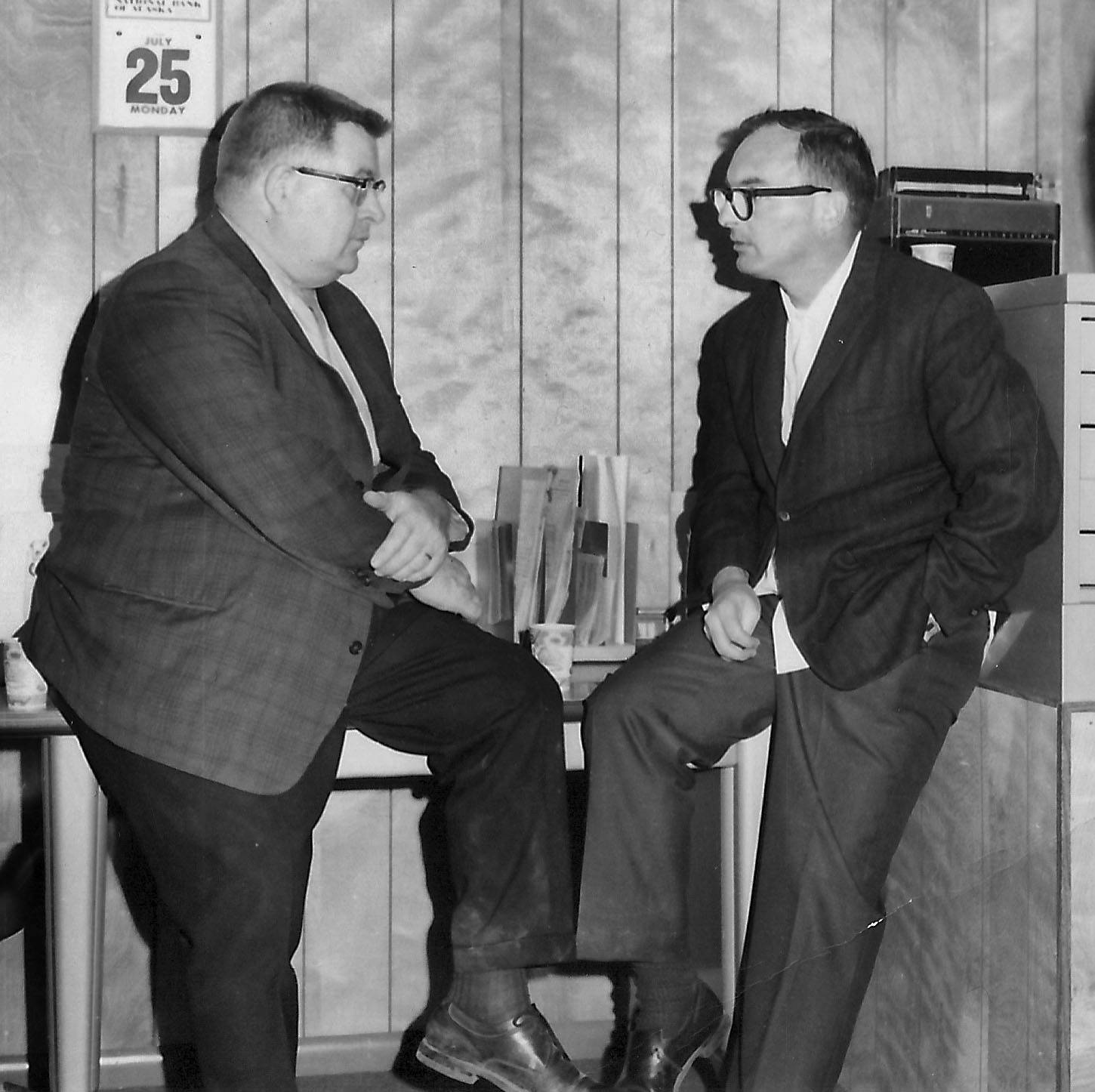
Dr. Robert Struthers, Kenai’s third resident physician, and Kenai dentist Dr. Charles Bailie converse in Struthers’ office in Kenai in July 1966. (Photo courtesy of Gloria Wisecarver)
