
By Clark Fair
For the Peninsula Clarion
Note: This is the first installment in a six-part series about the founding of Central Peninsula Hospital. Read Part 2, Part 3, Part 4, Part 5 and Part 6.
Central Peninsula Hospital began as a noble idea in the early 1960s. The central Kenai Peninsula at this time had a rapidly growing population, a burgeoning oil industry and limited medical facilities. Doctors on the central Kenai could handle childbirths and some minor surgical procedures, but many births and everything serious needed to go elsewhere.
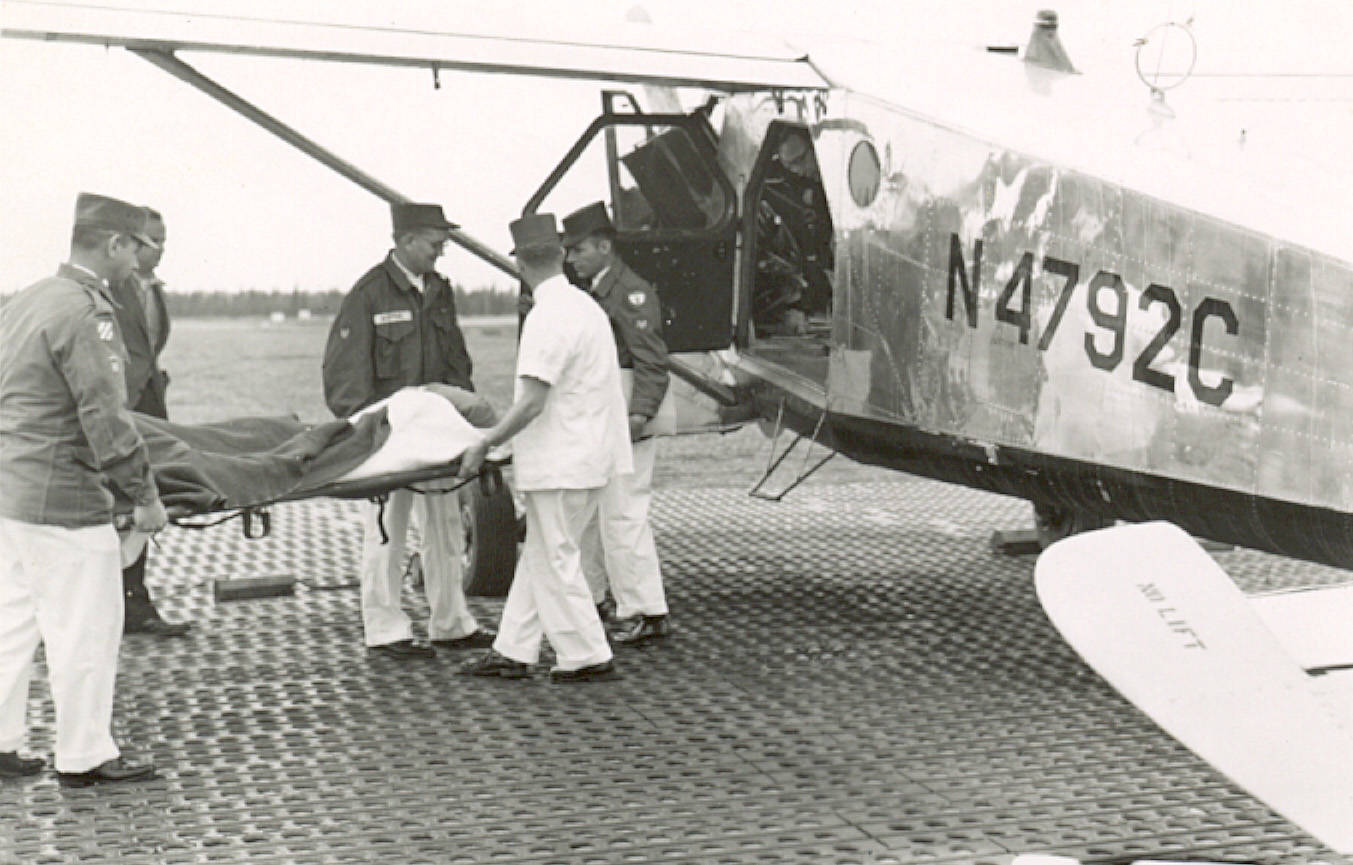
People who required hospital care had few options, none of them local: a seven-bed, nonsurgical hospital in Homer 75 road miles to the south; a six-bed, nonsurgical hospital in Seldovia, across Kachemak Bay from Homer; a 30-bed, fully functional hospital in Seward 90 road miles to the southeast; and much larger Providence and Elmendorf Air Force Base hospitals in Anchorage 150 road miles to the north.
The entire central peninsula had only a medical-dental clinic in Soldotna, housing two physicians and one dentist. Since the area had perhaps 5,000-6,000 residents between Cooper Landing and Ninilchik, a local hospital might save many lives.
So a grassroots, multi-community effort began. Those involved expected that, once the financing had been arranged, a modest-size hospital could be quickly constructed and ready to open its doors no later than 1964.
Instead, the effort required 10 years — a decade rife with financial snafus, contract disputes, bitter in-fighting, and one delay after another.
Throughout this entire struggle, the dogged determination of one individual stood above the rest: Dr. Paul Isaak, Soldotna’s first full-time physician, the originator of the hospital movement, and the man who, about a year before the hospital finally welcomed its first patient, told a friend that “the whole project turned out to be a fiasco.”
Many, many individuals deserve credit for making the hospital dream a reality, but only Dr. Isaak was there from the bright, enthusiastic beginning to the messy, bittersweet conclusion.
Storm
On the evening of March 5, 1962, as strong winds blew snow across the central peninsula, the first-ever general membership meeting for the Central Kenai Peninsula Hospital Association (CKPHA) was held in the gymnasium of Kenai High School. On the agenda was the election of board members for the coming year.
The nasty weather kept most of the 385 CKPHA members at home. In fact, few people from outside Kenai city limits were present. But board elections proceeded, nevertheless.
According to Dr. Isaak, a number of CKPHA members had been contacted prior to the meeting and asked to deliver proxy votes during the election. Since the association had created no cap on proxies, Isaak said, one member from Kenai was able to deliver 68 votes to the meeting.
The results were predictable: A total of 208 votes were cast, and, with one exception, Kenai and North Kenai residents were elected to every position on the nine-member board. The lone exception was Jim Fisher, who lived near Soldotna but served as the attorney for the city of Kenai.
Thus, in a single evening, a movement intended as a multi-community endeavor to serve the entire central peninsula was transformed into a Kenai-centric effort.
“To add insult to injury,” Isaak wrote a few months later, “the board called a special meeting of the membership (in Kenai again) to vote on the site for the hospital. The site that was chosen was in Kenai, which is neither the population [nor the] geographical center of the area to be served. … Some of the Kenai members felt so bad about this [decision] that they promptly resigned.”
Isaak’s assessment, which is generally accurate, compresses time and conflates events to make them seem rapid-fire, one right after the other. Actually, they took place over many months, and plenty of sniping and maneuvering occurred in the interim.
For instance, there was another CKPHA meeting, held just eight days after the March 5 election, at which many of the actions taken were clearly re-actions. Many of those actions were prompted by an appearance of what the Cheechako News called a “delegation,” headed by Dr. Isaak, from the Greater Soldotna Chamber of Commerce. The chamber representatives, said the newspaper, “expressed dissatisfaction” with the results of the election process.
They demanded change, and they got it.
Ruth Hursh, of North Kenai, refused her one-year seat on the board and was replaced by Soldotna’s Virginia Gibbs. Gibbs had been one of the founders of the hospital project and one of the original incorporators of the CKPHA.
The board also altered its by-laws: Henceforth, each CKPHA member could present no more than four proxy votes at any one election, and the board was expanded from nine members to 12. Promptly, three new board members were appointed: Ted Gaines (Sterling), George Denison (Ridgeway) and Ira Miller (Cohoe).
By community affiliation, the board was now represented by one member from North Kenai, one from Soldotna (not counting Fisher), one from Sterling, one from Ridgeway, one from Cohoe, and seven from Kenai.
Jess Nicholas, a Kenai magistrate, was named board president. Fisher was selected chair of the Site Committee, Miller chair of the Membership Committee, and the Rev. Carl Glick, of Kenai, chair of the Building & Facilities Committee.
Three days later, a letter to the editor from Donnis Thompson of North Kenai set the general tone for what was to follow. Thompson, a friend of Gibbs and also a devotee of the hospital effort, referred to the “unfortunate incidences that have taken place recently on the hospital project” in discussing at length the problem with proxy votes and the lopsided community representation.
She included an acknowledgement of the territoriality involved, particular between the main two rivals, Kenai, with its long history, and Soldotna, the upstart only 15 years past its founding.
“It is no secret,” Thompson wrote, “that most people in Kenai would dearly love to see [the hospital] built in Kenai and feel that we have the most logical arguments for it. It is also no secret that Soldotna feels the very same way and is working very hard for this and, just as frankly, with the luck Soldotna has had in the last five years getting things, they’ll probably make it on this.”
She concluded with a plea for unity: “Let’s stop hurting everyone’s feelings and remember that we’re trying to build a hospital. … I am dismayed at the personal hard feelings and possibly community hard feelings that have resulted from this. The hospital program has enough problems.”
Thompson was right. Feelings were being hurt, and location was everything.
Her call for harmony, however, went largely unheeded.
The political battles were just beginning.…
Read part two of this series next week.
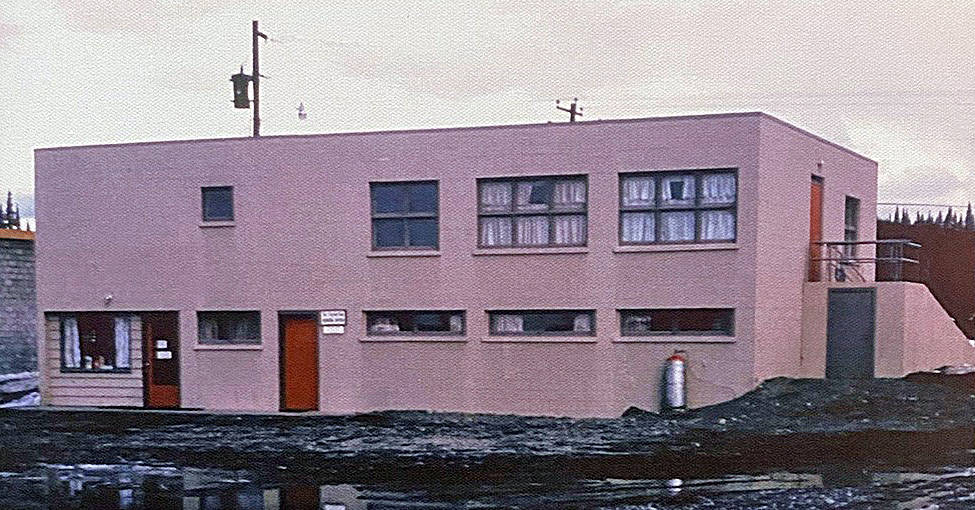
The Central Peninsula Medical Clinic about three years since its opening in April 1961. The first official clinic on the central peninsula, it housed physicians Paul Isaak and Elmer Gaede upstairs and dentist Calvin Fair and the Soldotna Public Library downstairs. (Photo courtesy of the Isaak family)
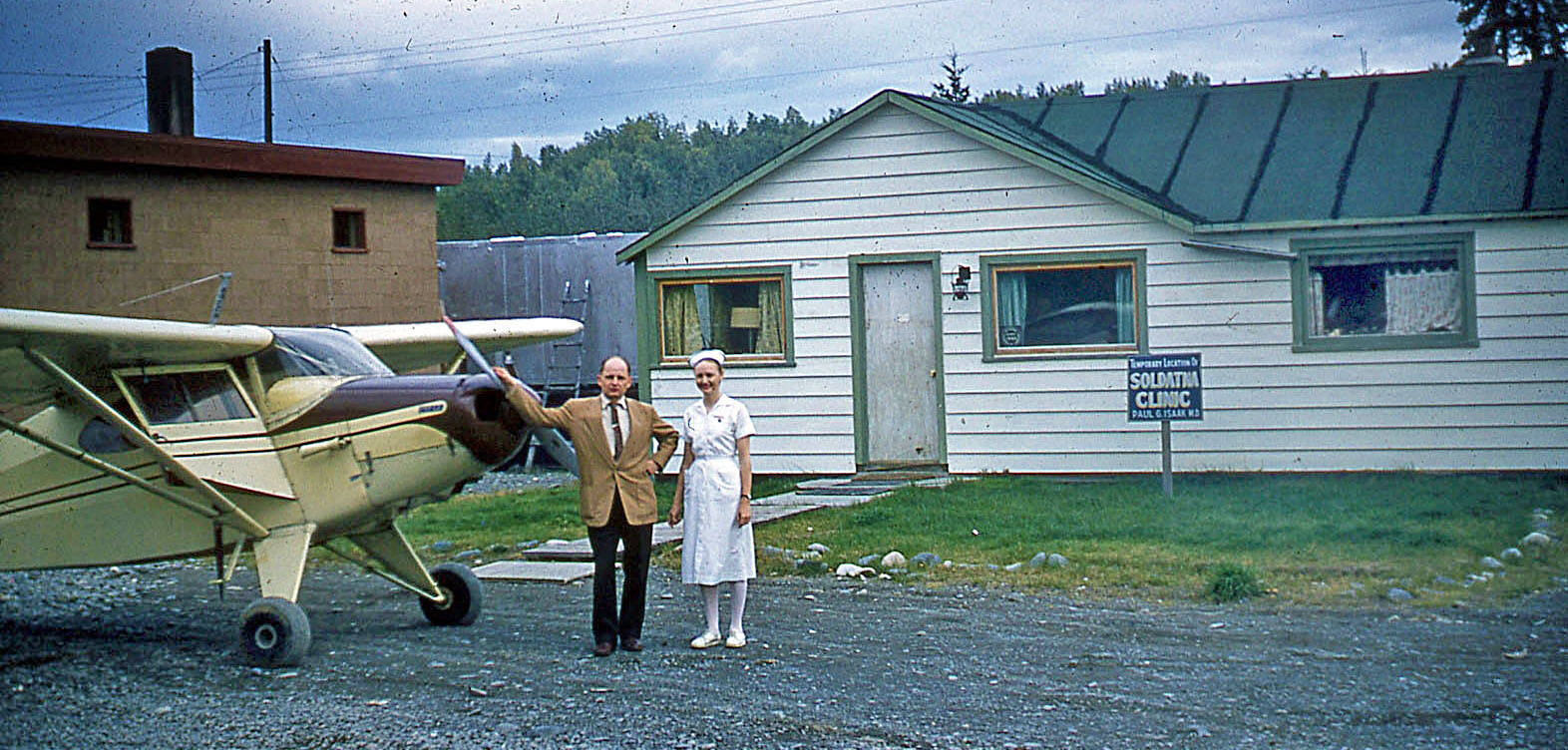
When Dr. Paul Isaak began providing medical service to the Soldotna-Kenai area, his Soldotna Clinic was located near the current site of the Soldotna Fire Department. Here he stands with his airplane and his nurse, Elizabeth Meadows. (Photo courtesy of the Isaak family)
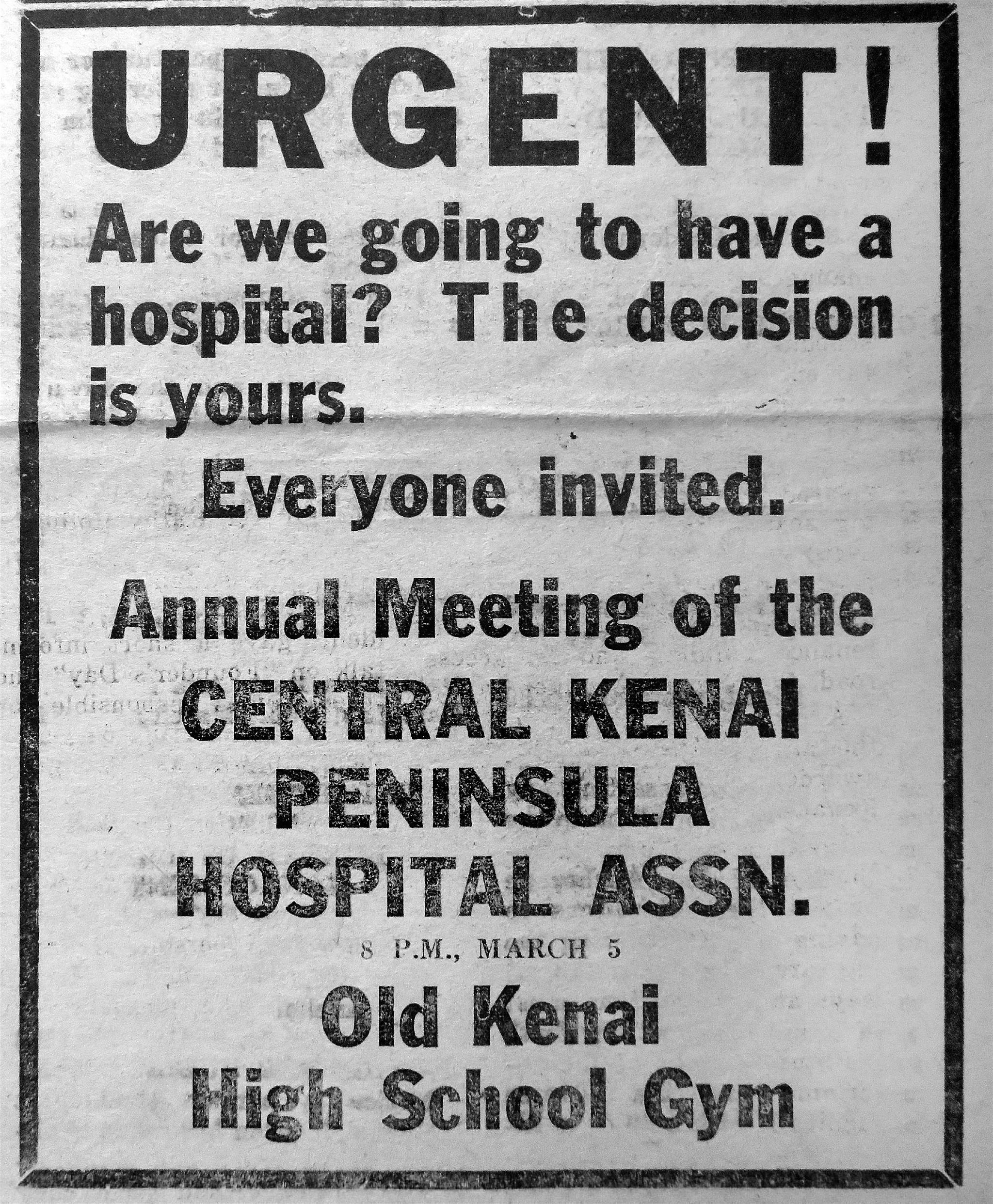
This ad in the Cheechako News promotes the first-ever membership meeting of the Central Kenai Peninsula Hospital Association. Actions taken at the meeting would reverberate through the decadelong struggle to establish a hospital.
