Refuge notebook: Laying a foundation for a biologically richer world
Published 3:46 pm Thursday, August 23, 2018


By TRACY MELVIN
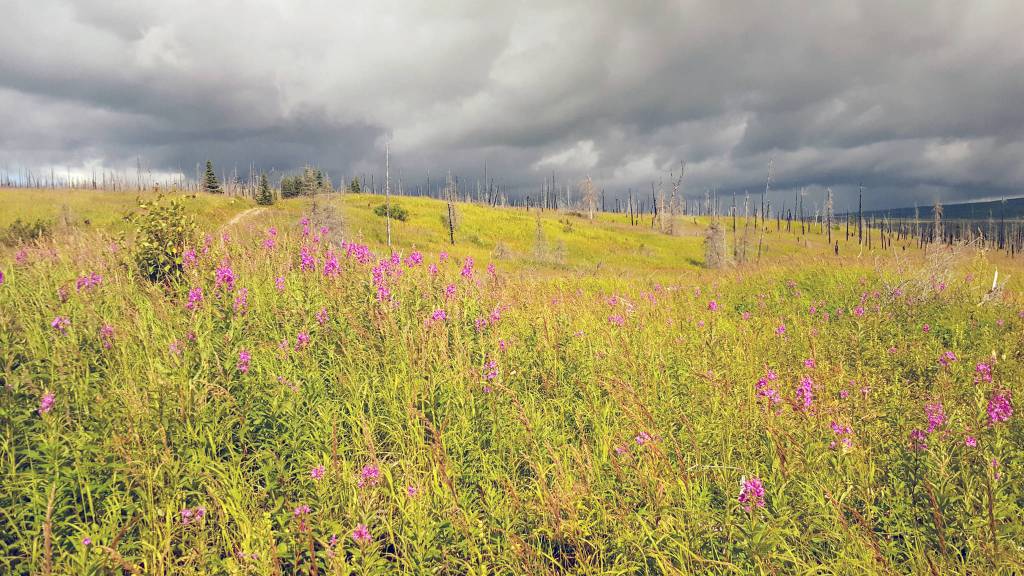
I spent considerable time this summer trekking around grasslands in the Caribou Hills with a giant red hula hoop (to survey vegetation), a net and trowel (to survey arthropods above and below ground), and gallons of water mixed with mustard powder (to detect earthworms), all in the name of science.
Our goal? To find out what lives there, how it all fits together, and what we might want to do to manage this evolving habitat on and around the Kenai National Wildlife Refuge.
I actually experienced vertigo out there a few times — when the wind whips around, it is as if you bob atop a fomenting green sea. This illusion is created by one extremely dominant grass, Calamagrostis canadensis, commonly known as bluejoint reedgrass.
A native but aggressively colonizing species, bluejoint expanded on parts of the Caribou Hills after repeated, unprecedented disturbances from both beetle-kill and human-caused wildfires in spring killed the spruce trees previously growing here.
Bluejoint is undoubtedly the ruler of this landscape, but what are its subjects and does it support a diverse biological community? We hypothesize that it actually does the opposite by excluding many species due to its thick, rhizomatous mat.
If our data confirm this, our next step is to find out which species could help enrich biodiversity in this novel landscape, sustaining resilience in a rapidly warming future.
We seek to find a “foundation species.” Dr. Paul Dayton, from the Scripps Institute of Oceanography, coined the term a half century ago while conducting research at the famous McMurdo Station scientific base in Antarctica. Foundation species disproportionately influence the structure of their respective ecological communities by creating or maintaining the organization of a suite of interacting species that would otherwise not persist.
Dayton discovered that beneath the ice of McMurdo Sound, a handful of species was key to laying the “foundation” for a resilient and diverse benthic community.
When sewage from the research base disturbed the system, the relationships among predator (starfish), detritivore (starfish) and prey (sponges) became off-balanced with a predictive loss of other species through changes in relationships, nutrients and habitat structure. Dayton concluded that focusing on foundation species would allow a rapid understanding of how a community as a whole would react to disturbances, rather than attempting to understand responses of all species simultaneously.
What are examples of foundation species here in the boreal biome? North American beavers directly create ecosystem structure by altering hydrology that benefits certain assemblages of vascular plant species, and altering biochemistry by slowing water currents that trap sediments and pollutants. They indirectly support vertebrate (including moose) and invertebrate populations that occupy beaver-modified landscapes.
Eastern hemlock, in North America’s northeastern forests, is also a foundation species. The removal of this dominant species initially increases biodiversity as the understory changes to early successional species but, in the longer term, simplifies structural diversity and ecosystem regulation (even the water table!) as the forest matures along a different ecological trajectory.
As a rapidly warming climate moves us toward a no-analog future with dire expectations of mass extinction, it challenges us to rethink how best to manage landscapes for wildlife.
Perhaps here on the Kenai Peninsula, could we help ameliorate the global biodiversity crisis by using foundation species as the biological engineers that they are? And how does our management response to a changing landscape fit into the larger conservation picture — 300, 500 or even 3,000 miles away? These are the questions that keep me up at night.
In the past, bison (and mammoths) might have played a role as a foundation species in much of Alaska, including the Kenai Peninsula.
During the Pleistocene, the peninsula sat on the southern extent of an arid grassland that extended from Siberia to Alaska. This was a time when steppe bison roamed the Caribou Hills as horns found there carbon-date to 43,000 years ago.
Like its modern descendants, woodland and plains bison, the steppe bison likely helped cycle nutrients (think poop), and created structure by digging wallows and compacting soil with their heavy hooves. They would have added species diversity and age structure with their sporadic and patchy grazing on graminoid species.
Currently, no large grazers occur on the Kenai Peninsula that can serve as a foundation species in our developing grassland complex, now spanning over 40,000 acres. If bluejoint reedgrass does indeed inhibit biodiversity with its thickening rhizomatous mat, there is much to be discussed about how to better steward this landscape by laying a strong “foundation.”
We will keep you updated on the story that our data tell as it unfolds.
Tracy Melvin is a doctoral student at Michigan State University. Find more Refuge Notebook articles (1999-present) at https://www.fws.gov/Refuge/Kenai/community/Refuge_notebook.html.