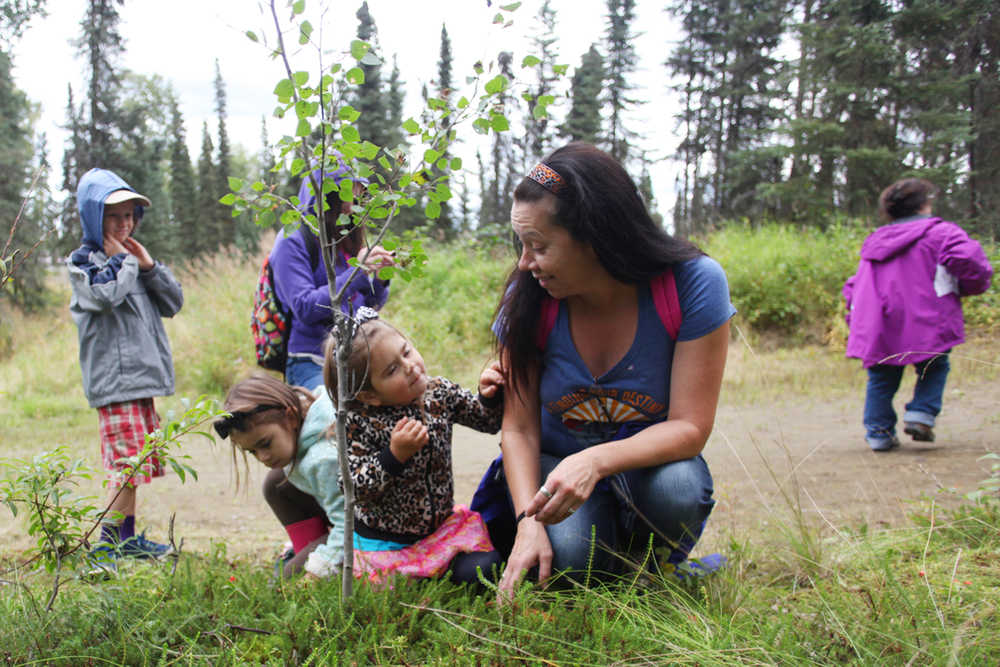
(Left to right) Kalista, Shaunzi and Kimbra Clements crouch in a patch of low bush cranberries Monday, Aug. 15, 2016 on Tsalteshi Trails' Wolverine Trail in Soldotna, Alaska. The trio attended the walk led by Janice Chumley, Integrated Pest Management Technician for the Kenai branch of the University of Alaska Fairbanks Cooperative Extension Service, for the Harvest Moon Festival. Kimbra said they wanted to learn about picking berries, and being a single mother, it helps to have extra resources.

(Left to right) Kalista, Shaunzi and Kimbra Clements crouch in a patch of low bush cranberries Monday, Aug. 15, 2016 on Tsalteshi Trails' Wolverine Trail in Soldotna, Alaska. The trio attended the walk led by Janice Chumley, Integrated Pest Management Technician for the Kenai branch of the University of Alaska Fairbanks Cooperative Extension Service, for the Harvest Moon Festival. Kimbra said they wanted to learn about picking berries, and being a single mother, it helps to have extra resources.

Harvest Moon Festival focuses on local foods

  • By Kelly Sullivan
  • Monday, August 22, 2016 10:38pm
  • News

This year’s Harvest Moon Festival was all about local foods — as local as they get.

From bright, bulging berries to papery, soaking wet seaweed, a host of Kenai Peninsula and national experts weighed in on wild edibles and seasonal harvests during the fourth annual event hosted by the Kenai Local Food Connection Aug. 12-18. This year’s long list of lectures, walks and activities aligned to teach attendees about the truest ways to live and eat sustainably.

“Any age is good to be introduced to wild foods,” said Janice Chumley, Integrated Pest Management Technician for the Kenai branch of the University of Alaska Fairbanks Cooperative Extension Service.

Chumley led Monday’s walk in the woods that started out at the food bank, where she and the extension service’s Health, Home, and Family Development Agent, Linda Tannehill, went over the basics of berry picking, cleaning and keeping.

Tannehill touted the high nutritional value of choosing naturally growing foods over their cultivated counterparts.

Southcentral Alaska is home to many species of wild fruits, including blueberries, cranberries, rose hips and raspberries, to name only a few. Some are safe to eat and some are not; some are easy to track down, others take a keen eye and knowledge of where things are most likely to crop up.

Chumley started with the example of the bane berry, which looks inviting enough to the hungry forager. The body is bright red or white in color with a single black spot on the outward facing surface of the berry, and protrudes in a cluster far above the large bush it stems from.

“It’s poisonous — it’s highly poisonous,” Chumley said. “It’s not something to mess with.”

Chumley asked that no one consume anything he or she does not feel 100 percent confident in indentifying. She also pointed out the likelihood that most foragers will be on their own when setting out to find their feast.

“I am here to tell you if you are here today thinking you are going to my favorite berry patch to pick 5 pounds, you are mistaken,” Chumley said.

While some may be hesitant to share their favorite patch, many, like Chumley, are more than willing to hand off what knowledge they have of the benefits of nature’s bounty.

Priscilla Russell spent decades adding to the collective work published in “Plantlore Wisdom from the Dena’ina People,” a compilation of wisdom from Dena’ina elders on the many uses of local flora.

“What we call ‘wilderness,’ that was their shopping center,” Russell said.

The Homer-based author first became interested in wild plants in the 1970s, when she arrived in Alaska with the sole intent of studying the dialects of the Dena’ina people. Many she met were willing to offer much more wisdom on living a subsistence lifestyle than she originally set out to find.

One of her favorite stories was of an elder she met named Shem Pete, Russell said. He told her about a day he cut his finger while out fishing, and it became so infected he went to a doctor for help. The practitioner told him the digit would have to be amputated but Shem Pete refused and went home.

After soaking the injury in wormwood and angelica for nearly a week, the infection healed and the finger was saved, Russell said. In her own experience, she has used the raw root of parsnip to alleviate the symptoms of a sore throat and nettles to combat hives induced by prolonged use of ibuprofen.

Beyond tracking down quick remedies, maybe the most important lessen one can glean from the Dena’ina elders is how they took care of the land and harvested sustainably, Russell said.

Sustainability and respect were also messages brought home by of the week’s Keynote Speaker Melinda Hemmelgarn, an award-winning dietician, writer, speaker and nationally syndicated radio host of Food Sleuth.

During her opening Friday night presentation, Hemmelgarn went over the whole of the nation’s food system, and the negative effects of GMOs, pesticide use and monoculture farming on the public’s overall health.

“We take for granted the core of our wellness,” she said, adding later, “…If you have prepared food you are involved in health care.”

Good food can be even more healing than Western medicine, Hemmelgarn argued. The human body absorbs so much of what it comes into contact with, and even small doses of harmful chemicals can be poisonous, she said.

While food isn’t the only factor, Hemmelgarn pointed out a direct correlation between cheaper foods and the average cost of medical bills. She said a healthy diet might mean paying more money up front on average, but in the long-term is a far more affordable option.

Additionally, farming only one crop, which is often genetically modified with the intent to fight of the adverse effects of pesticides, leaves a huge chunk of the nation’s food supply at risk, Russell said. Those fields are incredibly susceptible to being entirely wiped out by a single disease, she said.

“If you are not outraged, then you are not paying enough attention,” Hemmelgarn said.

However, she said, there is much hope and much to look forward to.

Throughout the evening Hemmelgarn gave pointers on what people can do immediately to eat well. Check labels on prepared foods, consume what is in season and products that are grown in a healthy, ethical way, she said.

“People are wanting a more honest relationship with their food,” Hemmelgarn said. “I think that is why farmers markets are becoming so popular.”

Reach Kelly Sullivan at kelly.sullivan@peninsulaclarion.com.

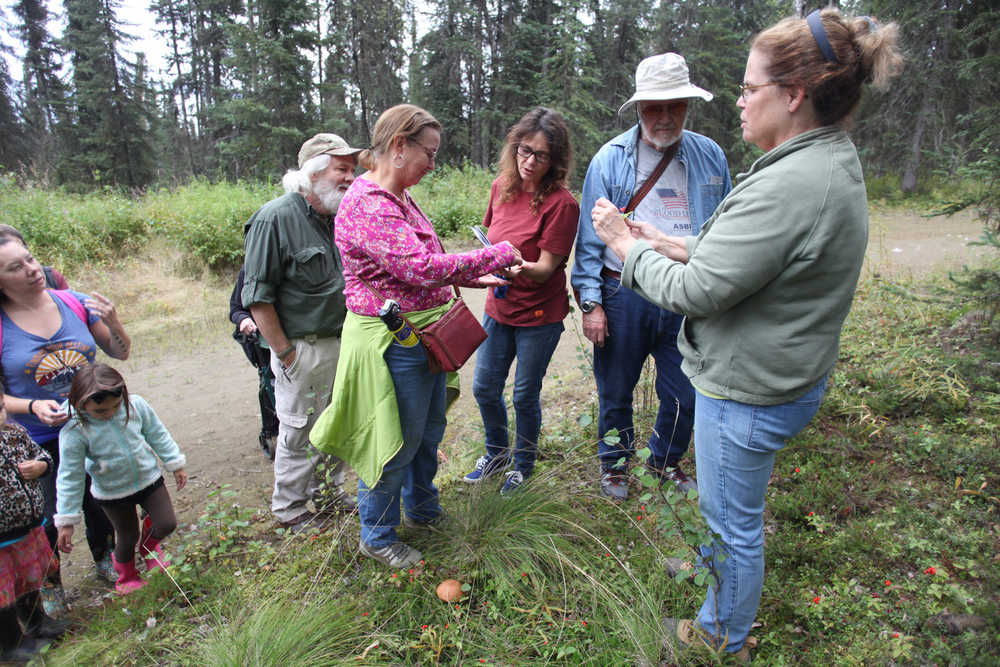
Photo by Kelly Sullivan/ Peninsula Clarion Janice Chumley, Integrated Pest Management Technician for the Kenai branch of the University of Alaska Fairbanks Cooperative Extension Service, for the Harvest Moon Festival, goes over various flora she and a group found during the fourth annual Harvest Moon Festival's local berry walk Monday, Aug. 15, 2016 on Tsalteschi Trails' Wolverine Trail in Soldotna, Alaska.

Photo by Kelly Sullivan/ Peninsula Clarion Janice Chumley, Integrated Pest Management Technician for the Kenai branch of the University of Alaska Fairbanks Cooperative Extension Service, for the Harvest Moon Festival, goes over various flora she and a group found during the fourth annual Harvest Moon Festival’s local berry walk Monday, Aug. 15, 2016 on Tsalteschi Trails’ Wolverine Trail in Soldotna, Alaska.

More in News

Snow covers a branch hanging over Watergate Way in Kenai, Alaska, on Thursday, Nov. 9, 2023. (Jake Dye/Peninsula Clarion)
District-wide school closure in effect Friday, Jan. 16

All Kenai Peninsula Borough School District schools and Kenai Peninsula College campuses are closed due to rain and freezing temperatures expected overnight.

Kenai Peninsula Borough Mayor Peter Micciche speaks during a meeting of the Borough Assembly in Soldotna, Alaska, on Tuesday, May 21, 2024. (Jake Dye/Peninsula Clarion)
Borough updates public noticing requirements

The Kenai Peninsula Borough Assembly approved an ordinance last week effectively ending requirements to publish notices in a newspaper of general circulation.

A map presented by the Alaska Department of Natural Resources during a virtual meeting on Dec. 11, 2025, shows the location of a potential Kenai Peninsula State Forest. Screenshot.
Community discusses state forest proposal at Homer meeting

The public comment period on the proposed Kenai Peninsula State Forest closes Jan. 16 at 5 p.m.

The Alaska Department of Environmental Conservation helped a Nikiski resident dispose of over 43 tons of contaminated soil after a home heating oil spill in November<ins> 2025</ins>. DEC on Friday launched a program to help eligible homeowners cover cleanup costs relating to home heating oil spills. Photo courtesy of the Department of Environmental Conservation
State launches home heating oil spill cleanup program

The Department of Environmental Conservation formally announced the program statewide on Friday.

Sterling resident Jonny Reidy walks 11 miles from his dry cabin to his part-time job at Fred Meyer on Dec. 15, 2025. Reidy aims to walk 1,000 miles by midsummer, and he’s asking people to pledge donations to food banks for every mile he travels. Photo courtesy of Jonny Reidy
Sterling man is walking 1,000 miles for hunger awareness

Jonathan Reidy asks people to pledge donations to local food banks for every mile he walks.

Soldotna High School students learn how to prepare moose meat through the school’s annual Moose Permit Project, an educational partnership between SoHi and the Alaska Department of Fish and Game. Photo courtesy of Tabitha Blades/Soldotna High School
Soldotna students get hands-on moose harvest experience

SoHi’s annual Moose Permit Project is an educational collaboration between the school and the Alaska Department of Fish and Game.

A snowmachine rider takes advantage of 2 feet of fresh snow on a field down Murwood Avenue in Soldotna, Alaska, on Monday, Dec. 12, 2022. (Jake Dye/Peninsula Clarion)
Kenai refuge announces snowmachine opening

All areas traditionally allowing snowmachine use in the Kenai National Wildlife Refuge are now open.

Kate Rich’s play, “The Most Comfortable Couch in Town,” is performed during “Stranded: A Ten-Minute Play Festival” in August 2025 in Homer, Alaska. Photo provided by Jennifer Norton
Homer playwright receives fellowship award

Kate Rich is revising a new play, which she hopes to take to the Valdez Theatre Conference Play Lab.

A BUMPS bus waits for passengers in the Walmart parking lot in Kenai, Alaska, on Oct. 15, 2018. (File photo)
Ninilchik Traditional Council expands public bus service

The Homer-Kenai BUMPS bus will now run five days a week.

Balloons fall on dozens of children armed with confetti poppers during the Ninth Annual Noon-Year’s Eve Party at the Soldotna Public Library in Soldotna, Alaska, on New Year’s Eve, Tuesday, Dec. 31, 2024. (Jake Dye/Peninsula Clarion)
Out with the old, in with the new

The Peninsula Clarion looks back on 2025 in this “year in review.”

The sign in front of the Homer Electric Association building in Kenai, Alaska as seen on April 1, 2020. (Photo by Brian Mazurek/Peninsula Clarion)
State regulatory commission approves electric utility rate increase

The Homer Electric Association ratified a 4% base rate increase in November.

A map presented by the Alaska Department of Natural Resources during a virtual meeting on Dec. 11, 2025, shows the location of a potential Kenai Peninsula State Forest. Screenshot.
Community meeting in Homer to focus on proposed state forest

The Department of Natural Resources will continue to gather community input on the potential establishment of a Kenai Peninsula State Forest during a meeting on Tuesday at Kachemak Bay Campus.