‘What gives it teeth’
Published 1:30 pm Saturday, May 3, 2025
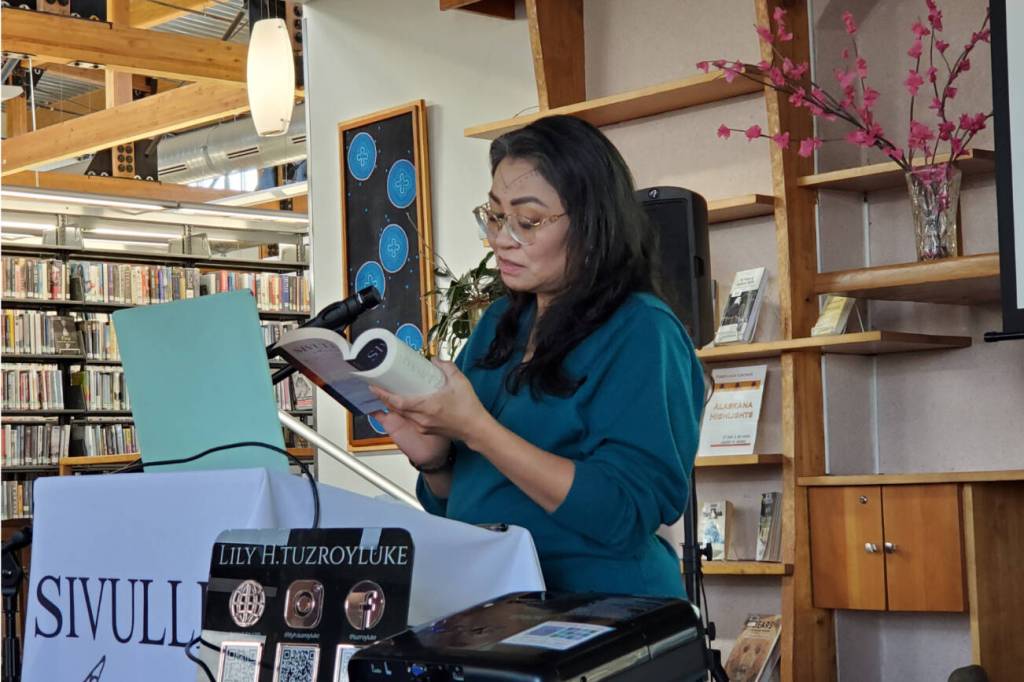
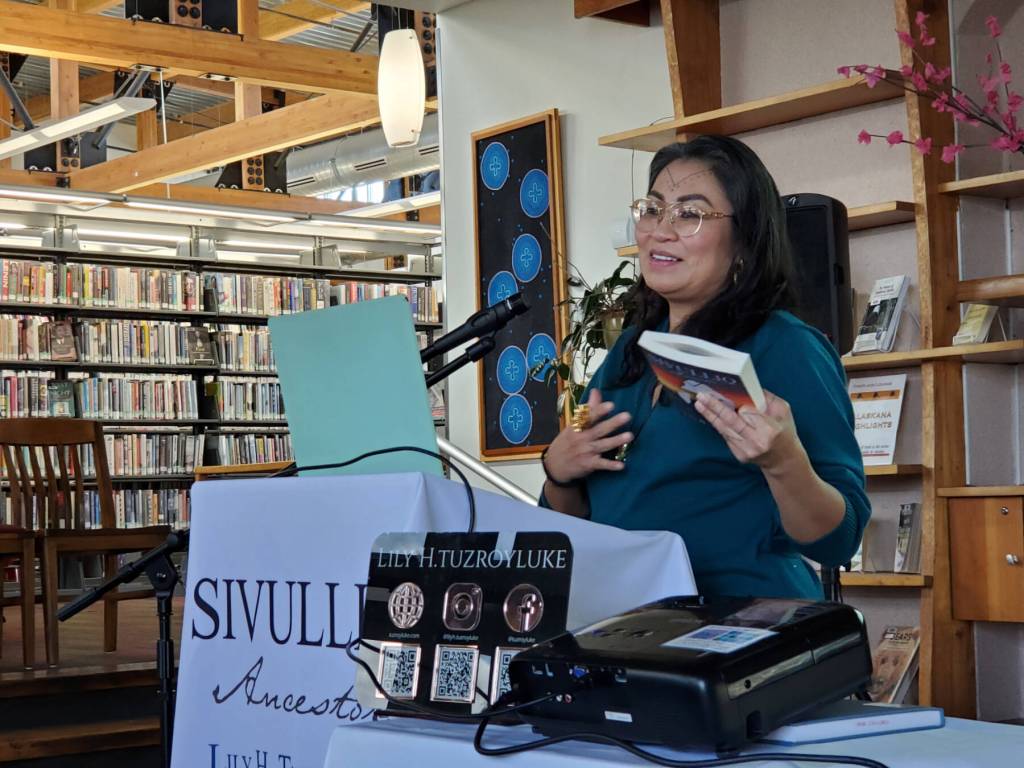
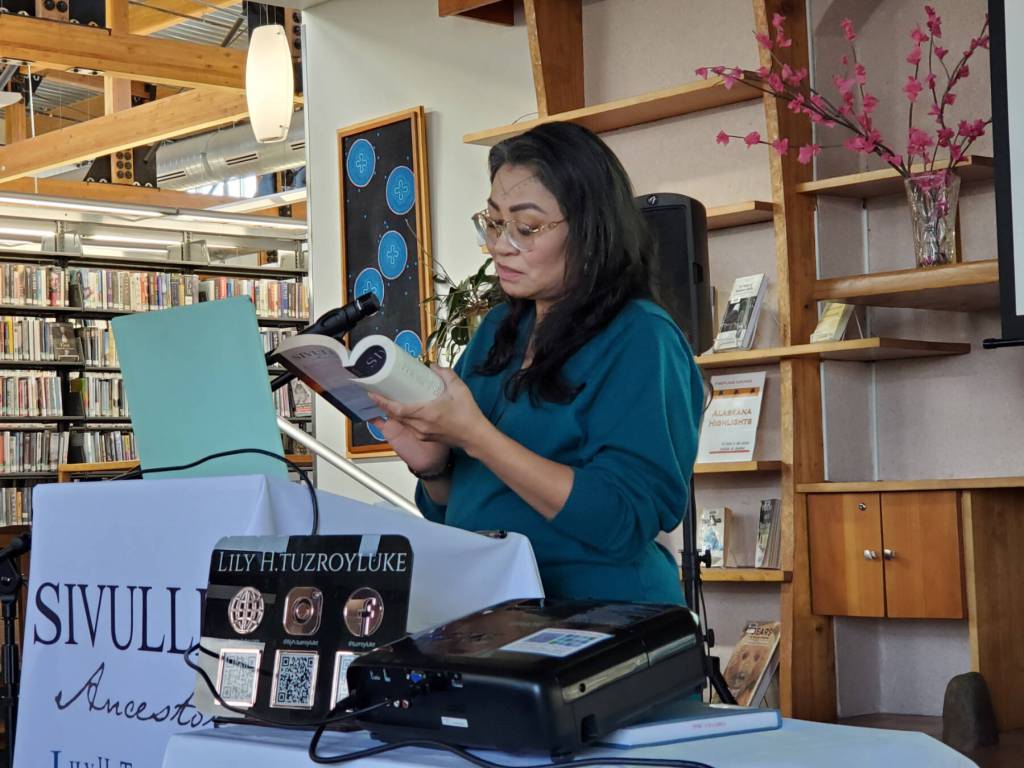


Last month, Homer readers and Homer Public Library staff celebrated the 10th anniversary of the library’s Lit Lineup reading program and welcomed Indigenous author Lily H. Tuzroyluke for a discussion on her historical novel, “Sivulliq: Ancestor.” Tuzroyluke was recently selected as the 2024-2026 Alaska Reads author.
The Alaska Reads program was also created 10 years ago by then-Alaska State Writer Laureate Frank Soos, who according to Friends of the Homer Library coordinator Cheryl Illg, started it “as a way to celebrate living Alaska authors and connect Alaskan readers.” The Alaska Reads committee selects a new publication every two years to create a shared reading experience for Alaskans, and the chosen Alaska Reads author travels throughout the state discussing their work at book discussion groups, libraries, bookstores, museums, cultural centers, and through radio broadcasts and social media.
The program is coordinated by Alaska Center for the Book in partnership with the Alaska State Library, the Alaska Humanities Forum and the Rasmuson Foundation.
Originally from Point Hope and now residing in Anchorage, Tuzroyluke is of Inupiaq, Tlingit and Nisga’a descent. Her debut novel, published in 2023 by Epicenter Press, is set in arctic Alaska in 1893, when Indigenous populations are being devastated by a smallpox epidemic introduced by American whalers. The main character, Kayaliruk, takes her children and leaves their home in search of surviving family members. Along their journey, they encounter the crew of a Yankee whaler ship who attach Kayaliruk and kidnap her daughter, Samaruna.
The novel follows both the perspectives of Kayaliruk on her determined pursuit to reclaim her daughter, and an African-American whaler on the ship, Ibai, who has been tasked by the captain with taking care of Samaruna. Along the way, Kayaliruk’s and Ibai’s lives become intertwined as they witness harrowing change and colonial horrors upon their peoples.
Tuzroyluke began her presentation by reading an excerpt from “Sivulliq,” pages 158-161, when Kayaliruk and her children reach what the novel calls “the stone homes.” Kayaliruk’s children ask her if she knows this place, if she knows who built the houses. What follows is a shared storytelling session between her and another woman, Nasauyaaq, who is travelling with them and helping them hunt down the whalers.
“I’m always drawn to that part because of the traditional knowledge that is in that particular section,” Tuzroyluke said, noting that traditional knowledge is constantly interwoven within the novel.
Tuzroyluke said that writing “Sivulliq” was a “discovery process” of what makes her most productive when writing.
“I love hearing about the writing process, about how writers sit down or go to their workspace and get into that flow state,” she said. “I feel like I’m always gathering different processes as a writer.”
She shared aspects of her writing process with the audience, as well as advice on how other writers might make the most of their writing time, including setting daily goals, planning downtime, free writing, organization using a table of contents, how to effectively conduct research and how to navigate the publishing process.
“It’s so important for me to plan downtime,” she said. “Being an overachiever, we’re always like ‘I should be producing, I should be doing something right now,” so I try and plan around that downtime.”
She gave the example of listening to audiobooks or creating a playlist of TV shows or movies that help her “keep her mind in the era” of her current project.
“For ‘Sivulliq,’ Bram Stoker’s ‘Dracula’ was written in the exact same year,” she said. “It was one of my go-to’s, like ‘What are they wearing? What are they getting around in, what is their transportation?’ Those types of things.”
Tuzroyluke said she considers free writing, or the writer’s process of putting all their thoughts on paper without restraint or focusing on editing, to be the foundation of her writing.
“I consider journaling, even, to be a part of my daily goal, because it’s so important for me to have a clear mind as I’m starting out,” she said.
Research and utilizing resources such as libraries is also key to Tuzroyluke’s writing process, or what she called her “favorite form of inspiration,” and that it is the historical details that she uncovers that gives the narrative its “teeth.”
“I love it, and I hope it’s reflected in ‘Sivulliq.’ With the traditional knowledge, I had some intrinsic knowledge of whaling and hunting. When it came to the Yankee whalers … I had zero knowledge … and that’s where research was really integral in this process,” she said.
“As a writer, as an avid reader, I definitely discovered that, even as an Indigenous person with an oral history, you can still find these glimpses of interactions between Indigenous peoples and non-native peoples in history. But it takes some work, and you’ll be surprised where you can find information.”
Noting that all writers are different and should figure out what best makes them productive, Tuzroyluke she “couldn’t stress enough” the importance of discovering her writing process and how it will help her write her next book faster.
“Sivulliq” is the product of Tuzroyluke committing herself to writing full-time for two years. Tuzroyluke is currently working on her next novel, which is set in Chilliwack Home, the British Columbian residential school that her grandfather attended.
Lit Lineup
Librarians Teresa Sundmark and Matthew Smith also gave short presentations on HPL’s Lit Lineup program, which was started in 2015 by Sundmark as a community-wide reading initiative.
Sundmark explained that when she was first trying to imagine what such a program would look like, three factors contributed to creating the Lit Lineup that library patrons know today. The first was the frequently asked question received by the library’s front desk for book recommendations.
“It’s a good question, but also loaded, because everyone has different ideas of what is a good book,” Sundmark said. “So it seems like a curated list of many different kinds of books would come in handy.”
The second factor was Sundmark’s own “fond” memories of summer reading programs she participated in as a child.
“Reading is great all on its own, but I wondered if adding prizes to the mix might push folks and adults, even, to read more or read outside their comfort zone,” she said.
The third factor stemmed from Sundmark’s observation in 2014 of the effects that spending time on social media and the internet was having on her attention span.
“I was still reading plenty, but I found that the nuanced, in-depth reading that comes with sitting down with a good novel, a well-researched book of nonfiction or a poetry collection was slipping away,” she said. “If it was happening to me, I was pretty sure it was happening to other people.”
Thus, the inauguration of the Lit Lineup program, then called “Read 15 in ‘15.”
“It’s been a real joy to see it continue throughout the years,” she said.
As the current program administrator, Smith “does all the behind-the-scenes work,” finalizing the annual book list, putting together the list brochures and writing the program newsletters.
“I am so thankful to be a part of this program,” he said. “I’m really thankful to be a part of the reading community here in Homer. People care so much about writing and great work and culture, and this is just a great place to be.”
“Sivulliq: Ancestor” is available for check-out at the Homer Public Library or purchase at the Homer Bookstore. Learn more about the Alaska Reads program and Tuzroyluke at www.alaskacenterforthebook.org/ or www.tuzroyluke.com/.