Fat bikes go where no bicycle has gone before
Published 3:02 am Friday, November 14, 2014
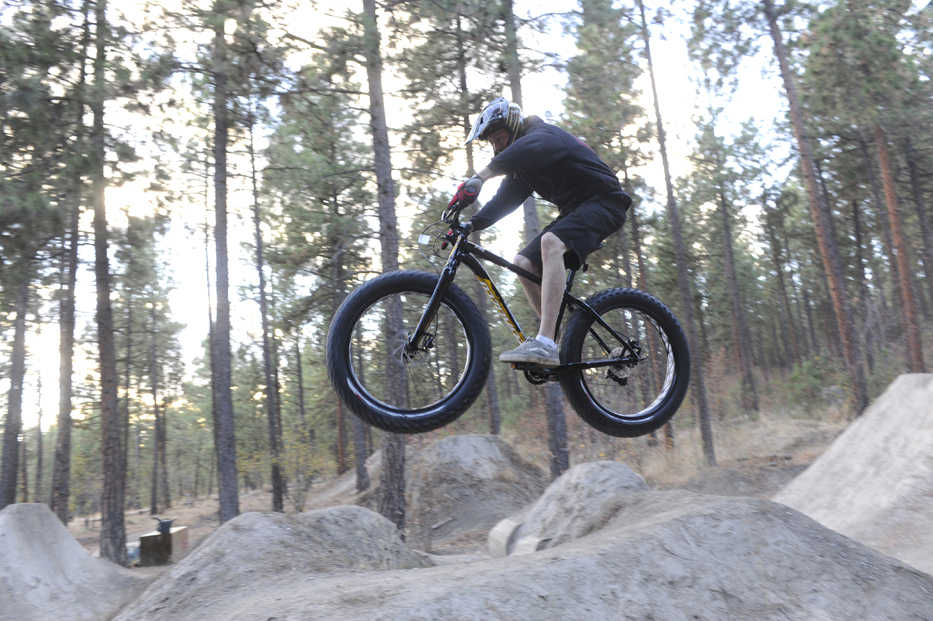
SPOKANE, Wash. (AP) — The first thing people notice: The tires, wider than the forearms of most grown men. Then, the inevitable first question: Where’s the motor?
The fat bike — a seemingly typical mountain bike frame with tires ranging from 3.7 to 4.8 inches wide — owes its origin to Fairbanks, Alaska.
In 1987, Simon Rakower was working as tech support for the Iditabike — a 160-mile race through snowy, rugged terrain. In order to meet the needs of participants, he welded together two rims and sewed two tire carcasses to create something entirely new and utilitarian.
The larger tires, with greater traction and more flotation, allowed racers to traverse the packed snow trails. Where most mountain bikes might’ve sunk inches deep, these new tires (later referred to as “Snow Cats”) could glide along without a hitch.
Over time, the design of a bike with fat tires evolved, allowing cyclists new territories and new seasons to explore. Manufacturers saw an increasing demand, and sought to meet it.
Today, fat bikes range from 22 to 30 pounds (depending on the frame’s material) and are produced by top bike manufacturers such as Surly, Trek, Salsa and Specialized. The wider tires allow for precise mitigation of tire pressure — 6-8 psi for snow or sand and a sturdier 28-30 for more rigid landscape.
The fat bike affords cyclists the opportunity to travel previously unimaginable routes — through snow, over sand, and for some, back in time.
“You feel like a kid,” explained Spokane attorney and biking enthusiast Dan DeRuyter. “I take my dog out when it first snows. He loves it — it (my fat bike) is hilarious as far as he’s concerned.”
DeRuyter bought his first fat bike — a Salsa Mukluk II — during a family vacation at Jackson Hole in 2012.
DeRuyter — who spends as much time as possible, no matter the season, riding his fat bike solo, with friends or his wife — has pedaled everywhere from Riverside State Park to Schweitzer to West Yellowstone to the coastal sand dunes of Manzanita, Oregon.
“Traction is not an issue,” he explained. “The gearing in these things is so complementary that you can climb things in Riverside Park that I can’t do on my mountain bike . It’s remarkable. I climb them faster, at a lower heart rate, than I do on my mountain bike.
“If you ride around here in the mud in the spring on your mountain bike, you’re looking at the ground. You’re studying the corners. You’re focused on the trail — you’re looking for the gravel and the sand as you go around corners. On a fat bike, because you’ve got a bigger patch, you’re not as focused on the trail. It’s a more relaxed ride.”
Fat bikes make it so riders don’t have to omit a season from their calendar. Although packed snow is best — the single-file path of a snowshoer or the tracks of a snowmobile — it is possible to romp through 6-8 inches of snow.
“It depends on how heavy it is,” DeRuyter explained. If the snow is wet and deep enough to where the bike’s bottom bracket is dragging, riding becomes very difficult.
DeRuyter does warn while fat biking in Palisades or Riverside State parks to be careful of glare ice.
“These things without studs don’t hold up to glare ice any better than a regular bike.”
Last year, DeRuyter entered the annual JayP’s Backyard Fat Pursuit race in West Yellowstone. While he had trained for local winter conditions, the West Yellowstone climate caught him a bit off-guard.
He toughed out 10 hours of 60 kilometers with no water or food, since they had frozen in the 5-degrees-below-zero weather.
He hopes to go back this year.
“This race — this is where fat biking is going,” he said. “I’m going to do it again. I’m going to be smarter.”
While cyclists are reaching new speeds on fat bikes, other riders are using its design to cross great distances.
Rich Shauvin, 58, of Spokane, rode the 2,571 miles of the Great Divide Mountain Bike Route — from Antelope Well, New Mexico to Banff, Alberta — on his fat bike last year.
He started planning his trip a year prior and had many things to consider, including whether to take his full-suspension mountain bike or his Salsa Mukluk II.
“Fewer things can go wrong with the fat bike,” Shauvin explained. “They have mechanical brakes, as opposed to hydraulic breaks, which most mountain bikes have.”
“With four-inch tires, you have a quite a bit more control with the ride you want. If you’re on a highway, you can pump them up to 30 pounds and zip right along. If you’re on rough terrain, you get down to six pounds and it’s a real soft ride.”
Shauvin makes the analogy between a fat bike and a pack mule.
“It’s really stable,” he said. “You sit up a little bit higher. It handled the weight well. I probably had about 75 pounds on there.”
In his shirt pocket, Shauvin carried a spot tracker the size of a deck of cards, which sent out a GPS signal, allowing his wife to check his location on her phone.
He had named his bike “Rocinante,” the horse of classic literary character Don Quixote. In the book of the same name, the horse serves as a mirror image for its rider — a creature past its prime, undertaking an adventure beyond his capabilities.
“I’ve spent my whole life passing on opportunities for ‘life adventures,’” Shauvin said.
“The day I left was really hard. Once I started pedaling, that euphoric feeling came over me and it didn’t bother me at all being in the desert. It became an adventure.”Over the course of 69 days, through torrential rain, gusting sands and elevations up to nearly 12,000 feet, Shauvin lost 25 pounds despite loading up on as many calories as possible at each stop.
“The exercise I get out of mountain biking is a byproduct to just the way it makes me feel internally, the euphoric feeling I get,” Shauvin said.
“We all pack a lot of stress in our daily lives. Anything I can do to become more at peace with myself, I’m all over it.”
Because spare fat bike tires are so bulky and heavy, Shauvin didn’t carry one with him. He took duct tape, patches and an extra tube. Along the way, he came across five decent bike shops, where he had a bike technician go through the whole bike. He never encountered any serious mechanical issues, he said.
Read more about his incredible journey, in his own words, in his online diary by searching online for “Rocinante on the GDMBR.”
Interest in fat bikes continues to grow, especially in the Pacific Northwest where riders can test the limits of their fat tires.
“We’re seeing more and more interest spiked by this type of bike,” explained Mic Woodruff, General Manager of Wheel Sport on the South Hill.
“Regardless of their age, regardless of what they ride now, these bikes are definitely getting people’s attention.”
Even hunters, looking for a quieter, more environmentally conscious alternative to ATVs and UTVs, are making inquiries.
“Every year I talk to a certain amount of hunters who are looking to use these bikes for hunting,” Woodruff said.
Different people are finding different reasons to fall in love with fat bikes, which many bike experts are now classifying as a growing trend.
Both DeRuyter and Shauvin, on their fat bikes, are accomplishing feats people half their age wouldn’t dare attempt.
On a fat bike, the path is accessible, weather not an issue.
You’re at the handlebars. No matter your age, or where you’re going, there are fewer reasons to turn back.