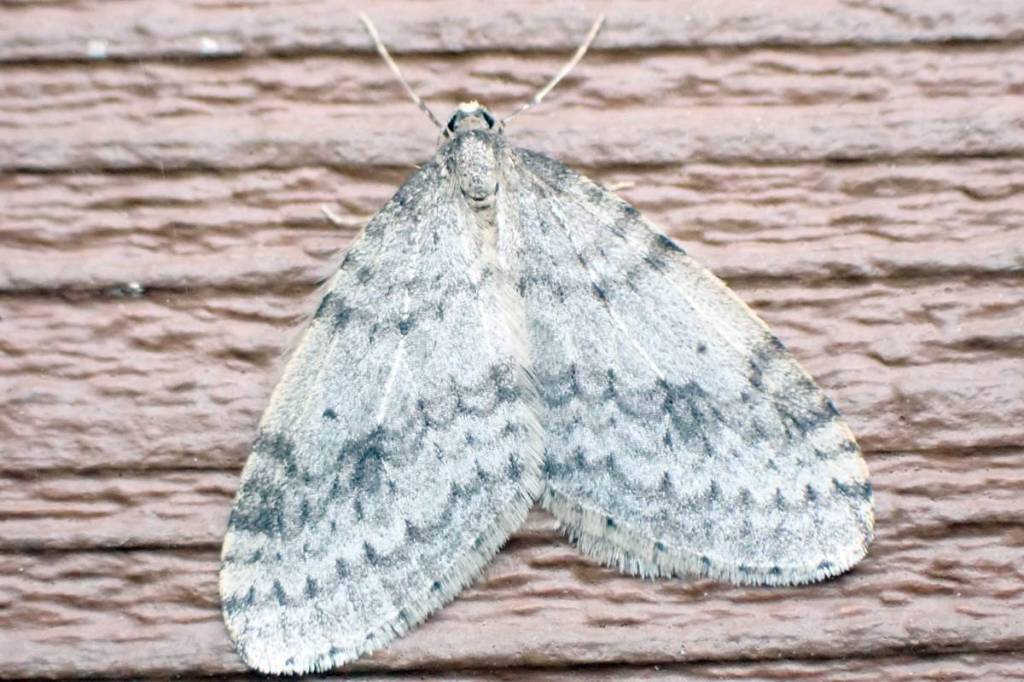
A winter moth resting on the siding of the Kenai National Wildlife Refugeճ headquarters building in Soldotna on Monday, Oct. 21, 2019. (Photo by Matt Bowser/Kenai National Wildlife Refuge)

A winter moth resting on the siding of the Kenai National Wildlife Refugeճ headquarters building in Soldotna on Monday, Oct. 21, 2019. (Photo by Matt Bowser/Kenai National Wildlife Refuge)

Refuge notebook: Winter moth time

  • By MATT BOWSER Kenai National Wildlife Refuge
  • Thursday, October 24, 2019 7:26pm
  • Sports

On the windows of my home in Kasilof, under lights at the Kenai National Wildlife Refuge’s headquarters in Soldotna, in Anchorage and in Fairbanks, winter moths are appearing in large numbers this year. These delicate, pale brown or gray moths flit about in the evenings from September into November. I have witnessed the frail moths flying through lightly falling snow, seeming to defy the change of seasons.

Like unsolicited advertisements left on our doors to claim our attention, the drab moths tell us about something we might otherwise not have considered. As with the rise and fall of snowshoe hares, pulses of spruce cone production and biennial runs of pink salmon in the Kenai River, winter moths come and go in one of the interwoven cycles of the boreal forest around us.

Several similar-looking species of winter moths occur around the world in northern to temperate latitudes. The winter moth, Operophtera brumata, is the common species in Europe and northern Asia. It is now an invasive species in Canada and the Lower 48.

The bruce spanworm, Operophtera bruceata, inhabits most of North America’s boreal forest. Operophtera occidentalis, also known as the Kodiak looper, ranges from coastal Alaska down to California. On the Kenai Peninsula, we have both bruce spanworms and Kodiak loopers.

Right now, winter moths are seeking mates and laying eggs. The strange-looking, wingless females climb up trees or shrubs and emit a scent that the winged males follow. Females deposit eggs singly in crevices in bark. All of the adults die as winter closes in.

The eggs are tuned to hatch as the buds burst in the spring to take advantage of new spring growth. For newly hatched winter moth caterpillars, timing is critical: if the eggs hatch too early, they will starve; if they hatch late, they miss the best food source.

After the initial flush of growth in the spring, trees and shrubs begin to incorporate chemicals into their leaves that render them less palatable to caterpillars.

Winter moth caterpillars eat the leaves of deciduous trees and shrubs, grow quickly and mature around the end of June. At this time they drop to the ground, crawl into the leaf litter and there spend the rest of the summer as pupae. Adults emerge in the fall.

In this one-year life cycle of the winter moths, the whole population is basically in synchrony, with all individuals at close to the same stage of life at all times. This cycle repeats every year, but the size of the population varies drastically over the years.

Outbreaks of winter moths have been documented in Alaska in the 1950s, 1970s and most recently in 2010 to 2013, when caterpillars consumed almost every leaf of alders, willows and shrubby birches in the subalpine zone in Southcentral Alaska, leaving brown patches on mountain slopes and subalpine thickets.

We still do not know what initiates these outbreaks, but we do know about how outbreaks are synchronized regionally, the causes of population declines after outbreaks and how these moths affect other species in the boreal forest.

Regionally, we have seen that outbreaks of winter moth caterpillars occur across Southcentral Alaska in a short span of a few years. One way these outbreaks are synchronized is through long-range dispersal, where moths in one area spread out tens to hundreds of miles.

You might wonder how winter moths, having flightless females, can disperse farther than a moth or caterpillar can crawl. In these species, the young caterpillars can travel long distances downwind by ballooning on long strands of silk in the same way Charlotte’s spiderlings left Zuckerman’s farm in the story of Charlotte’s Web.

During outbreaks, winter moths serve as food for birds, insects and spiders. Voles and shrews prey on pupae in the leaf litter. Trees and shrubs fed upon by the caterpillars defend themselves by increasing bitter compounds in their foliage. Heavily damaged plants grow more slowly or die back.

Now with fewer and more bitter leaves, the plants provide poorer forage for hares and moose. Under denuded trees and shrubs, with increased sunlight filtering through the canopy and fertilizer added to the soil as caterpillar droppings, grasses flourish, covering the ground more thickly until the canopy above recovers.

Winter moth outbreaks conclude when most leaves have been eaten. The starving caterpillars turn to devouring whatever green things they can find, but they languish on alternative diets.

Even when food remains available, winter moth populations decline after two to three years at least partly due to diseases that spread through the moth populations. After populations decline, winter moths generally exist as an inconspicuous part of the forest system for 10 or more years.

The apparently higher numbers of winter moth adults this fall do not necessarily mean that we are entering a new outbreak, but they are a reminder of the intertwined cycles of the boreal forest in which we live.

Matt Bowser serves as Entomologist at Kenai National Wildlife Refuge. Find more Refuge Notebook articles (1999–present) at https://www.fws.gov/refuge/Kenai/community/refuge_notebook.html.
More in Sports

Senior Mason Bock exclaims after winning the state title during the ASAA Division I state championships in Anchorage, Alaska on Dec. 20, 2025. Bock beat No. 2 seed Isaiah Schultz of Colony High School in the final, securing his victory in the 135-pound title as the No. 4 seed. Bock said standing on the podium was the best moment of his life, telling the Clarion that since he had lost to Schultz once earlier in the season, he was “focused and determined to have a different outcome” during the final match. Photo courtesy of Andie Bock/Andie’s Alaskan Adventures Photography
SoHi girls 3-peat at state wrestling championships

The boys team placed second and saw five wrestlers win state titles in the Division I tournament.

Homer and Soldotna hockey players battle for the puck during the Carlin Cup home varsity game on Saturday, Dec. 13, 2025, at the Kevin Bell Arena in Homer, Alaska. (Delcenia Cosman/Homer News)
SoHi hockey claims 3rd Carlin Cup victory

The Soldotna varsity hockey team defeated Homer 9-1 Saturday at Kevin Bell Arena.

Seward’s Atlin Ryan wrestles against a Mountain City Christian Academy athlete during the regional Kachemak Conference Wrestling Championships on Saturday, Dec. 13, 2025, at Homer High School in Homer, Alaska. (Delcenia Cosman/Homer News)
Homer girls wrestling team named regional champions

Kenai boys, girls both placed third overall in the Kachemak Conference Wrestling Championships on Saturday.

The Soldotna High School wrestling team is pictured after the Northern Lights regional conference in Wasilla, Alaska, on Saturday, Dec. 13, 2025. SoHi sent 33 boys and 11 girls to regionals. 22 boys and nine girls will compete in the state tournament at the Alaska Airlines Center this weekend. Photo courtesy of Soldotna High School Athletics
SoHi wrestling wins regional title; 31 wrestlers advance to state

22 boys and nine girls will compete in the state tournament this weekend.

Sophie Tapley is photographed with her parents, Josh and Whitney Tapley, during Sophie’s signing ceremony at Kenai Central High School on Nov. 26, 2025. Tapley committed to playing volleyball at the University of Alaska Anchorage during the 2026-2027 school year. Photo courtesy of Jesse Settlemyer, Kenai Central Athletics
Kenai Central’s Sophie Tapley signs with UAA volleyball

Tapley will trade her Kardinals jersey for a Seawolf one during the 2026-2027 academic year.

Photo courtesy Pete Dickinson
The SoHi junior varsity and varsity wrestling teams compete in the Battle for the Bird at Soldotna High School on Wednesday, Nov. 26. The Kenai Peninsula Athletics Sapphire dance team performed the halftime show.
SoHi, Nikiski wrestling teams compete for Thanksgiving dinner

The Stars and Bulldogs faced off during the Battle for the Bird duals last Wednesday.

Runners of all ages gather for a photo in the Homer High School Commons after the annual Thanksgiving Turkey Trot on Thursday, Nov. 27, 2025, in Homer, Alaska. Due to icy outdoor conditions, the official run was moved to the high school halls. Photo courtesy Matthew Smith
55 turn out for Homer Turkey Trot

Each Thanksgiving morning, the Kachemak Bay Running Club and the City of… Continue reading

The varsity wrestling team is pictured after the Robin Hervey individual tournament in Kodiak on Nov. 22, 2025. Photo courtesy of Pete Dickinson
Sports briefs: Soldotna hockey, wrestling teams secure wins at weekend tournaments

SoHi hockey won the End of the Road tournament in Homer and the wrestling team gained 20 individual wins.

The Kenai Central High School varsity volleyball team is named the 2025 3A Volleyball State Championship Tournament, held Nov. 13-15, 2025, at the Alaska Airlines Center in Anchorage, Alaska. The Kardinals defeated the Nikiski Bulldogs 3-2 in a "rematch" championship game on Saturday, Nov. 15, securing their third state title in the last four years. Photo courtesy of the Kenai Volleyball Booster Club
Kenai Central takes home 3rd volleyball state title

The Kards defeated Nikiski in a rematch championship game on Saturday during the state tournament in Anchorage.

Soldotna High School wrestlers won six individual championships during the Lancer Smith Memorial wrestling tournament in Wasilla Nov. 14-15. Photo courtesy of SoHi Stars Wrestling on Facebook
SoHi wrestling sweeps Lancer Smith tourney, eyes state title

SoHi girls and boys took first and second place as teams, respectively.

Soldotna’s Gracelyn Altobelli attacks against Nikiski’s Addison Perkins on Tuesday, Sept. 16, 2025, at Soldotna High School in Soldotna, Alaska. (Photo by Jeff Helminiak/Peninsula Clarion)
Sports briefs: Soldotna volleyball claims third Northern Lights Region III title

The SoHi Stars will compete at the state tournament this weekend.

The Homer Mariners varsity football team celebrates their victory after the Division III state championships game on Saturday, Oct. 18, 2025, in Wasilla, Alaska. Photo provided by Justin Zank
Homer, Kenai football receive Division III All-State awards

Players on the Homer High School and Kenai Central High School varsity… Continue reading