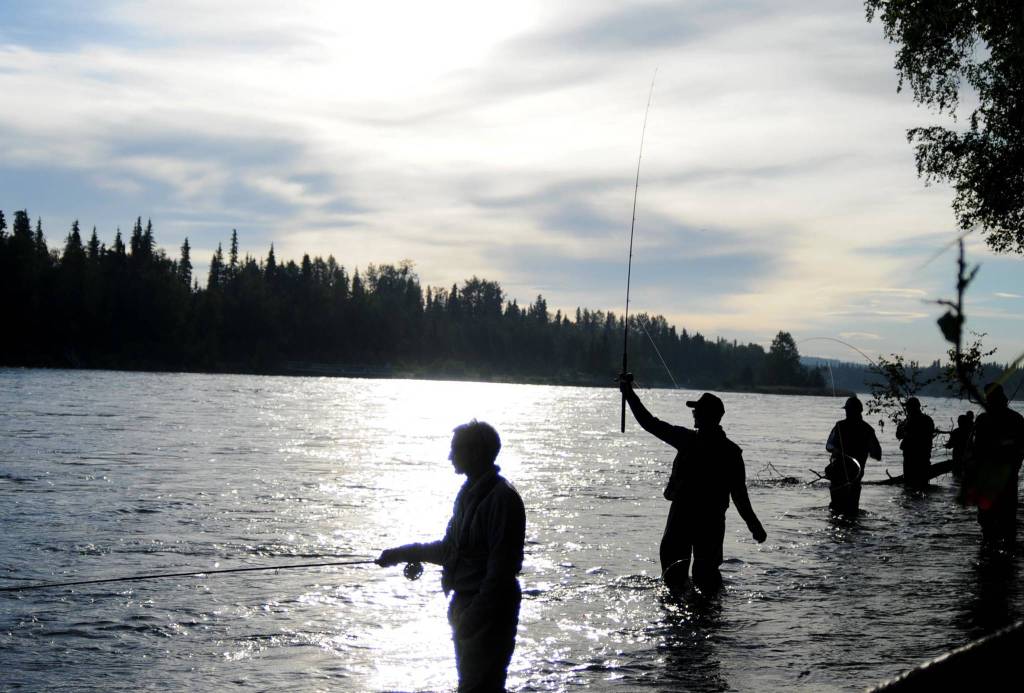
In this July 2016 photo, anglers cast their lines into the Kenai River from the bank above the Sterling Highway Bridge in Soldotna, Alaska. (Photo by Elizabeth Earl/Peninsula Clarion, file)

In this July 2016 photo, anglers cast their lines into the Kenai River from the bank above the Sterling Highway Bridge in Soldotna, Alaska. (Photo by Elizabeth Earl/Peninsula Clarion, file)

Sportfishing licenses jump in 2016

The Alaska Department of Fish and Game sold nearly 50,000 more sportfishing licenses and stamps and hunting licenses in 2016 than it did in 2015, according to Fish and Game data.

Overall, the department sold 751,050 licenses and stamps for sportfishing and hunting, not including hunting tags, in calendar 2016. That’s a sharp increase over 2015, when 701,010 licenses and stamps were sold. It’s about 100,000 more licenses than were sold in calendar year 2011, according to Fish and Game data.

It’s not the highest sales year ever — that was in 2005, when the department sold 786,998 sportfishing licenses and stamps and hunting licenses — but it’s the most sold since 2008, according to Fish and Game records.

In fiscal year 2016, which lasted from July 1, 2015 to June 30, 2016, the department brought in a total of $13.7 million in license sales, which was higher than projected, according to the Division of Sport Fish’s fiscal year 2016 report.

One of the Division of Sport Fish’s identified goals in its 2015–2020 strategic plan is to increase nonresident license sales. For 2015–2016, nonresident sportfishing licenses increased across the board, with the largest bump in one-day licenses. Nonresident king salmon stamp purchases increased across the board as well.

Resident sportfishing license sales actually decreased slightly, from 107,332 in 2015 to 107,086 in 2016, according to Fish and Game’s statistics.

The fees from license sales go toward a federal match program called the Dingell-Johnson funds for sportfishing and the Pittman-Robertson funds for hunting, allowing states to match three federal dollars for every state dollar. Last year, the Legislature passed a bill authorizing an increase in license prices beginning in 2017, which are expected to bring in an additional $9 million between the hunting and fishing licenses, according to a May 2016 fiscal note attached to the bill.

In a foreword to the 2016 annual report, Division of Sport Fish Director Tom Brookover noted the contribution of license sales to the division’s funding.

“Our success is due in large part to the contributions that Alaska’s anglers make,” he wrote. “They enable us to meet the goals and objectives described in our (strategic) plan. Your support through the purchase of a sport fishing license directly benefits conservation of our fishery resources. Adequate funding is required if we are to pursue and complete the activities contained within our plan.”

The Division of Sport Fish uses the license fees and federal funds to support itself but also draws from the state general fund. Of its $48 million budget in fiscal year 2016, about 16 percent came from the state general funds, 33 percent from fishing license revenues, 42 percent from federal matching funds for the license fees, 5 percent from grants, with the other 4 percent from interagency agreements and special projects, according to the annual report.

Of the expenditures, about 20 percent went toward fisheries management, 14 percent toward hatcheries and stocking, 15 percent toward internal operations, 12 percent toward habitat improvement, ad the other 9 percent toward external communications and fixed costs. About 30 percent of the division’s budget went toward fisheries research, which is slightly less than the 34 percent set out as a goal in the division’s strategic plan.

Fisheries research projects accomplished in FY16 included 67 research and stock assessment projects across Alaska as well as modifying the statewide harvest survey database system, publishing eight manuscripts in peer-reviewed scientific literature and submitting four more to journals. Research often supports management activities, which include monitoring salmon runs and regulating openings by emergency order.

The amount spent on research fell slightly because the department received fewer grants than expected, according to the 2016 annual report. Future funding for the research projects often depends on grants, which are not always assured, according to the report.

“Continuing current or implementing new research projects that rely on external funding sources may not be feasible because the Division’s project proposals are not always selected or approved; loss of this funding hinders our ability to address fisheries management needs,” the report states.

Reach Elizabeth Earl at elizabeth.earl@peninsulaclarion.com.

More in News

David Ross is sworn in as Kenai Police Chief on Tuesday, May 31, 2016 at Kenai City Hall. The Alaska Association of Chiefs of Police named Ross the 2025 Police Chief of the Year, recognizing over two decades of service. Photo by Megan Pacer/Peninsula Clarion
Kenai police chief named 2025 Police Chief of the Year

The Alaska Association of Chiefs of Police recognized David Ross for his more than two decades of leadership.

The cast of Nikiski Middle School’s upcoming performance of “Alice in Wonderland” is pictured on Dec. 2, 2025. The upperclassmen-directed play opens on Friday, with additional showtimes Saturday and next weekend. Photo courtesy of Carla Jenness
Nikiski Middle School debuts student-led “Alice in Wonderland”

The show opens on Friday, with additional showtimes this weekend and next.

On Tuesday, the Kenaitze Indian Tribe unveiled Kahtnu Area Transit, a public transportation service open to the entire Peninsula Borough community. Photo courtesy of Kahtnu Area Transit
Kenaitze Indian Tribe unveils Kahtnu Area Transit

The fixed bus route offers 13 stops between Nikiski and Sterling.

The Kenai Chamber of Commerce and Visitor Center hosts the annual Christmas Comes to Kenai on Nov. 28<ins>, 2025</ins>. The beloved event began over 40 years ago, and this year over 1,000 attendees enjoyed hot chocolate, fireworks, pictures with Santa and shopping. Photo courtesy of the Kenai Chamber of Commerce
 Photo courtesy of the Kenai Chamber of Commerce
The Kenai Chamber of Commerce and Visitor Center hosted the annual Christmas Comes to Kenai on Nov. 28. The beloved event began over 40 years ago, and this year over 1,000 attendees enjoyed hot chocolate, fireworks, pictures with Santa and shopping.
Kicking off a month of holiday festivities

Last weekend’s holiday events, including the annual Christmas Comes to Kenai and the Soldotna Turkey Trot, drew folks from all over the Kenai Peninsula.

Starting Dec. 2, Aleutian Airways will offer roundtrip flights between Anchorage and Unalakleet every Tuesday, Friday and Sunday.
Aleutian Airways to offer roundtrip flights between Anchorage and Unalakleet

Starting Dec. 2, Aleutian Airways will offer three roundtrip flights per week.

The Trump administration’s “Big Beautiful Bill” act requires the Bureau of Ocean Energy management to hold at least six offshore oil and gas lease sales in Alaska between 2026-2028 and 2030-2032. The first of these sales — known as “Big Beautiful Cook Inlet 1,” or BBC1— is scheduled for March 2026. Photo courtesy of the Bureau of Ocean Energy Management
Cook Inletkeeper launches petition against federal government

The organization is calling for transparency in Cook Inlet offshore oil and gas sales.

Winter dining has always carried more weight than the menu might suggest. In the off-season, eating out isn’t just about comfort food or convenience; it’s a way of supporting local businesses as they hold steady through the slower months. Photo credit: Canva.
The ripple effect: How local spending builds stronger communities on the Kenai Peninsula

From cozy cafés to fine-dining bistros, purchases made close to home sustain local jobs and services

Courtesy Harvest
On the Kenai Peninsula, a dormant liquefied natural gas export plant could be repurposed to receive cargoes of imported LNG under a plan being studied by Harvest, an affiliate of oil and gas company Hilcorp. The fuel would be transferred from ships to the tanks on the left, still in liquid form, before being converted back into gas and sent into a pipeline.
Utilities say Alaska needs an LNG import terminal. Consumers could end up paying for two.

Planning for two separate projects is currently moving ahead.

A map shows the locations of the 21 Alaska federal offshore oil and gas lease sales proposed by the Trump administration. (Map provided by the U.S. Bureau of Ocean Energy Management)
Trump administration proposes offshore leasing in almost all Alaska waters

A new five-year offshore oil and gas leasing plan proposes 21 sales in Alaska, from the Gulf of Alaska to the High Arctic, and 13 more off the U.S. West Coast and in the Gulf of Mexico.

Most Read