Setnet petition fails
Published 4:58 am Friday, April 4, 2014
A petition to separate management of the Kenai, East Forelands and Kasilof sections of the commercial setnet fishery in Cook Inlet was failed unanimously by Alaska’s seven-member Board of Fisheries.
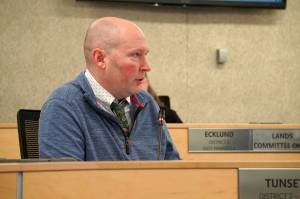
During a Thursday hearing on the emergency petition, submitted by Paul A. Shadura II representing the South K Beach Independent Fishermen’s Association, members of the board discussed whether the proposal met the criteria of an emergency.
Under state law, the board can make an emergency finding if it determines an unforeseen or unexpected event has occurred that either threatens a fishery, or one in which a regulatory inaction would prevent harvesting a surplus of those fish.
The crux of the association’s, or SOKI, petition was that board members had not considered the potential effects to commercial fisheries when they amended the Kenai River Late-Run King Salmon Management Plan during their February meeting on the Upper Cook Inlet.
New additions to the management plan include language that would restrict the entirety of the commercial setnet fishery on the East Side of the Cook Inlet to 36 hours of fishing time per week.
However, because sockeye runs peak at different times on the Kenai and Kasilof rivers — and commercial setnetters in the Kenai and Kasilof sections target the two different runs — fisheries managers will have to allocate those 36 hours between two sections and could wind up prioritizing one river’s sockeye run over another.
“Maybe managers will be saying … let’s hold off on opening up the Kasilof area, even though the run is substantial for this area, so we can make sure we have enough hours on the Kenai,” Shadura said. “If we’re all bound together, it would be difficult for managers to make that decision.”
According to ADFG data the historic midpoint, or peak, of the Kasilof river sockeye run is about a week earlier than the midpoint of the Kenai River run.
So, instead of using the same 36-hour pool of available hours between the two sections — the SOKI petition requested that the board allow managers to fish the sections separately and provide up to 36-hours for both.
Board member Fritz Johnson, of Dillingham, said he thought the petition could provide Alaska Department of Fish and Game managers who are tasked with running the Upper Cook Inlet fisheries, more flexibility when managing the two sections of the fishery to intercept sockeye headed for the Kenai and Kasilof rivers.
“It may allow this department to have a little more precision in regards to managing those areas,” Johnson said after he and Kodiak board member Sue Jeffrey moved to take up the petition.
Jeffrey echoed Johnson’s comments and brought up the “1 percent rule” which closes the commercial setnet fisheries in August if less than one percent of the season’s harvest is caught during two consecutive fishing periods.
During the February Upper Cook Inlet meeting board members adopted a proposed regulation that changes the way the rule has been calculated in the past.
Prior to 2014, managers calculated the harvest of the entire set gillnet fishery in the Kasilof, Kenai and East Foreland sections of the Cook Inlet — those fisheries were “decoupled.” Now the rule is calculated in each section separately and is expected to cause the Kasilof section to be closed more frequently.
According to ADFG data, had the new criteria been applied in the two fisheries over the last 13 years, the Kasilof section would have been closed early in nine of those years reducing their sockeye harvest by more than 77,000 fish.
Jeffrey also asked ADFG managers to clarify whether ADFG emergency order authority would be restricted by the recently adopted changes to the management plan.
Under Alaska statute the commissioner of ADFG can open or close seasons or areas for fishing or change weekly closed periods for fish or game via emergency order. The Board of Fisheries cannot adopt a regulation that would limit the power of the commissioner to exercise that authority.
“In the actual new language now, yes,” said Tim Baker, an ADFG regional management coordinator over Cook Inlet salmon and herring fisheries.
Baker said the new regulations —which are designed to kick in when Kenai River king salmon are returning to the river in low numbers — would trigger a reduction in the number of hours that the set gillnet fisheries could be fished.
“Those are significant reductions on what they would normally do in this case if we’re trying to conserve king salmon,” Baker said.
Orville Huntington, board member from Huslia, asked if the SOKI petition would make it easier to manage the fishery.
“I guess the answer to that would be yes,” said Pat Shields, ADFG commercial area management biologist who manages the Upper Cook Inlet setnet fisheries. “That would provide more flexibility to the department and you would manage each section separately with the hours that were provided.”
Some board members were unconvinced that the petition was a necessary change to the new regulations.
Tom Kluberton, board member from Talkeetna, said the board made the changes to the king salmon management plan, at least in part, for the benefit of inriver sport fishers who target the same fish.
“We all know the economic consequences that amounts to millions of dollars and the loss of those 389 guiding outfits,” Kluberton said.
Allowing the commercial set gillnet fishers in the southern part of the Cook Inlet to fish also reduced the amount of fish available to anglers and commercial fishers in the northern part of the Cook Inlet, he said.
“In my mind, there’s nothing unforseen about what we were doing,” Kluberton said. “Yes, there are impacts on all fisheries and I think this petition is an effort to reduce that impact on one set of fisheries … so I’m not able to register the same level of concern that I’m hearing from some of my fellow board members.”
As deliberations progressed, board chairman Karl Johnstone asked again about emergency order authority and whether ADFG managers felt they could do what the petitioners were asking with that authority.
“We do feel we have that,” said Jeff Regnart, director of ADFG commercial fisheries division.
However, while ADFG has that authority, it has rarely been used to separate fishing between the Kenai and East Foreland section and Kasilof section of the commercial setnet fishery.
During the last five years, commercial area managers have fished the Kasilof section separately of the Kenai and East Foreland section for 15 days, according to ADFG data.
During those time periods, the Kasilof setnet fishery has been restricted to within half a mile of the beach — instead of its usual one and a half miles.
Shields said ADFG managers don’t typically split the two fisheries up via emergency order as doing so would allow commercial fishers in one section to harvest fish that could have been harvested in the other — an allocative decision that managers try to avoid.
In addition to emergency order authority that could regulate the two fisheries, Regnart said managers could also use the Kasilof Special Harvest Area — a fishery that opens two miles around the mouth of the Kasilof river to all drift gillnet and commercial setnet fishers in the Cook Inlet.
Using it for king salmon conservation is a relatively new use for the area, which was designed to allow Kasilof section setnet fishers to harvest Kasilof sockeye when Kenai River sockeye were returning in low numbers.
Shields said ADFG managers used the special harvest area, which has been in place since 1986, as a king salmon conservation tool for the first time during the 2013 fishing season.
While it could technically be possible to pack the 450 setnet permit holders in the Cook Inlet into the two-mile area — as there are no restrictions on how far apart their nets have to be — Shields says the fishery can sometimes become chaotic as it “puts people in possible scenarios of contention.”
Christine Brandt, an East Side Setnet fisher who listened in on the proceedings in Soldotna, echoed Shields’ sentiment saying that the special harvest area closed off inriver fishing in the Kasilof as so many nets were in the water near the mouth.
“We hate it,” Brandt said. “It doesn’t provide equal opportunity for everyone in the area.”
Rashah McChesney can be reached at rashah.mcchesney@cmg-northwest2.go-vip.net/peninsulaclarion.