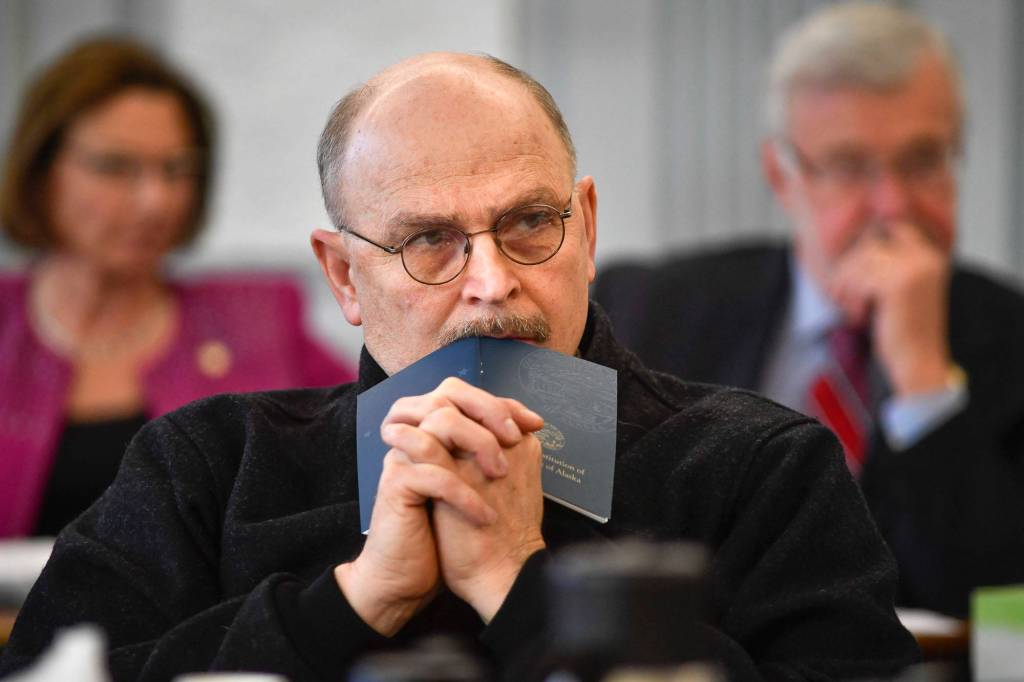
Sen. Click Bishop, R-Fairbanks, rests his head on a Constitution of Alaska booklet as he listens to Donna Arduin, Director of the Office of Management and Budget, and Mike Barnhill, policy director for the OMB, present Gov. Mike Dunleavy’s budget to the Senate Finance Committee at the Capitol on Tuesday, Feb. 18, 2019. Senate President Cathy Giessel, R - Anchorage, left, and Sen. Gary Stevens, R-Kodiak, right, are in the background. (Michael Penn | Juneau Empire)

Sen. Click Bishop, R-Fairbanks, rests his head on a Constitution of Alaska booklet as he listens to Donna Arduin, Director of the Office of Management and Budget, and Mike Barnhill, policy director for the OMB, present Gov. Mike Dunleavy’s budget to the Senate Finance Committee at the Capitol on Tuesday, Feb. 18, 2019. Senate President Cathy Giessel, R - Anchorage, left, and Sen. Gary Stevens, R-Kodiak, right, are in the background. (Michael Penn | Juneau Empire)

Proposed tax would boost school maintenance, construction

A bill that would deduct $30 a year from every worker in Alaska and pool that money to be used for maintenance and construction costs in the state’s schools is making its way through the Alaska Senate.

Senate Bill 50 is sponsored by Sen. Click Bishop (R-Fairbanks), Sen. Gary Stevens (R-Kodiak) and Sen. Jesse Kiehl (D-Juneau) and looks to collect revenues to fund schools.

Money generated from the tax would be deposited into the state’s general fund and accounted for separately to pay maintenance and construction needs of Alaska’s schools. Those maintenance and construction needs are growing, Bishop said in his sponsor statement.

On the Kenai Peninsula, about 25% of the district’s schools are 50 years or older, and 80% are over 30 years old.

“I think we have to take a stand to tackle deferred maintenance in our schools,” Bishop said during the Jan. 28 Senate Labor and Commerce Committee meeting.

A similar tax once existed in Alaska from 1919 to 1980, according to the bill’s sponsor statement. When the tax was repealed in 1980 it was $10 per person. When adjusted for inflation, that tax would have the equivalent value of $30 today.

The bill seeks to revive the repealed head tax on employees, both resident and nonresident, whose income is coming from a source in Alaska. The tax, known as the “Alaska Education Facilities, Maintenance, and Construction Tax,” would collect $30 from each person employed in the state, withholding those funds from an employee’s first paycheck each year.

Self-employed Alaskans would be required to remit payment to the Alaska Department of Revenue. The tax would be deductible on a federal income tax return. Retirees would not be taxed.

The tax is estimated to generate $13 million annually from about 442,000 employees.

“Roughly 20% of those workers who earn their living in Alaska do not reside here resulting in $2.5 billion in non-resident income that leaves Alaska’s economy each year and, in most cases, gets taxed by a non-resident’s home state,” Bishop said in his sponsor statement.

The bill made it’s way through the Senate Labor and Commerce Committee and has been referred to Senate Finance Committee.

Should the bill pass the Legislature and be signed into law by Gov. Mike Dunleavy, the tax would take effect Jan. 1, 2021.


More in News

Photo courtesy of Jessie Gacal-Nelson
Soldotna artist Lester Nelson-Gacal will receive a $10,000 grant through the Rasmuson Foundation to support the creation of a handmade book telling the story of his relationship with his father during his father’s final year.
Soldotna artist awarded Rasmuson Foundation grant

Lester Nelson-Gacal will use the funds to create a handmade, illustrated book about his father’s final year.

State of Alaska Department of Law logo. Photo courtesy of the State of Alaska Department of Law
Kenai man sentenced for sexual abuse of minor, possession of child pornography

Joshua Aseltine was sentenced on Dec. 4 to serve 28 years in prison.

Alaska Department of Natural Resources logo (graphic)
State proposes changes to material sales regulations

The Department of Natural Resources is proposing changes to regulations related to material sales and conveyances to state agencies.

A map depicts the Cook Inlet Area state waters closed to retention of big skates through Dec. 31, 2025. Photo courtesy of the Alaska Department of Fish and Game
Cook Inlet area closed to big skate bycatch retention

The closure is effective in Cook Inlet Area state waters through Dec. 31.

A diagram presented by Seward City Manager Kat Sorenson during a Kenai Peninsula Borough Assembly meeting on Dec. 2, 2025, shows the expected timeline for the Port of Seward Vessel Shore Power Implementation Project. Screenshot
Seward shore power project moves into preliminary design phase

The project will create jobs, reduce cruise ship emissions and provide a backup power grid.

The U.S. Forest Service Porcupine Campground offers gorgeous views of the Kenai Mountains and Turnagain Arm, as seen here on July 20, 2020, near Hope, Alaska. (Photo by Michael Armstrong/Homer News)
Department of Natural Resources seeks public input on proposed Kenai Peninsula State Forest

DNR is gathering community perspectives during several meetings this week.

David Ross is sworn in as Kenai Police Chief on Tuesday, May 31, 2016 at Kenai City Hall. The Alaska Association of Chiefs of Police named Ross the 2025 Police Chief of the Year, recognizing over two decades of service. Photo by Megan Pacer/Peninsula Clarion
Kenai police chief named 2025 Police Chief of the Year

The Alaska Association of Chiefs of Police recognized David Ross for his more than two decades of leadership.

The cast of Nikiski Middle School’s upcoming performance of “Alice in Wonderland” is pictured on Dec. 2, 2025. The upperclassmen-directed play opens on Friday, with additional showtimes Saturday and next weekend. Photo courtesy of Carla Jenness
Nikiski Middle School debuts student-led “Alice in Wonderland”

The show opens on Friday, with additional showtimes this weekend and next.

On Tuesday, the Kenaitze Indian Tribe unveiled Kahtnu Area Transit, a public transportation service open to the entire Peninsula Borough community. Photo courtesy of Kahtnu Area Transit
Kenaitze Indian Tribe unveils Kahtnu Area Transit

The fixed bus route offers 13 stops between Nikiski and Sterling.

Most Read