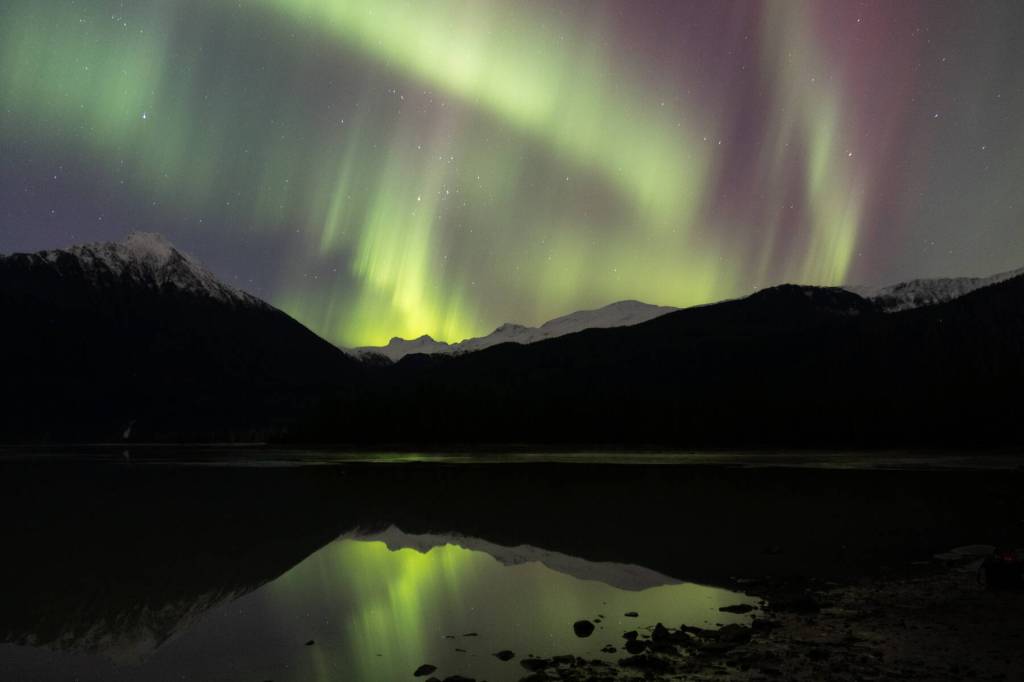
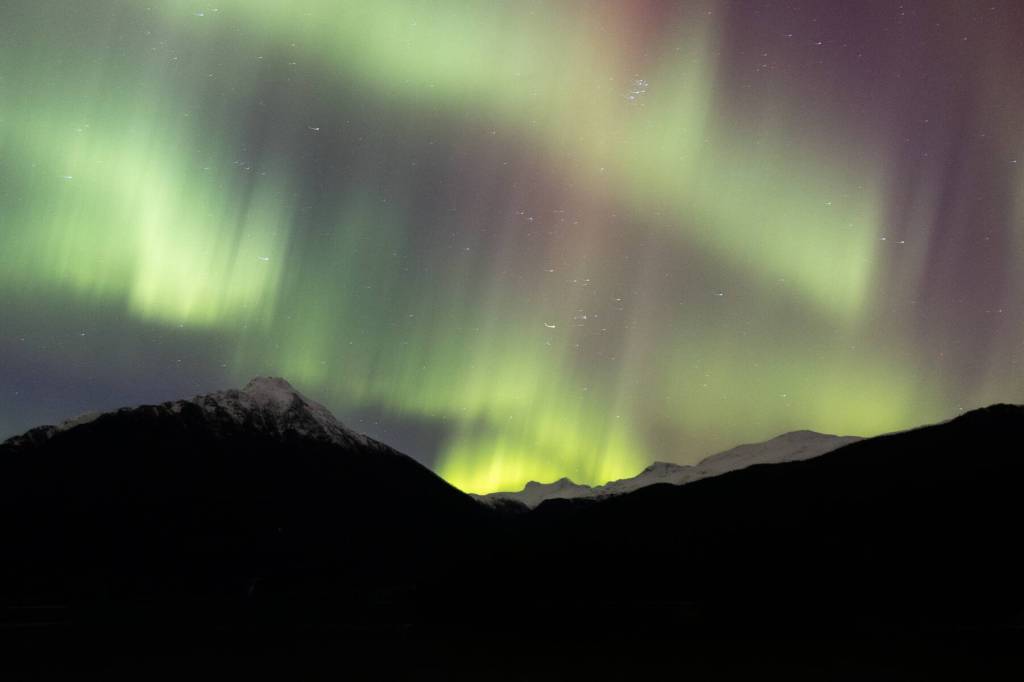
The aurora borealis dances over the Mendenhall Glacier in Juneau on Nov. 12<ins>, 2025</ins>. Hundreds of Juneauites flocked to dark areas of town to catch particularly strong performances from the northern lights due to a series of solar flares Tuesday and Wednesday nights. (Chloe Anderson/Peninsula Clarion)

The aurora borealis dances over the Mendenhall Glacier in Juneau on Nov. 12, 2025. Hundreds of Juneauites flocked to dark areas of town to catch particularly strong performances from the northern lights due to a series of solar flares Tuesday and Wednesday nights. (Chloe Anderson/Peninsula Clarion)

Out of the Office: Aurora’s performance was worth the wait

A series of solar flares caused an unusually bright display of the northern lights Wednesday night.

If I were to tally up the hours I’ve spent trying to find the aurora borealis, they would likely add up to weeks.

Searching for them is like trying to bake cookies with a pantry some invisible entity stocks at random. The recipe calls for just three ingredients: Geomagnetic activity powerful enough for the human eye (or my camera’s image sensor) to detect, a clear sky and a time of year where the sun really, truly sets and it gets really, truly dark outside. Sounds easy enough, right?

Anywhere else it would be. But I live in a rainforest, and it’s rare to have a clear sky in stock. During the summers, the sky is a deep, velvety blue on cloudless nights — while it’s one of my favorite colors, it’s not conducive to spotting Lady A. The final ingredient in this seemingly simple recipe is a moderate KP index, which is available far more often than the other two, but invisible without them.

Every night, I poke my head into the pantry to see what’s there. I clamber on to my roof when there’s a break in the clouds; I check my aurora forecasting app religiously. Something has been missing every day for the past two weeks.

But yesterday, the sky was clear. I checked the forecast all day and looked forward to sunset as the KP index climbed and kept climbing. Last night, when I broke my lease agreement for the dozenth time by crawling up to the roof of my apartment complex, I realized the pantry was finally fully stocked.

I gathered my camera supplies and several friends, and we drove north to Mendenhall Lake. I set my camera on its tripod and adjusted the settings, taking dozens of test shots. It felt like following a recipe without knowing any of the measurements until the faint green blobs in the sky lit up and turned to ribbons.

There are many ways to write about what happened next. I could write scientifically and say the show was so spectacular because a series of explosions on the sun’s surface caused charged particles to hit the Earth’s atmosphere, resulting in unusually bright and colorful displays of greens and reds. I could write metaphorically and say that for once, I followed the recipe perfectly and got a taste of the most incredible cookies I’ve had so far. But in those moments, I wasn’t thinking about science, or cookies, or even about how cold my toes were getting.

As I stood under the stars and watched Lady A dance and throw colors across the night’s black canvas, I thought about how I was just one small, insignificant part of the landscape, as relevant as one of the rocks by the lakeshore or the tree I was standing near. I thought about how it’s natural for protons and electrons to enter the earth’s magnetic field just like it’s natural for humpback whales to bubblenet feed. It’s also natural for bears to eat salmon and killer whales to breach and glaciers to calve.

But witnessing these things doesn’t feel natural. It feels like a miracle every single time.

Reach reporter Chloe Anderson at chloe.anderson@peninsulaclarion.com.

The aurora borealis is seen from Mendenhall Lake in Juneau on Nov. 12<ins>, 2025</ins>. A series of solar flares caused unusually bright displays of the northern lights across Alaska Tuesday and Wednesday nights. (Chloe Anderson/Peninsula Clarion)

The aurora borealis is seen from Mendenhall Lake in Juneau on Nov. 12, 2025. A series of solar flares caused unusually bright displays of the northern lights across Alaska Tuesday and Wednesday nights. (Chloe Anderson/Peninsula Clarion)

The aurora borealis dances over the Mendenhall Glacier in Juneau on Nov. 12<ins>, 2025</ins>. Hundreds of Juneauites flocked to dark areas of town to catch particularly strong performances from the northern lights due to a series of solar flares Tuesday and Wednesday nights. (Chloe Anderson/Peninsula Clarion)

The aurora borealis dances over the Mendenhall Glacier in Juneau on Nov. 12, 2025. Hundreds of Juneauites flocked to dark areas of town to catch particularly strong performances from the northern lights due to a series of solar flares Tuesday and Wednesday nights. (Chloe Anderson/Peninsula Clarion)

More in News

File.
Soldotna aims to change short-term rental tax and permitting

Public hearings for two ordinances addressing existing short-term rental regulations will occur during the next city council meeting on Jan. 14.

Low clouds hang over Cook Inlet north of Anchor Point on Oct. 23, 2025. (Photo by Yereth Rosen/Alaska Beacon)
Inletkeeper condemns federal management of Cook Inlet oil lease sale

The agency alleges an environmental study by the Bureau of Ocean Energy Management was conducted with a “serious” lack of transparency.

The Kenai Chamber of Commerce announced the winners of the 13th annual gingerbread house competition on Dec. 20, 2025. This creation by Sierra won the 2-5 year old age category. Photo courtesy of the Kenai Chamber of Commerce
Wrapping up the holiday season

The Kenai Chamber of Commerce’s Angel Tree program and gingerbread house competition spread Christmas cheer to hundreds locally.

The Challenger Learning Center is seen here in Kenai<ins>, Alaska,</ins> on Sept. 10, 2020. (Photo by Brian Mazurek/Peninsula Clarion)
Kenai City Council considers possible uses for Challenger Center

One option would assess the facility’s potential as the new public safety building.

A snowmachine rider takes advantage of 2 feet of fresh snow on a field down Murwood Avenue in Soldotna, Alaska, on Monday, Dec. 12, 2022. (Jake Dye/Peninsula Clarion)
Ice fishing opens on some Kenai National Wildlife Refuge lakes

Snowmachines are permitted for ice fishing access on Hidden, Kelly, Petersen, Engineer and Watson lakes.

The waters of Cook Inlet lap against Nikishka Beach in Nikiski, Alaska, where several local fish sites are located, on Friday, March 24, 2023. (Jake Dye/Peninsula Clarion)
Kenai asks for fishery economic disaster declaration

The Kenai City Council requested that Gov. Dunleavy declare a disaster and support a recovery plan for the Upper Cook Inlet East Side Set Net fishery.

The Kenai Peninsula Borough School District logo. (Photo courtesy of Kenai Peninsula Borough School District)
District superintendent dispels rumors about student construction

Superintendent Clayton Holland said student involvement in Seward High School construction is “based on rumor, not fact.”

Anchorage-based singer and songwriter Keeley Boyle is pictured in Anchorage<ins>, Alaska,</ins> on Sept. 26, 2023. Boyle, who was raised on the Kenai Peninsula, will use a $10,000 grant she received from the Rasmuson Foundation to create an album of songs about her grandparents’ home in Nikiski. Photo courtesy of Jovell Rennie
Musician hailing from Kenai receives Rasmuson grant

Keeley Boyle will record an album of songs about her grandparents’ Nikiski home.

Commercial fishing and recreational vessels are docked in the Homer harbor on Oct. 23, 2025. The commercial fishing industry endured a series of challenges over the year, some of them imposed by the new Trump administration. (Photo by Yereth Rosen/Alaska Beacon)
Alaska fisheries in 2025: turmoil, economic and environmental challenges and some bright spots

NOAA cuts, economic headwinds and invasive species pose problems, but there was some recovery in crab stocks and salmon harvests.

Most Read