Murkowski says she is trying to restore some resilience funding for Alaska villages
Published 9:30 pm Tuesday, October 21, 2025
Five months after the Trump administration canceled a series of environmental grants for Alaska, including an erosion-control grant that was to have gone to one of the villages hardest hit by ex-Typhoon Halong, the fight over the money continues.
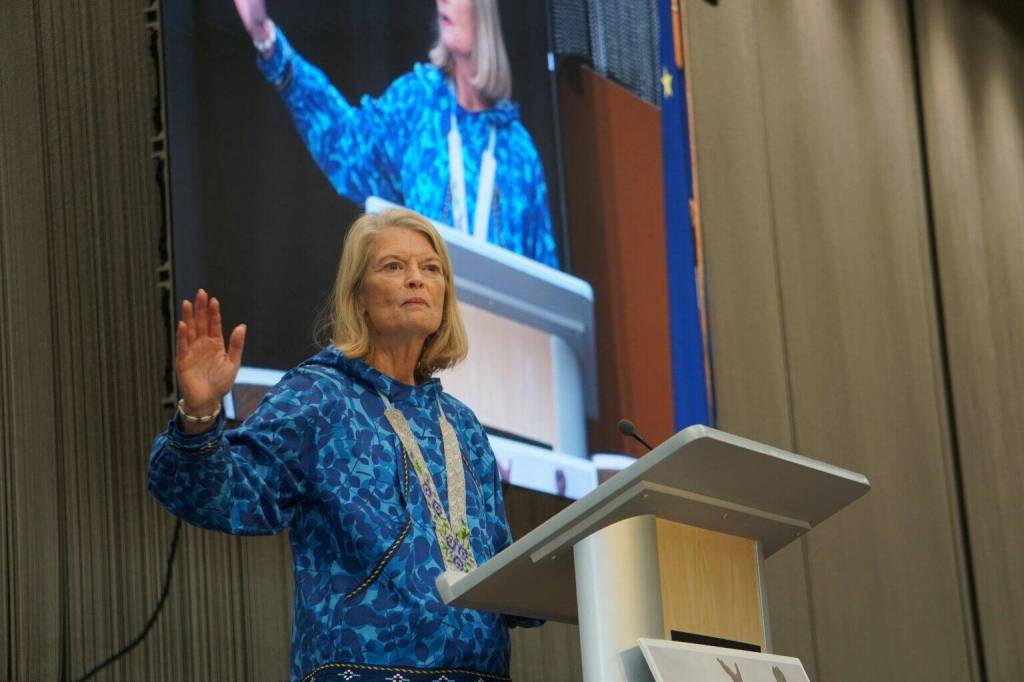
Sen. Lisa Murkowski, R-Alaska, in her speech Saturday to the annual Alaska Federation of Natives convention, said she is trying to restore some of the canceled funding, including money that was to have gone to the Yukon-Kuskokswim Delta village of Kipnuk. The village of 700 had been awarded $20 million by the Biden administration to combat problems connected with permafrost thaw and other climate change effects, but in May the Trump administration canceled that and other grants.
Murkowski blasted officials who characterized the grant to Kipnuk as wasteful.
“I am offended,” she said. “I am outright mad that some have suggested that it is a waste of taxpayer dollars to protect Alaskan communities. We are Americans. Every single person that has been impacted is an American that deserves to be treated with that level of respect.”
Murkowski was responding obliquely to Environmental Protection Agency Administrator Lee Zeldin and his spokesperson, who issued what delegates to the AFN convention considered to be insulting statements.
In a post on the social media site X, Zeldin called news reports about the canceled grant “left-wing hackery” that were dishonest. The grants would not have provided protection in time for ex-Typhoon Halong, he said.
“And to be brutally candid, due to the proactive cancellation of this grant, $20 million of hardworking U.S. tax dollars are currently sitting in the U.S. treasury instead of swept into the Kuskokwim River,” his post said. He concluded the post on a pugnacious note: “As for the clowns who want the EPA to light tens of billions of tax dollars on fire, we refuse to bend the knee and play along.”
Grant cancellations hit Indigenous communities
The Kipnuk grant was to have paid for a barrier on the rapidly eroding Kugkaktlik River. The project was part of Kipnuk’s broader erosion control and climate-change adaptation plan, which includes elements of “managed retreat,” the relocation of some structures and facilities to safer ground farther from the river.
Murkowski, in her AFN speech, said it may be true that work under the canceled grant would not have come in time for the devastation wrought by ex-Typhoon Halong. But that and other grants were still needed, she said.
“They may prevent future disasters, and that’s the point,” she said. “It’s not just what happens today. It’s the ability to look forward out into the future, to make it better into the future.”
Most of Kipnuk’s residents were airlifted out of the storm-wrecked village, part of the more than 1,500 people now taking shelter in Bethel, Anchorage or other spots. The Yukon-Kuskokwim Delta is one of the most rural parts of North America; no road connects its communities, where the mostly Yup’ik residents depend on traditional Indigenous fishing, hunting and other food-gathering practices.
The Kipnuk grant had been among several awarded by the Biden administration to Alaska Native communities under the EPAs’ Community Change Grant Program. That program was funded by the Inflation Reduction Act of 2022, a piece of legislation that passed with no Republican votes. In all, over $150 million in Alaska grants under the program were canceled by the Trump administration.
Among the nixed grants was $20 million previously awarded to Kotzebue for expansion of wind power. As in other areas of rural Alaska, residents of Kotzebue are seeking to reduce reliance on diesel fuel, which is costly and difficult to transport and store, by shifting to locally produced renewable energy.
The administration also canceled a previously awarded $20 million grant to Utqiagvik, the nation’s northernmost community, for work to protect infrastructure from permafrost thaw, improvements to the utility system and other environmental tasks.
Aside from the more than $150 million in Community Change Grant Program funding for Alaska that the Trump administration’s EPA canceled, the agency also eliminated the Biden-era Solar For All program and, with it, $125 million in funding that had been awarded to expand solar energy in Alaska.
At a news conference following her AFN speech, Murkowski said the state’s congressional delegation and others might be able to use a $40 million pot of money to restore some of the lost project funding. That would be much less than a full restoration, she conceded.
“The Community Change Grant Program was very specific, and the criteria were very specific. And so many of our communities, including Kipnuk, met the criteria,” she told reporters. “That’s where the real tragedy is in all of this. But we’re working to get some portion of that funding to go towards Kipnuk again, to recognize that you’ve got a vulnerability in the community and how they’re able to address it. You can’t do it with just a lot of good thoughts.”
The administration also eliminated a Federal Emergency Management Agency grant program called Building Resilient Infrastructure and Communities. That program funded projects intended to prevent damages from disasters like floods, thus saving money that would be spent on recovery and repair.
Murkowski said the administration has taken the position that it will oppose anything having to do with resilience or “anything that has the word ‘climate’ in it,” she said.
“Crazy, in my view,” she said.
In her convention speech, Murkowski described what she saw the previous day in Kipnuk — an eerily quiet village that a week earlier would have been filled with children playing and four-wheelers zipping around. She also saw one of the main obstacles to escaping this and other storms.
“Flying over, you realize there is no retreat to higher ground, because there is no higher ground in many parts of the delta,” she said.
Public broadcasting funding loss another AFN concern
Beyond her comments on the remnants of Typhoon Halong, Murkowski lamented the recent vote by Congress to rescind all previously appropriated funding for public broadcasting.
The Corporation for Public Broadcasting is a key source of funding for rural Alaska stations, and Murkowski voted against recission of its funding. The other two members of Alaska’s all-Republican congressional delegation, Sen. Dan Sullivan and Rep. Nick Begich, were enthusiastic supporters of the recission, which had been championed by President Donald Trump.
Murkowski said she and Sullivan eked out a slight reprieve by securing some Bureau of Indian Affairs money to help 14 rural Alaska stations. “But that’s one-time money. That’s this year. What about next year?” she said.
The role of public broadcasting and the threat posed by elimination of previously awarded federal funding was much discussed at the convention. Attention to that issue was heightened by the typhoon disaster and the role that public broadcasting, notably the Bethel outlet KYUK, played in relaying emergency information.
Several attendees, including those staging a silent protest during Sullivan’s speech on Friday, held signs that said: “Public radio saves lives.”
Alaska House Speaker Bryce Edgmon, I-Dillingham, in an address on Friday, urged audience members and organizations to donate to public broadcasting outlets to make up for the loss of federal support.
“We learned a lot how important public radio is, based on the last week or so,” Edgmon said.
Like other rural outlets, Bethel’s KYUK, which broadcasts across the Yukon-Kuskokwim Delta in the Yup’ik language as well as in English, has been highly dependent on support from the now-defunded Corporation for Public Broadcasting, said Kristin Hall, the outlet’s manager.
“For KYUK, that funding made up nearly 70% of our annual operating budget,” Hall said during a panel discussion Thursday on public broadcasting. “That funding is not just a line item. That is not just a line item in our budget. That is our livelihood.”
Public broadcasting in rural Alaska is about much more than emergency communications, Hall and other panel members said. The Indigenous content is a comfort to elders, educational for youth and an important part of civic life in the villages, they said.
“Not only do we provide cultural and traditional knowledge, but it’s also a human need to see ourselves in media,” said Jaclyn Sallee, president of Kohanic Broadcast Corp., an Alaska-based nonprofit that produces and distributes Indigenous programs statewide and nationally.
Yereth Rosen came to Alaska in 1987 to work for the Anchorage Times. She has reported for Reuters, for the Alaska Dispatch News, for Arctic Today and for other organizations. This article originally appeared online at alaskabeacon.com. Alaska Beacon, an affiliate of States Newsroom, is an independent, nonpartisan news organization focused on connecting Alaskans to their state government.