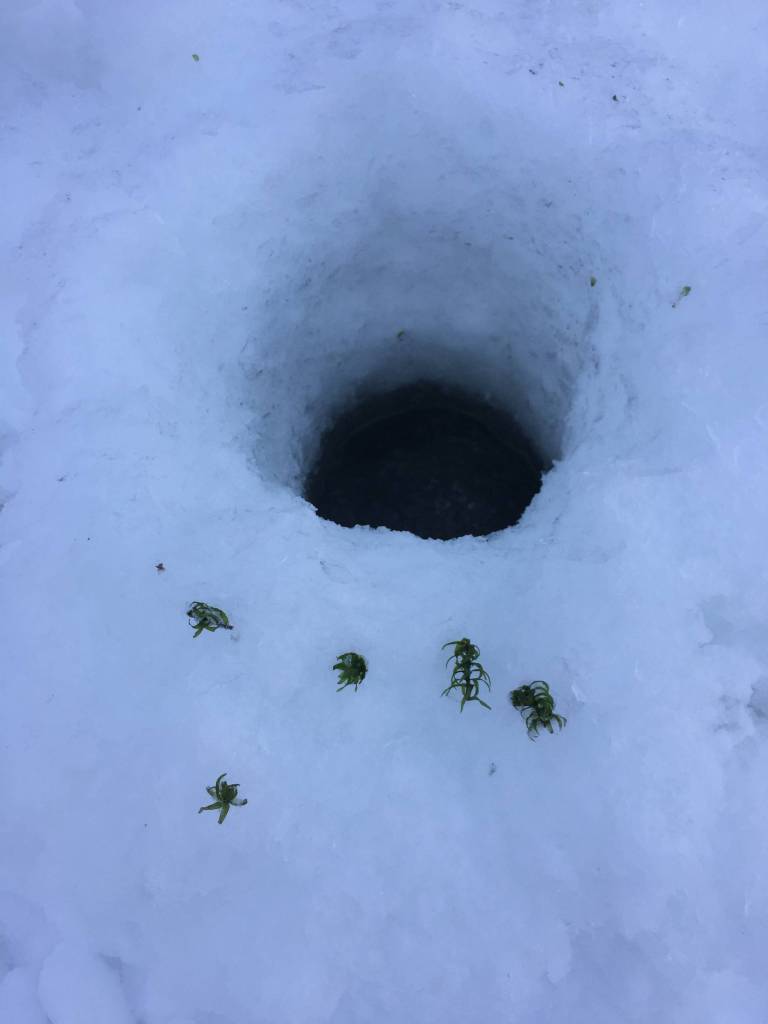
Fragments of the invasive water weed elodea lay in the snow beside an auger hole drilled on Sport Lake in February 2017 in Soldotna, Alaska. Alaska Department of Fish and Game biologists found a small amount of elodea when drilling auger holes in preparation for an ice fishing event for the Kenai Peninsula Borough School District. (Photo courtesy Rob Massengill/Alaska Department of Fish and Game)

Fragments of the invasive water weed elodea lay in the snow beside an auger hole drilled on Sport Lake in February 2017 in Soldotna, Alaska. Alaska Department of Fish and Game biologists found a small amount of elodea when drilling auger holes in preparation for an ice fishing event for the Kenai Peninsula Borough School District. (Photo courtesy Rob Massengill/Alaska Department of Fish and Game)

Invasive elodea found in Sport Lake

The invasive water weed elodea has been identified in Soldotna’s Sport Lake.

The lake is one of the most popular on the central Kenai Peninsula for sportfishing because of its centrality and regular stocking efforts by the Alaska Department of Fish and Game. Fish and Game staff turned up fragments of the weed while they were drilling ice auger holes for a recent Kenai Peninsula Borough School District ice fishing event on Feb. 22.

They didn’t turn up much — of the 120 holes they drilled, elodea only surfaced in one, said Rob Massengill, a fisheries biologist with Fish and Game in Soldotna. After the event, the staff went back and looked for more, locating some fragments in another hole that may have been spread around by the students participating in the ice fishing event, he said.

Though they couldn’t tell the extent of the weed’s growth right away, he said it was positive that it only turned up in one of the holes.

“I take it as a good sign,” he said.

Fish and Game contacted the U.S. Fish and Wildlife Service, which has been coordinating elodea eradication efforts on the Kenai Peninsula and working with the Alaska Department of Natural Resources on efforts to eliminate the weed elsewhere in the state. Elodea can be particularly destructive to freshwater lake systems, as it grows beneath ice and can grow so thick that oxygen availability is low enough to kill fish. It can also degrade spawning habitat, get in the way of boat and floatplane traffic and damage property values.

It’s been documented in lakes in the Matanuska-Susitna Valley, Fairbanks, Cordova and Anchorage. The three lakes where it was documents on the Kenai Peninsula — Stormy, Daniels and Beck lakes in Nikiski — were treated and are thought to be clear of elodea.

Sport Lake was sampled in 2014, and there was no indication of elodea then, said John Morton, the supervisory biologist at the Kenai National Wildlife Refuge.

“That doesn’t mean it wasn’t there, but it wasn’t detected,” he said.

Refuge staff went out on the lake and attempted to survey it, but the ice and overflow interfered, Morton said. The rough plan is to try to start treatment after ice-out in the spring, and the staff is working on paperwork and will set up a public meeting to get people involved, he said.

There are a number of possible ways the weed could have been introduced. Elodea is natural in some places and is used as an aquarium plant, and some think that that is how it was introduced to Alaska in the first place — an illegally dumped aquarium. The weed also only requires a fragment to spread, so if a piece hitched a ride on a boat or a floatplane, it could have made it into the lake. Sport Lake has houses all around it, some of which have floatplane docks. The weed was found near the boat launch, Morton said.

To eliminate elodea, refuge staff has applied herbicides called diquat and fluridone, which don’t harm fish but have been fairly effective at killing elodea, into the three Nikiski lakes. The DNR is looking at the method for other parts of Alaska with elodea infestations, such as Chena Slough near Fairbanks and Lake Hood in Anchorage.

Morton said the refuge staff and the DNR are working together on eradicating the weed in Southcentral and will consult with the state on paperwork for Sport Lake. The refuge staff and the state are sharing information and materials — for example, the refuge donated extra product to help the state treat Alexander Lake in the Mat-Su Valley in September 2016, where the infestation had grown to cover 500 acres. The state plans to continue watching for other infestations in the Mat-Su valley.

“We’re actively trying to keep the Mat-Su and the Kenai Peninsula clear,” Morton said.

Reach Elizabeth Earl at elizabeth.earl@peninsulaclarion.com.

More in News

A diagram presented by Seward City Manager Kat Sorenson during a Kenai Peninsula Borough Assembly meeting on Dec. 2, 2025, shows the expected timeline for the Port of Seward Vessel Shore Power Implementation Project. Screenshot
Seward shore power project moves into preliminary design phase

The project will create jobs, reduce cruise ship emissions and provide a backup power grid.

The U.S. Forest Service Porcupine Campground offers gorgeous views of the Kenai Mountains and Turnagain Arm, as seen here on July 20, 2020, near Hope, Alaska. (Photo by Michael Armstrong/Homer News)
Department of Natural Resources seeks public input on proposed Kenai Peninsula State Forest

DNR is gathering community perspectives during several meetings this week.

David Ross is sworn in as Kenai Police Chief on Tuesday, May 31, 2016 at Kenai City Hall. The Alaska Association of Chiefs of Police named Ross the 2025 Police Chief of the Year, recognizing over two decades of service. Photo by Megan Pacer/Peninsula Clarion
Kenai police chief named 2025 Police Chief of the Year

The Alaska Association of Chiefs of Police recognized David Ross for his more than two decades of leadership.

The cast of Nikiski Middle School’s upcoming performance of “Alice in Wonderland” is pictured on Dec. 2, 2025. The upperclassmen-directed play opens on Friday, with additional showtimes Saturday and next weekend. Photo courtesy of Carla Jenness
Nikiski Middle School debuts student-led “Alice in Wonderland”

The show opens on Friday, with additional showtimes this weekend and next.

On Tuesday, the Kenaitze Indian Tribe unveiled Kahtnu Area Transit, a public transportation service open to the entire Peninsula Borough community. Photo courtesy of Kahtnu Area Transit
Kenaitze Indian Tribe unveils Kahtnu Area Transit

The fixed bus route offers 13 stops between Nikiski and Sterling.

The Kenai Chamber of Commerce and Visitor Center hosts the annual Christmas Comes to Kenai on Nov. 28<ins>, 2025</ins>. The beloved event began over 40 years ago, and this year over 1,000 attendees enjoyed hot chocolate, fireworks, pictures with Santa and shopping. Photo courtesy of the Kenai Chamber of Commerce
 Photo courtesy of the Kenai Chamber of Commerce
The Kenai Chamber of Commerce and Visitor Center hosted the annual Christmas Comes to Kenai on Nov. 28. The beloved event began over 40 years ago, and this year over 1,000 attendees enjoyed hot chocolate, fireworks, pictures with Santa and shopping.
Kicking off a month of holiday festivities

Last weekend’s holiday events, including the annual Christmas Comes to Kenai and the Soldotna Turkey Trot, drew folks from all over the Kenai Peninsula.

Starting Dec. 2, Aleutian Airways will offer roundtrip flights between Anchorage and Unalakleet every Tuesday, Friday and Sunday.
Aleutian Airways to offer roundtrip flights between Anchorage and Unalakleet

Starting Dec. 2, Aleutian Airways will offer three roundtrip flights per week.

The Trump administration’s “Big Beautiful Bill” act requires the Bureau of Ocean Energy management to hold at least six offshore oil and gas lease sales in Alaska between 2026-2028 and 2030-2032. The first of these sales — known as “Big Beautiful Cook Inlet 1,” or BBC1— is scheduled for March 2026. Photo courtesy of the Bureau of Ocean Energy Management
Cook Inletkeeper launches petition against federal government

The organization is calling for transparency in Cook Inlet offshore oil and gas sales.

Winter dining has always carried more weight than the menu might suggest. In the off-season, eating out isn’t just about comfort food or convenience; it’s a way of supporting local businesses as they hold steady through the slower months. Photo credit: Canva.
The ripple effect: How local spending builds stronger communities on the Kenai Peninsula

From cozy cafés to fine-dining bistros, purchases made close to home sustain local jobs and services

Most Read