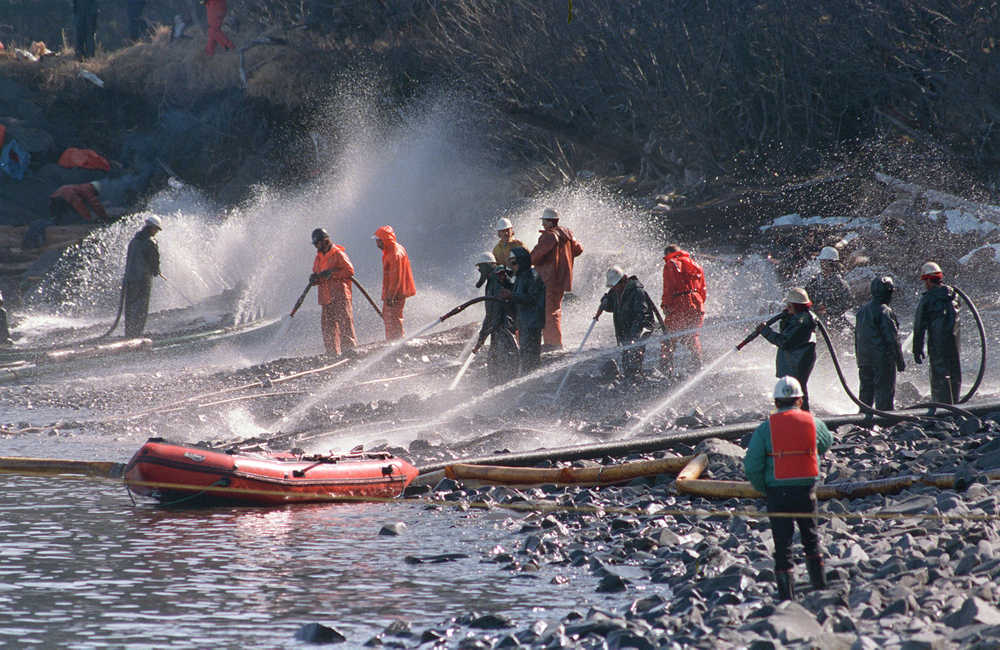
In this April 21, 1989 file photo, crews use high pressured hoses to blast the rocks on this beach front on Naked Island, Alaska. This is one of only two beaches that are being worked on, of the 58 beaches in the Prince William Sound.  On March 24, the crude oil tanker Exxon Valdez grounded on a reef and spilled nearly 11 million gallons of oil in the waters. Nearly 25 years after the Exxon Valdez oil spill off the coast of Alaska, some damage heals, some effects linger in Prince William Sound.  (AP Photo/Rob Stapleton, File)

In this April 21, 1989 file photo, crews use high pressured hoses to blast the rocks on this beach front on Naked Island, Alaska. This is one of only two beaches that are being worked on, of the 58 beaches in the Prince William Sound. On March 24, the crude oil tanker Exxon Valdez grounded on a reef and spilled nearly 11 million gallons of oil in the waters. Nearly 25 years after the Exxon Valdez oil spill off the coast of Alaska, some damage heals, some effects linger in Prince William Sound. (AP Photo/Rob Stapleton, File)

25 years later, Exxon Valdez spill effects linger

  • By Dan Joling
  • Sunday, March 23, 2014 10:41pm
  • News

ANCHORAGE — Before the Deepwater Horizon oil spill in 2010 in the Gulf of Mexico, there was the Exxon Valdez disaster in Alaska, at the time the nation’s largest oil spill.

The 987-foot tanker, carrying 53 million gallons of crude, struck Bligh Reef at 12:04 a.m. on March 24, 1989. Within hours, it unleashed an estimated 10.8 million gallons of thick, toxic crude oil into the water. Storms and currents then smeared it over 1,300 miles of shoreline.

For a generation of people around the world, the spill was seared into their memories by images of fouled coastline in Prince William Sound, of sea otters, herring and birds soaked in oil, of workers painstakingly washing crude off the rugged beaches.

Twenty five years later, most of the species have recovered, said Robert Spies, a chief science adviser to governments on the oil spill restoration program from 1989 to 2002. But some wildlife, as well as the people who live in the region, are still struggling.

Here’s a look at what’s changed since the spill:

“The bottom fell out of the price of fish,” he said. Pink salmon that sold for 80 cents per pound fell to 8 cents per pound. Consumers turned to farm fish or tuna out of fear of tainted salmon. His boat caught 2.5 million pound of pinks one season and lost money.

Culbertson turned to other fisheries, traveling as far as California. Fishing 12 months a year, his marriage failed. Friends couldn’t repay loans and lost boats or homes. Exxon compensation checks, minus what fishermen earned on spill work, arrived too late for many.

The fisheries today are not the same. “The shrimp are slowly, slowly coming back. The crab aren’t back. The herring aren’t back. The salmon are back in abundance,” he said.

At the time of the spill, complacency among government officials and the oil industry had set in after a dozen years of safe shipments, said Mark Swanson, director of the Prince William Sound Regional Cizens Advisory Council and a former Coast Guard officer.

When the tanker ran aground, for instance, spill response equipment was buried under snow. Alyeska Pipeline Service Co. in 1989 had 13 oil skimmers, five miles of boom and storage capacity for 220,000 gallons of spilled oil.

Now, Alyeska has 108 skimmers, 49 miles of boom and on-water storage capacity of almost 38 million gallons. North Slope oil must be transported in double-hull tankers, which must be escorted by two tugs. Radar monitors the vessel’s position as well as that of icebergs.

The company conducts two major spill drills are conducted each year. And nearly 400 local fishing boat owners are trained to deploy and maintain boom.

After the spill, the population of herring crashed. It is now listed as “not recovering.” The silvery fish is a key species because it is eaten by salmon, seabirds and marine mammals from otters to whales. Four years after the spill, the estimated herring population based on modeling shrunk from 120 metric tons to less than 30 metric tons.

How that happened remains a question, said Scott Pegau, research program manager for the Oil Spill Recovery Institute in Cordova, Alaska.

Here’s what’s known: Adult herring feed on zooplankton, which crashed for three years after the spill. With less to eat, herring may have been more susceptible to disease normally fended off within a herring population.

Herring populations can stabilize at a low or high number, but something has prevented a rebound. Oil likely is no longer a factor, Pegau said.

Responders estimated that as many as 3,000 sea otters died the first year. Hundreds more died in the years after of exposure to oil that persisted in sediment, where otters dig for clams.

Three factors could have had an impact on the otters’ ability to survive. Oiled fur loses insulating value. Otters ingest oil as they groom, and researchers years after the spill found blood chemistry evidence consistent with liver damage. Grooming takes time away from feeding.

“One of the lessons we can take from this is that the chronic effects of oil in the environment can persist for decades,” said Brenda Ballachey, who moved to Alaska a few months after the spill and spent the next summer dissecting sea otter carcasses collected from beaches and frozen.

The U.S. Geological Survey research biologist is the lead author of a federal study released last month that concludes that sea otters have finally returned to pre-spill numbers.


More in News

David Ross is sworn in as Kenai Police Chief on Tuesday, May 31, 2016 at Kenai City Hall. The Alaska Association of Chiefs of Police named Ross the 2025 Police Chief of the Year, recognizing over two decades of service. Photo by Megan Pacer/Peninsula Clarion
Kenai police chief named 2025 Police Chief of the Year

The Alaska Association of Chiefs of Police recognized David Ross for his more than two decades of leadership.

The cast of Nikiski Middle School’s upcoming performance of “Alice in Wonderland” is pictured on Dec. 2, 2025. The upperclassmen-directed play opens on Friday, with additional showtimes Saturday and next weekend. Photo courtesy of Carla Jenness
Nikiski Middle School debuts student-led “Alice in Wonderland”

The show opens on Friday, with additional showtimes this weekend and next.

On Tuesday, the Kenaitze Indian Tribe unveiled Kahtnu Area Transit, a public transportation service open to the entire Peninsula Borough community. Photo courtesy of Kahtnu Area Transit
Kenaitze Indian Tribe unveils Kahtnu Area Transit

The fixed bus route offers 13 stops between Nikiski and Sterling.

The Kenai Chamber of Commerce and Visitor Center hosts the annual Christmas Comes to Kenai on Nov. 28<ins>, 2025</ins>. The beloved event began over 40 years ago, and this year over 1,000 attendees enjoyed hot chocolate, fireworks, pictures with Santa and shopping. Photo courtesy of the Kenai Chamber of Commerce
 Photo courtesy of the Kenai Chamber of Commerce
The Kenai Chamber of Commerce and Visitor Center hosted the annual Christmas Comes to Kenai on Nov. 28. The beloved event began over 40 years ago, and this year over 1,000 attendees enjoyed hot chocolate, fireworks, pictures with Santa and shopping.
Kicking off a month of holiday festivities

Last weekend’s holiday events, including the annual Christmas Comes to Kenai and the Soldotna Turkey Trot, drew folks from all over the Kenai Peninsula.

Starting Dec. 2, Aleutian Airways will offer roundtrip flights between Anchorage and Unalakleet every Tuesday, Friday and Sunday.
Aleutian Airways to offer roundtrip flights between Anchorage and Unalakleet

Starting Dec. 2, Aleutian Airways will offer three roundtrip flights per week.

The Trump administration’s “Big Beautiful Bill” act requires the Bureau of Ocean Energy management to hold at least six offshore oil and gas lease sales in Alaska between 2026-2028 and 2030-2032. The first of these sales — known as “Big Beautiful Cook Inlet 1,” or BBC1— is scheduled for March 2026. Photo courtesy of the Bureau of Ocean Energy Management
Cook Inletkeeper launches petition against federal government

The organization is calling for transparency in Cook Inlet offshore oil and gas sales.

Winter dining has always carried more weight than the menu might suggest. In the off-season, eating out isn’t just about comfort food or convenience; it’s a way of supporting local businesses as they hold steady through the slower months. Photo credit: Canva.
The ripple effect: How local spending builds stronger communities on the Kenai Peninsula

From cozy cafés to fine-dining bistros, purchases made close to home sustain local jobs and services

Courtesy Harvest
On the Kenai Peninsula, a dormant liquefied natural gas export plant could be repurposed to receive cargoes of imported LNG under a plan being studied by Harvest, an affiliate of oil and gas company Hilcorp. The fuel would be transferred from ships to the tanks on the left, still in liquid form, before being converted back into gas and sent into a pipeline.
Utilities say Alaska needs an LNG import terminal. Consumers could end up paying for two.

Planning for two separate projects is currently moving ahead.

A map shows the locations of the 21 Alaska federal offshore oil and gas lease sales proposed by the Trump administration. (Map provided by the U.S. Bureau of Ocean Energy Management)
Trump administration proposes offshore leasing in almost all Alaska waters

A new five-year offshore oil and gas leasing plan proposes 21 sales in Alaska, from the Gulf of Alaska to the High Arctic, and 13 more off the U.S. West Coast and in the Gulf of Mexico.

Most Read