Kenai considers therapy horse in city
Published 6:01 am Friday, December 11, 2015
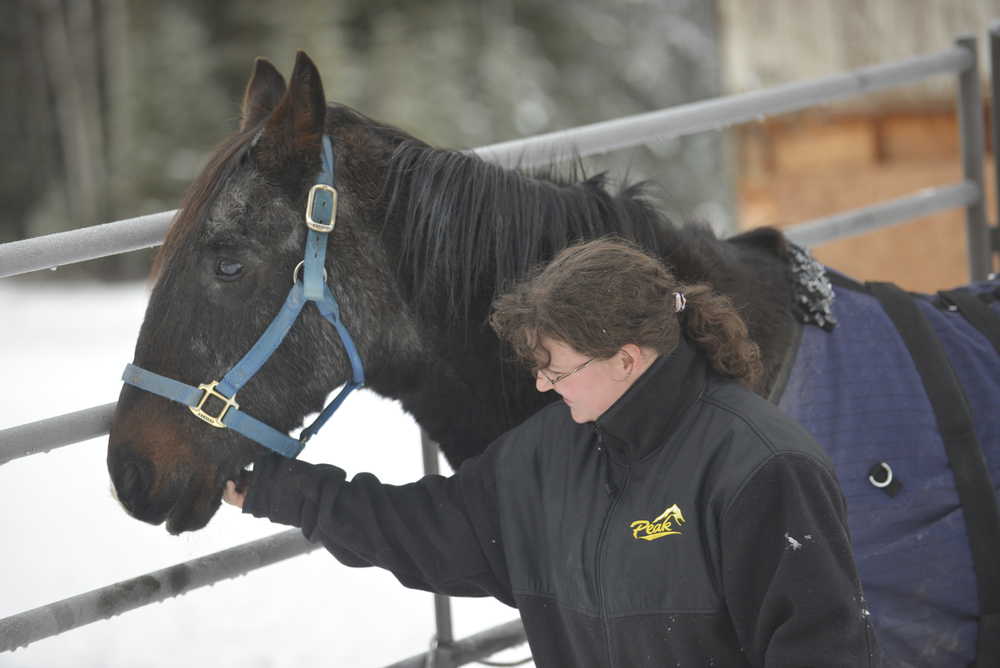



On Tuesday Kenai city council members heard the case for allowing a horse on a Kenai lot in exception to zoning code for an autistic woman who uses the animal for emotional support.
The horse, Major, is owned by Kenai resident Kim Garretson, who keeps him in the 10,000 square foot yard of the home she shares with Cristal Barton, her autistic daughter who cares for the horse. Kenai city code prohibits livestock on land less than 40,000 square feet, and the Kenai Planning and Zoning Commission denied Garretson the permit needed for exemption from that rule. Garretson attempted to overturn that denial in the Tuesday appeal hearing.
Garretson’s representative, staff attorney Anne Applegate of the nonprofit law firm Disability Law Center of Alaska, argued that Major should be permitted on the property under the federal Fair Housing Act. The council heard Applegate’s case while acting as a Board of Adjustment — a group with the power to modify, reverse, or affirm an earlier city decision, or to force the original deciding body to reconsider.
In this case, two council members will not be debating or voting as board members: council member Terry Bookey was absent from the hearing and Kenai mayor Pat Porter asked to be excused because of a conflict of interest.
According to Kenai Department of Animal Control investigation reports, Porter made the initial complaints about the horse on Garretson’s land — the first on April 5, 2015 of an unsheltered horse tied to a tree, and the second a week later, when the horse remained on the property. Porter said she had made the complaint on behalf of neighborhood residents who had complained to her.
“They (the residents) called me wanting to know what to do about it, and I basically said … I’ll look, because I’m familiar with planning and zoning and codes,” Porter said. “I drove over and saw the horse they were talking about. I then called the animal control officer and turned it totally over to them. I had nothing more to do at that point with the issue.”
According to the animal control report, Porter asked to be notified when Garretson’s permitting process for the horse began. At the hearing, she said she was not involved with the administration of the issue.
“I personally feel that I could sit on this board, but it’s up to you to make that determination,” Porter said to the other board members.
After they voted to excuse Porter from the hearing, Kenai vice mayor Brian Gabriel took over as chair. Applegate asked the board to declare another conflict of interest — this one within the Planning & Zoning Commission that initially denied Garretson’s permit.
Commissioner Robert Springer is the husband and business partner of realtor Darla Springer, who in an Oct. 14 letter to Kenai City Planner Matt Kelley wrote that she believed a horse would decrease the value of nearby properties, stating that “we can have difficulty selling homes that have horses next door even if they are on larger lots, due to odors and the unsightly yards, not to mention the lack of sanitary conditions.”
Robert Springer did not disclose his relationship to Darla Springer in the commission hearings.
Kenai city attorney Scott Bloom argued that Springer’s interests weren’t conflicted, saying that possible connections between Springer’s vote and his business were “speculative,” since Springer Real Estate has no properties for sale in Garretson’s subdivision and only two properties for sale in Kenai.
After the board discussed the conflict of interest possibility in an executive session, Applegate withdrew her claim of Springer’s conflicted interest. In a later email, she wrote that she withdrew the claim because she “realized that I wanted the Board of Adjustment to hear the testimony and apply the Fair Housing Act elements.”
“The members (of the board) were clearly interested in understanding the issue, and their questions reflected careful thought,” Applegate wrote. “I realized that the Board was better prepared to look at the larger picture of the Fair Housing Act claim, to apply the established rules of law that define reasonable accommodations to a new set of facts. … It takes careful thought to look past complaints about aesthetics and apply the existing rules of law to this set of facts.”
In testimony, Applegate attempted to demonstrate that having Major on the 10,000 square foot lot where Garretson and Barton live allowed Barton to live on the property as a non-disabled person would, and that having the horse elsewhere — such as Garretson’s nearby 1.25 acre property, where the horse could live without being permitted — would not.
While being questioned by Applegate, Garretson said Barton’s emotions “escalated” into nonverbal states of anger, during which she could not make proper decisions, an occurrence that happened both day and night. Barton controls her escalations by visits to Major, Garretson said — which she had done about five times a day in the past week. Were Major in the nearby lot, Garretson said Cristal could not reach him safely during these episodes.
“When she’s that upset she can’t see cars coming,” Garretson said. “She can’t see the ground she’s walking on. It could be slick.”
The board is meant to make a fresh decision of whether Major should be permitted on Garretson’s property.
Representing Kenai’s administration, city attorney Scott Bloom presented the administrative finding: that permitting Major on Garretson’s property would not be detrimental to the horse or the neighborhood.
“I want to emphasize that while the city planner’s recommendation is that the permit be granted, we’re not asserting that the planning and zoning commission made a bad decision or a wrong decision,” Bloom said in his closing argument.
One of Bloom’s witnesses, Kenai Animal Control Officer Jessica Hendrickson, said that after consulting with veterinarian Dr. Jerry Nybakken, she believed “Major, being of his age and size, could be cared for on this property. He wouldn’t need the amount of room for grazing that a horse of a younger age would need.”
Asked by Applegate, city planner Kelley said there were two or three other horses in Garretson’s subdivision, which were kept on properties over 40,000 square feet and thus did not need permits.
Asked by board member Bob Molloy, Garretson said she had known about the permit requirement before bringing Major to Kenai.
The hearing concluded with the board members deliberating in an executive session.
They will hold further discussions in closed meetings before issuing their decision by Jan. 7.
Reach Ben Boettger at ben.boettger@cmg-northwest2.go-vip.net/peninsulaclarion.