Refuge notebook: The difference between predicting climate change and its ecological outcomes
Published 9:30 pm Wednesday, August 7, 2019
The University of Alaska Fairbanks has a great online climate forecasting tool. Simply type in a town, the future decade(s), an emission scenario and voila — you get a forecast of what the future climate may look like.
I used this tool to assess the climate in Homer, the nearest town to where I conduct my graduate research in deforested areas of the Caribou Hills. June 2010 to 2019 had 0.3 inches less rain and was 3.5 degrees warmer on average than historical records. These differences might seem modest, but collectively they correspond to some truly dramatic ecological transformation.
Ecological responses to shifts in climate are real, happening now and they are downright complicated.
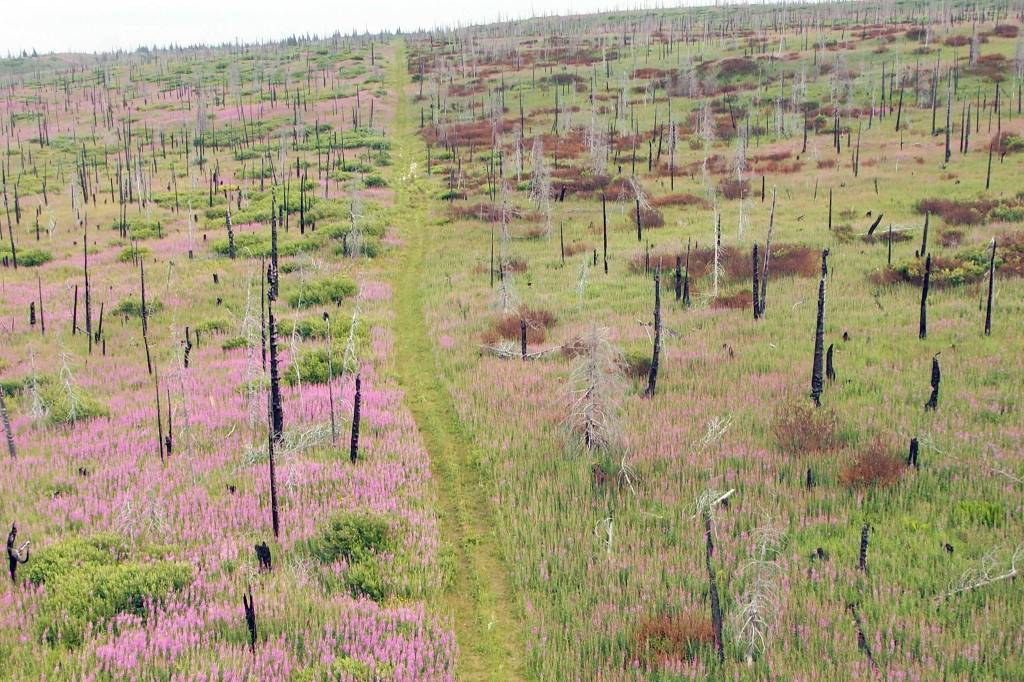
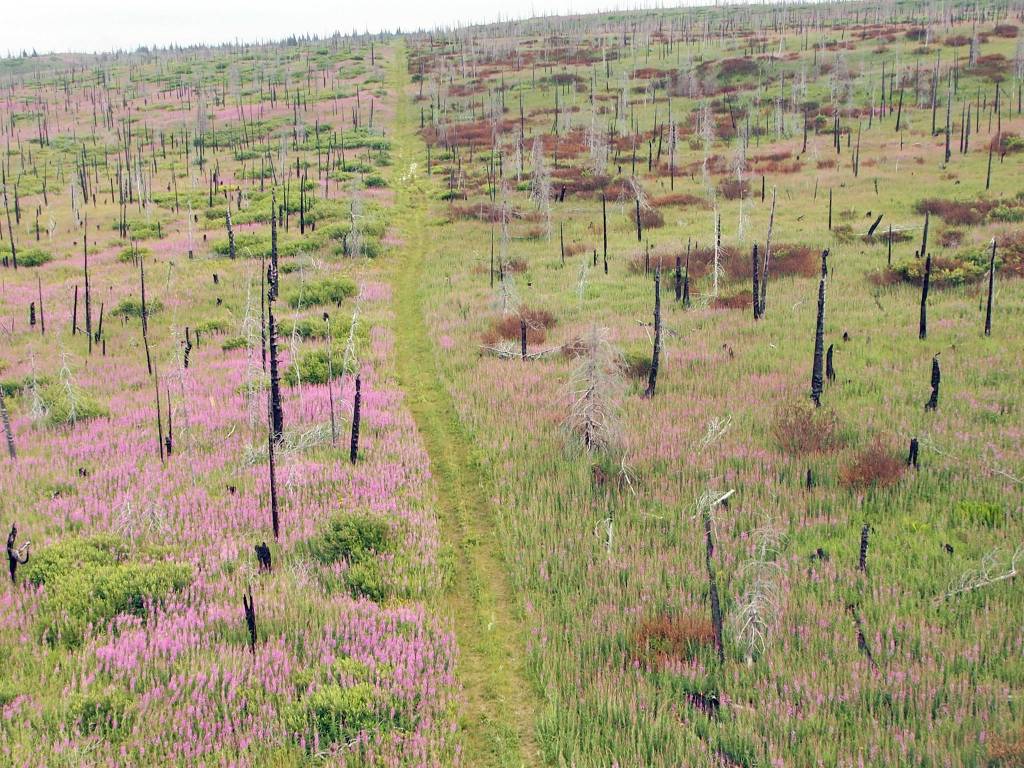
The Caribou Hills grassland is so big I can’t see the end of it!
In just 15 years, this landscape changed from a mature Lutz spruce forest to a bluejoint grassland littered with burned stumps. This deforestation was caused by a massive spruce bark beetle outbreak in the 1990s that coincided with warming and drying, followed by the human-caused Caribou Hills Fire that burned this developing grassland in spring 2007.
In early June of this year, an unprecedented lightning-caused fire in this grassland was extinguished by firefighters. We believe this novel grassland system, which is experiencing fire return intervals of less than 10 years, is crossing an ecological threshold in which the current grasslands will not only persist but may expand in coming years.
Herein lies the difference between forecasting the physical aspects of climate change, and predicting ecological effects that are the outcome of a changing climate.
In the case of the former, much of the uncertainty is in estimating the emissions of greenhouse gases, which are strongly influenced by how successful the global community will be in reducing those emissions. Additionally, there are uncertainties introduced by poor modeling of positive feedback mechanisms in climate change, such as how much and how soon methane will be released from thawing permafrost.
In contrast, while direct ecological responses to a warming climate can be reasonably predicted, the indirect and frequently cascading effects of novel ecological trajectories have great uncertainty.
Their complexity runs up against the limits of what is scientifically knowable. For example, we can predict with great certainty that spruce bark beetles and wildfire will be more prevalent in a warming and drying climate, but it is much harder to understand how these two disturbances interact to affect vegetation and the habitats they create.
Why is that? First, we don’t even have a complete inventory of species which occur on the Kenai Peninsula. We aren’t sure how each species got here, or exactly how they interact with other species. We don’t know their fundamental niches and how that may change when competition is removed or their climate envelope changes.
Second, we aren’t quite sure how putting directional pressure (from a warming climate) on an entire ecosystem influences these relationships.
Third, and most unknowable, we don’t know how a changing ecosystem will function with a new climate, new disturbance regimes and a novel mix of species.
To remove some of this ecological uncertainty, we are trying to determine which species occur in these new grasslands in the Caribou Hills. After all, you have to have a starting point.
We use Next Generation Sequencing (genetic) techniques to determine arthropod species that occur above and below ground, as well as the soil fungi – the little things that run the world.
Is biodiversity in this grassland depauperate? Does it lack species necessary to function and perpetuate diversity? How do these species fit together? Could it serve as a refugia for species being diminished in other areas? What species are primed to colonize this area, from folks deliberately or accidentally bringing them to the peninsula?
We can also quantify the number and size of tree seedlings by species to predict how frequent the fire return interval would have to be to kill them and eventually exhaust the seed bank. We can measure the size of the grassland and see if it changes with the next fire, and we can determine how, where and when fires are ignited.
We can also read the story of the woods using dendrochronological techniques. Where fire and spruce bark beetles are not imposing their sometimes draconian culling of forests, we can assess if native trees are stressed, regardless, using tree ring data.
By applying data from around the peninsula to models that account for age-related and stand-related growth, we can deduce if some of our species are on their way out in parts of the western peninsula that are warming and drying at different rates.
Lastly, we can use climate envelope modeling to predict which species might do quite well here, and also use core nonnative trees planted here, like larch and lodgepole pine, to assess which species are likely to be successful here.
All of this gets at the uncertainty of how our boreal system is responding to a rapidly warming climate here on the peninsula. When we know this, perhaps we can steward the ecological outcomes toward a more benign and productive future.
Just so you know, Homer is predicted to be a whopping 11.5 degrees warmer with 0.2 inches less precipitation by the end of this century.
Tracy Melvin is a doctoral student at Michigan State University who is conducting her research at Kenai National Wildlife Refuge. Find more Refuge Notebook articles (1999–present) at https://www.fws.gov/refuge/Kenai/community/refuge_notebook.html.