Trump and Putin put on a show of friendship but come away without a deal
Published 10:30 pm Thursday, August 14, 2025
ANCHORAGE — President Donald Trump and Russian President Vladimir Putin reached no agreement to end the war in Ukraine at a high-profile summit meeting Friday, although they reported making unspecified progress during a strikingly convivial reunion on U.S. soil.
Trump had hoped to seal a deal for an immediate ceasefire, but he acknowledged that the two leaders fell short, at least for now. “We haven’t quite got there, but we’ve made some headway,” he told reporters after hours of meetings on a U.S. military base in Alaska. “There’s no deal until there’s a deal.”
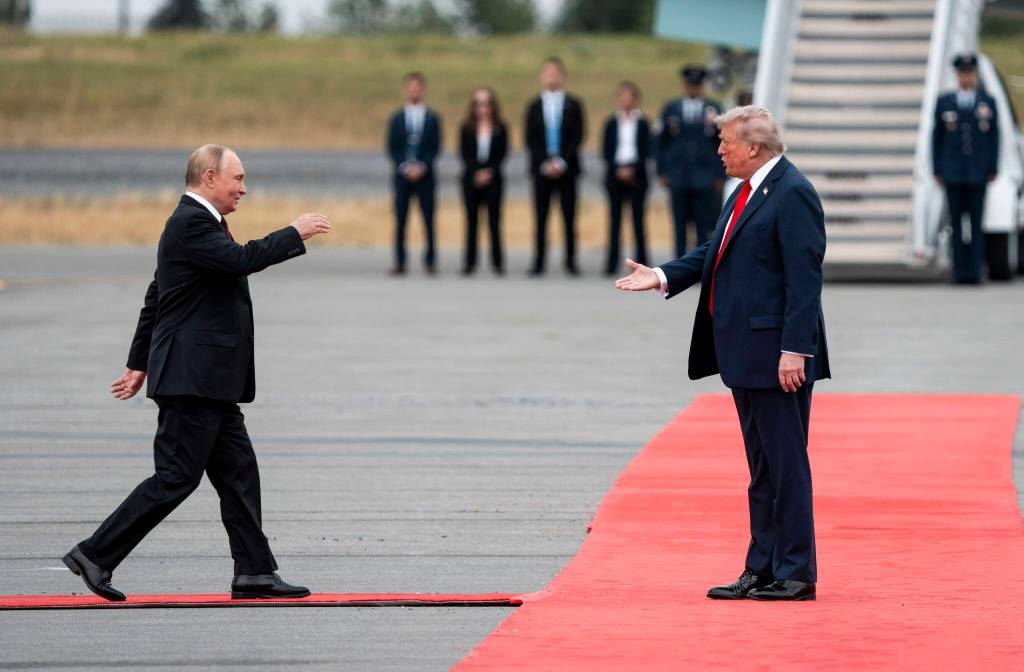
But if the substance remained unsettled, the atmospherics were extraordinary. The president rolled out a literal red carpet and even applauded as he welcomed Putin, who is under U.S. sanctions and faces an international arrest warrant for war crimes. The two laughed and spoke warmly with each other, and Trump even invited Putin to ride with him in the armored presidential limousine to their meeting.
At their subsequent joint appearance at side-by-side lecterns at Joint Base Elmendorf-Richardson, they heaped praise on one another. “We really made some great progress today,” Trump said. “I’ve always had a fantastic relationship with President Putin, with Vladimir.”
Putin referred to Trump as a “dear neighbor” with whom he can do business. “President Trump and I have established a very good, businesslike and trustworthy contact,” he said in Russian.
Putin even suggested that Trump visit him in the Russian capital. “Next time in Moscow,” he said, breaking into English.
“Ooh, that’s an interesting one,” Trump replied. “I don’t know. I’ll get a little heat on that one, but I could see it possibly happening.”
The two ended their encounter in Alaska, however, in a cloud of uncertainty. Trump referred obliquely to “agreement” on some undisclosed points but not on others, while Putin said even more elliptically that they reached an “understanding.” Neither explained nor took questions from reporters. Trump said he would follow up by calling fellow NATO leaders and Ukrainian President Volodymyr Zelenskyy.
The meeting was a major diplomatic gamble by Trump unlike anything his predecessors might have tried and seen as a victory for Putin, who has not been welcome in the West for years and now has been effectively liberated from the diplomatic isolation he had been consigned to for the past three years.
In fact, it would be hard to imagine an event that could have gone better from the point of view of the Russian leader, who made no public commitment to stop his assault on Ukraine and yet was treated as a valued friend. Trump did not fault Putin for starting the brutal war and left without mentioning the sanctions that just hours earlier he had threatened to impose if there were no deal.
The images emerging from the Alaska encounter were remarkable in the history of U.S.-Russian summits. Putin, who has not been to the United States outside of U.N. meetings since 2007 and has been under sanctions since 2022, was invited to a military base that is on the front line of the defense of U.S. territory against possible Russian aggression.
Flying overhead as Putin arrived was a B-2 stealth bomber that is key to the U.S. nuclear deterrent, flanked by the kind of fighter jets that are often deployed to intercept Russian planes in the airspace near Alaska.
Standing on the tarmac waiting, Trump clapped for Putin as the Russian strode toward him then gave him a warm handshake, patting his arm and hand. Putin smiled broadly and talked jovially with Trump like old friends. When a reporter asked Putin if he would stop killing civilians, he smirked and pointed to his ear as if to suggest he could not hear the question.
Trump’s invitation to Putin to join him in the armored presidential limousine for the ride to their meeting location without aides was a highly unusual gesture. Putin could be seen through the window laughing as the car pulled away.
Democrats contended that hosting Putin under such circumstances sent a dangerous message. “The photo-op in and of itself essentially legitimizes war crimes, telegraphs to other autocrats or evil men around the world that they can get away with murdering civilians and still get a photo-op with the president of the United States,” Sen. Chris Murphy, D-Conn., said earlier Friday on MSNBC’s “Morning Joe.”
The hurriedly arranged meeting was meant to break the logjam that has stymied Trump’s peacemaking efforts since he returned to office more than six months ago with a promise to end the Ukraine war within 24 hours. The rest of the world watched to see whether Trump would find common ground with Putin and whether Ukraine’s interests would be represented or sacrificed by the leaders of the two major nuclear superpowers.
Trump told reporters on Air Force One on the way to Alaska that he hoped to broker at least a temporary end to hostilities. “I want to see a ceasefire rapidly,” he said. “I don’t know if it’s going to be today. But I’m not going to be happy if it’s not today.”
He repeated his warning that he would impose “severe consequences” if Russia balked at a halt to the fighting without specifying what they might be. And he promised to involve Ukraine in any decision over territorial concessions that might accompany a more enduring peace settlement.
Zelenskyy, who was not invited to the conference called to determine his country’s future, sought to influence it from afar by reminding the world that Russia continues to attack civilian targets in hopes of stiffening Trump’s spine against Russian spin.
“On the day of negotiations, the Russians are killing as well,” Zelenskyy said in a video posted online before the meeting began. “And that speaks volumes.” He added: “Ukraine is ready to work as productively as possible to bring the war to an end, and we count on a strong position from America. Everything will depend on this — the Russians factor in American strength. Make no mistake — strength.”
The meeting was the seventh in-person encounter between Trump and Putin and the first of the American’s second term. Trump said in the days before the Alaska get-together that it was meant to be a listening session to determine whether peace was possible and that if he decided it was, he would then invite Zelenskyy to sit down with Putin directly.
No mention of that was made following Friday’s session.
While it was originally scheduled to be a one-on-one meeting with Putin, along with interpreters, the session was expanded at the last minute to include Secretary of State Marco Rubio and Steve Witkoff, the president’s special envoy, who has been negotiating with the Russians.
Putin was joined by Sergey Lavrov, his often combative foreign minister, who sent a pointed message when he arrived in Alaska the previous night wearing a sweatshirt emblazoned with CCCP, the Cyrillic letters for USSR.
The two leaders, however, spent less time together than originally scheduled, raising questions about how far they got, and they scrapped plans to hold a news conference in favor of the two making back-to-back statements on camera without answering questions. Neither did much to illuminate what happened behind closed doors, and U.S. officials did not brief reporters, as is traditionally done after such meetings.
In a rare move for the host of a diplomatic meeting, Trump deferred to his Russian visitor to speak first at their public appearance. Putin played to his host’s sensibilities by offering validation of his long-standing insistence that Moscow would not have staged its full-scale invasion of Ukraine in 2022 if Trump had still been president.
“Today we hear President Trump say, ‘If I were president, there would be no war,’” Putin said. “I think that would actually happen. I confirm this.”
He suggested that the two would now succeed at ending that war without saying how. “I would like to hope that the understanding we have reached will allow us to get closer to that goal,” Putin said of security for Ukraine, “and open the way to peace in Ukraine.”
But he still insisted that any enduring resolution had to address the “root causes” of the war, a phrase that in the past he has used to insist on conditions unacceptable to the West, including a rollback of NATO and neutralization of Ukraine. And he asserted that Ukraine might throw a wrench in any peace effort “through provocations or behind-the-scenes intrigues.”
When it came to his turn, Trump was equally vague on what if anything they had concurred. “We had an extremely productive meeting and many points were agreed to, and there are just a very few that are left,” he said. “We didn’t get there, but we have a very good chance of getting there.”
The flattery by the former KGB officer certainly registered. In an interview with Sean Hannity of Fox News afterward, Trump volunteered that he was “very happy” to hear Putin say the invasion would not have happened on his watch. More broadly, he expressed satisfaction with the discussion, declaring that on a scale of 1 to 10, “the meeting was a 10 in the sense that we got along great.”
He also shifted the burden for ending the war away from the Russian leader who started it, asserting that Putin “wants to solve the problem” and that “now it is really up to President Zelenskyy to get it done.”
Trump, who has long expressed admiration for Putin, returned to the White House in January expecting to translate their friendly relationship into tangible progress. But after his repeated promise during last year’s campaign to end the Ukraine war within 24 hours, Trump discovered what others had long tried to convince him of: Putin was not eager to make peace, at least not on terms acceptable to Ukraine.
Putin brought with him a number of business executives in hopes of appealing to Trump’s desire to rekindle economic ties that were all but shattered by the 2022 full-scale invasion. On the plane ride to Alaska, Trump said that the Ukraine conflict would have to be resolved first. “They are not doing business until we get the war settled,” he said.
Trump said that he expected that territorial concessions would be part of a more sustained peace agreement that would follow a temporary ceasefire but acknowledged that Ukraine would have to agree.
“I’ve got to let Ukraine make that decision,” he said. “I think they’ll make a proper decision, but I’m not here to negotiate for Ukraine.”
He also said that “there’s a possibility” of security assurances for Ukraine from the United States in conjunction with Europe as part of such an eventual peace deal, but “not in the form of NATO” membership, which has been a key point of dispute between Moscow and Kyiv, Ukraine’s capital.
Russia’s leader was not the only autocrat Trump freed from diplomatic isolation on Friday. As he made his way to Alaska, the president called President Alexander Lukashenko of Belarus, one of the longest-ruling dictators in the world and a figure long shunned by U.S. and European leaders.
Writing on social media, Trump said that he “had a wonderful talk with the highly respected President of Belarus, Aleksandr Lukashenko,” to thank him for the release of 16 prisoners, who were pardoned last month for crimes including “extremism.” Trump added that they were discussing the release of another 1,300 prisoners.
The government of Belarus later reported that Lukashenko invited Trump to visit and that the invitation was accepted. The White House did not immediately confirm that, but Trump wrote on social media that “I look forward to meeting President Lukashenko in the future.”
While President Barack Obama posed for a courtesy picture with Lukashenko during a U.N. meeting in 2015, U.S. leaders have kept their distance from him during his 31-year reign. Trump, though, has shown more willingness to engage. During his first term, he sent Mike Pompeo, then his secretary of state, and John Bolton, then his national security adviser, to meet with Lukashenko in Belarus.
This article originally appeared in The New York Times.