Fish and Game rescinds Cook Inlet season summary to correct ‘nomenclature’
Published 6:10 am Thursday, October 16, 2014
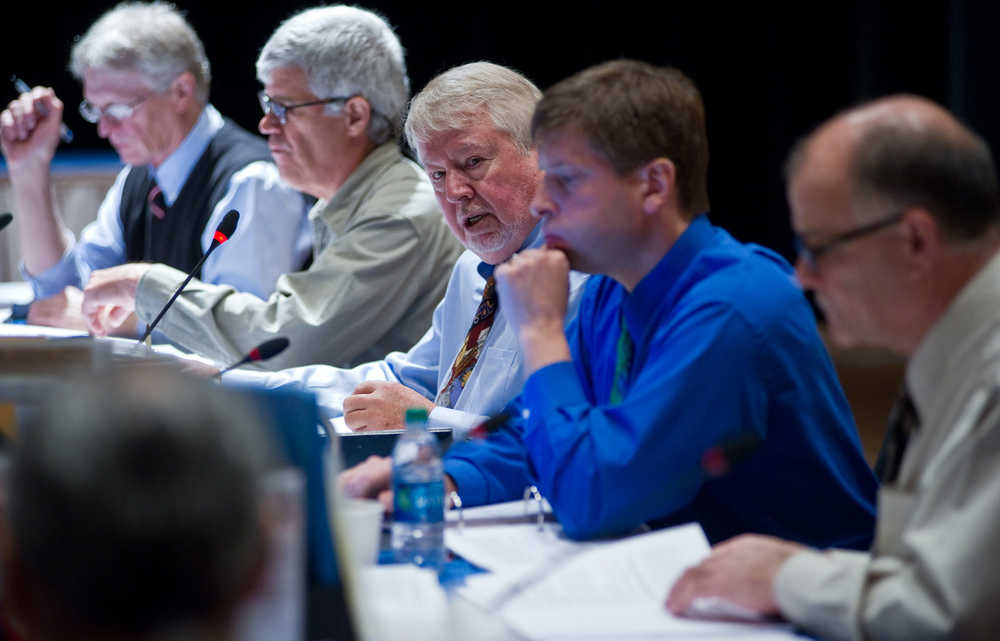
No matter how far they travel, members of the Alaska Board of Fisheries cannot seem to stop talking about Cook Inlet salmon.
A work session that began Wednesday in Juneau started with one member asking the Alaska Department of Fish and Game to amend its commercial salmon season summary in Upper Cook Inlet due to issues with “nomenclature.”
At issue is a portion of the summary that lists the number of sockeye estimated to have passed into their spawning beds on several rivers, lakes and creeks in the Cook Inlet.
Staff at Fish and Game were asked to change a table in the summary to add a sockeye salmon escapement goal range — one that the current end-of-season fish passage estimate on the Kenai River comes much closer to meeting.
The summary, which was issued Oct. 10 by Soldotna-area commercial management biologist Pat Shields and assistant area management biologist Aaron Dupuis, contained a table that showed a final sockeye passage of 1.52 million sockeye up the Kenai River. The passage estimate is well in excess of the top end of the sustainable escapement goal of 700,000 to 1.2 million sockeye salmon.
It’s a table that is published each year, containing the same data — but this year, something changed. Board of Fisheries members wanted Fish and Game staff to include data showing that while the inriver goal had been exceeded by nearly 300,000 fish, final fish escapement data would likely show that fish passage did not exceed the other two escapement goals for those sockeye salmon.
Once sockeye salmon make it past the drift boat gillnets and setnets in Cook Inlet, the dipnets at the mouth of the river, the hooks and lines from anglers along the banks and pass river mile 19, they are counted in an in-season passage number. Fish and Game staff will then subtract the estimated angler harvest to get a final escapement number.
Based on current fish passage information in the postseason summary, the number of sockeye that passed the sonar exceeds all three goals on the Kenai River: the sustainable escapement goal, the optimum escapement goal, and the in-river goal.
But, that will likely change by next year.
“I can tell you, almost for sure, that we didn’t exceed the (optimum escapement goal),” Shields said.
The goals
Fish and Game managers must try to get enough sockeye into the Kenai River to meet three different escapement goal ranges.
“That’s why the Kenai River is so confusing, even for staff,” Shields said. “You have a (sustainable escapement goal), an in-river goal and an (optimum escapement goal) on the same stock, on the same river.”
Escapement is the number of salmon that reach the river and spawn.
Optimum escapement goals are set by the Board of Fisheries and factor in harvests for commercial, sport, subsistence, aquaculture and personal-use fishermen. The optimum escapement goal set for Kenai River sockeye salmon is 700,000 to 1.4 million fish.
Sustainable escapement goals are set by the Department of Fish and Game and are based on historical performance of the fish stock and biological information about the fishery. The idea is to achieve the highest possible number of fish returning to the river off of each fish that makes it up the river and spawns.
Managers want to avoid overescapement, or too many spawners, which can lead to fewer returning fish and smaller harvests for fishermen in the future.
The sustainable escapement goal range for Kenai River sockeye is 700,000 to 1.2 million fish.
The level of salmon abundance forecasted in 2014 had commercial managers aiming for an in-river goal on 1 million to 1.2 million sockeye.
Managers aim for that goal because trying to reach the other two goals for sockeye on the Kenai River would require knowing the number of fish caught by sportfishermen — a figure that won’t be calculated until nearly a year after the fishing season has ended.
The process takes that long because angler harvest estimates are not calculated until statewide harvest surveys are returned; typically the harvest survey numbers are released in the fall of the year following the fishing season.
The inriver goal was created, Shields said, to give commercial managers something to aim for when they manage commercial fisheries to allow sockeye into the river. The goal has hundreds of thousands of sockeye built into it to account for sportfishing harvest, he said.
This year, according to the season summary, managers overshot that goal by about 300,000 fish.
The final count
In 2013, sportfishermen harvested more than 300,000 sockeye above the sonar. Shields said the 2014 fishing season would likely see similar harvest numbers. When the final numbers are crunched, enough fish will likely have been harvested in the sport fishery that the final escapement will fall into the optimum escapement goal range, at least below the top end of 1.4 million.
But, it may not be enough to put the final escapement below the sustainable escapement goal range, which tops at 1.2 million fish.
“It is going to be close,” Shields said.
During the board works session Wednesday, chairman Karl Johnstone said board members and Fish and Game staff discussed the language in the season summary Tuesday and wanted to know what was going to be done to address it.
Fish and Game commercial fisheries division director Jeff Regnart told Johnstone that staff had pulled the summary from the website and would be adding a footnote and extra data to the table showing sockeye salmon passage estimates seven Cook Inlet rivers.
Shields said staff would add the optimum escapement goal range to the table.
When that range is added, the 2014 estimate of fish passage will show that the range could have been exceeded by as few as 125,000 fish rather than the 300,000 currently reflected by the table. In addition, a footnote will be added explaining that the final escapement of sockeye salmon will take more than a year to calculate, Shields said, in a post-meeting interview.
“I appreciate the correction,” Johnstone said.
Rashah McChesney can be reached at rashah.mcchesney@cmg-northwest2.go-vip.net/peninsulaclarion.