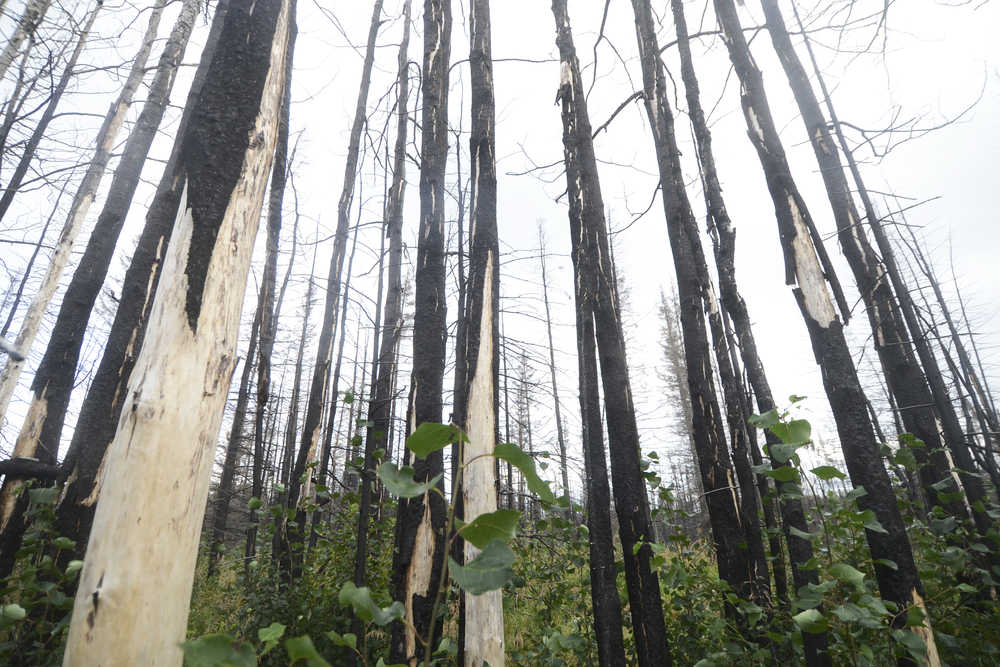
Grass and bushes grow up around the burnt trees left in the wake of the 2014 Funny River Fire, pictured Tuesday, Aug. 23, 2016 at the trailhead of the Funny River Horse Trail at Mile 7 of Funny River Road in Alaska. The lack of a large fire this season allowed area agencies to focus on preventative work, such as improving a fuel break in the Funny River area.

Grass and bushes grow up around the burnt trees left in the wake of the 2014 Funny River Fire, pictured Tuesday, Aug. 23, 2016 at the trailhead of the Funny River Horse Trail at Mile 7 of Funny River Road in Alaska. The lack of a large fire this season allowed area agencies to focus on preventative work, such as improving a fuel break in the Funny River area.

Cooling off period: Calm fire season lets agencies focus on prevention

Editor’s note: This story has been updated to reflect that the Division of Forestry, not including the Office of Emergency Management, sent personnel around the state and to the Lower 48 to help with other fires.


The Kenai Peninsula got a break this fire season with no major burns, but local agencies stayed busy with prevention and other fire suppression work.

The Funny River fire consumed six structures and nearly 200,000 acres in 2014, while last year’s Card Street burned across more than 8,800 acres and took 11 structures in its wake, according to the Alaska Interagency Coordination Center. Both were human caused.

This year’s fire season got off to an earlier and hotter start than usual, said Area Forester Hans Rinke at the Soldotna office of the Alaska Division of Forestry. While the peninsula escaped another large burn, there was plenty of opportunity for one throughout May and June, and for the beginning of July, he said.

“We had times where we could have had large fire growth,” Rinke said, referencing the lack of snowpack and high spring temperatures that fanned many fires around the state as early as April.

More typical weather patterns of alternating sun and rain took over later in the season, which Rinke said was a factor in the peninsula avoiding a large fire. Still, Division of Forestry firefighters were busy this season taking care of brush fires and other small burns that continually cropped up, he said, as well as addressing several “holdover” fires from Funny River and Card Street.

They were also sent out to fight fires across Alaska and in the Lower 48, Rinke said.

“Our staff is basically engaged … whether it’s a busy fire season or not in Alaska,” he said.

The same is true of U.S. Fish and Wildlife Service personnel who work for the Kenai National Wildlife Refuge. Nathan Perrine, a fire operations and fuels technician, said some staff members are currently down in California helping with fire suppression efforts.

The lack of a large burn on the peninsula, though, has let refuge staff focus on prevention this season, he said.

“It definitely let us concentrate on putting our fuel breaks in this year,” Perrine said.

Work to improve an existing fuel break in the Funny River area was done, and a start was made on a new fuel break in the Sterling area in the wake of Card Street, Perrine said.

The Kenai Peninsula Borough’s Office of Emergency Management also took advantage of the quieter fire season, said Director Scott Walden.

“It did relieve us of having to send a lot of our resources out in the field, that’s for sure,” he said of the break.

Walden’s office was able to focus this year on pushing prevention programs such as Firewise, which Walden said began several years ago and is being continued. “The community’s been great,” in terms of reception to the program, Walden said.

“We were able to take advantage of the uninterrupted time to conduct that training,” he said.

The lack of a major fire on the peninsula also provided some respite from the cost of containing one. While agencies like local fire departments, the Office of Emergency Management and the Division of Forestry are reimbursed for their fire suppression efforts through pre-established agreements, some of that burden falls on the state rather than the federal government depending on how much of the fires burn on federal versus private lands.

Last year’s Card Street fire cost just more than $6.7 million total, while the Funny River fire in 2014 cost nearly $11.5 million altogether, according to data from the Alaska Interagency Coordination Center.

As far as the actual refuge is concerned, Perrine said areas that have been burnt by the last two fires are not expected to burn again any time soon, so staff lets “mother nature do her thing” while the land rejuvenates. Time not spent actively fighting a wildfire is spent preparing for the next inevitable one, Perrine said.

“I think we’re ready to deal with anything that comes our way,” he said.


Reach Megan Pacer at megan.pacer@peninsulaclarion.com.

More in News

David Ross is sworn in as Kenai Police Chief on Tuesday, May 31, 2016 at Kenai City Hall. The Alaska Association of Chiefs of Police named Ross the 2025 Police Chief of the Year, recognizing over two decades of service. Photo by Megan Pacer/Peninsula Clarion
Kenai police chief named 2025 Police Chief of the Year

The Alaska Association of Chiefs of Police recognized David Ross for his more than two decades of leadership.

The cast of Nikiski Middle School’s upcoming performance of “Alice in Wonderland” is pictured on Dec. 2, 2025. The upperclassmen-directed play opens on Friday, with additional showtimes Saturday and next weekend. Photo courtesy of Carla Jenness
Nikiski Middle School debuts student-led “Alice in Wonderland”

The show opens on Friday, with additional showtimes this weekend and next.

On Tuesday, the Kenaitze Indian Tribe unveiled Kahtnu Area Transit, a public transportation service open to the entire Peninsula Borough community. Photo courtesy of Kahtnu Area Transit
Kenaitze Indian Tribe unveils Kahtnu Area Transit

The fixed bus route offers 13 stops between Nikiski and Sterling.

The Kenai Chamber of Commerce and Visitor Center hosts the annual Christmas Comes to Kenai on Nov. 28<ins>, 2025</ins>. The beloved event began over 40 years ago, and this year over 1,000 attendees enjoyed hot chocolate, fireworks, pictures with Santa and shopping. Photo courtesy of the Kenai Chamber of Commerce
 Photo courtesy of the Kenai Chamber of Commerce
The Kenai Chamber of Commerce and Visitor Center hosted the annual Christmas Comes to Kenai on Nov. 28. The beloved event began over 40 years ago, and this year over 1,000 attendees enjoyed hot chocolate, fireworks, pictures with Santa and shopping.
Kicking off a month of holiday festivities

Last weekend’s holiday events, including the annual Christmas Comes to Kenai and the Soldotna Turkey Trot, drew folks from all over the Kenai Peninsula.

Starting Dec. 2, Aleutian Airways will offer roundtrip flights between Anchorage and Unalakleet every Tuesday, Friday and Sunday.
Aleutian Airways to offer roundtrip flights between Anchorage and Unalakleet

Starting Dec. 2, Aleutian Airways will offer three roundtrip flights per week.

The Trump administration’s “Big Beautiful Bill” act requires the Bureau of Ocean Energy management to hold at least six offshore oil and gas lease sales in Alaska between 2026-2028 and 2030-2032. The first of these sales — known as “Big Beautiful Cook Inlet 1,” or BBC1— is scheduled for March 2026. Photo courtesy of the Bureau of Ocean Energy Management
Cook Inletkeeper launches petition against federal government

The organization is calling for transparency in Cook Inlet offshore oil and gas sales.

Winter dining has always carried more weight than the menu might suggest. In the off-season, eating out isn’t just about comfort food or convenience; it’s a way of supporting local businesses as they hold steady through the slower months. Photo credit: Canva.
The ripple effect: How local spending builds stronger communities on the Kenai Peninsula

From cozy cafés to fine-dining bistros, purchases made close to home sustain local jobs and services

Courtesy Harvest
On the Kenai Peninsula, a dormant liquefied natural gas export plant could be repurposed to receive cargoes of imported LNG under a plan being studied by Harvest, an affiliate of oil and gas company Hilcorp. The fuel would be transferred from ships to the tanks on the left, still in liquid form, before being converted back into gas and sent into a pipeline.
Utilities say Alaska needs an LNG import terminal. Consumers could end up paying for two.

Planning for two separate projects is currently moving ahead.

A map shows the locations of the 21 Alaska federal offshore oil and gas lease sales proposed by the Trump administration. (Map provided by the U.S. Bureau of Ocean Energy Management)
Trump administration proposes offshore leasing in almost all Alaska waters

A new five-year offshore oil and gas leasing plan proposes 21 sales in Alaska, from the Gulf of Alaska to the High Arctic, and 13 more off the U.S. West Coast and in the Gulf of Mexico.

Most Read