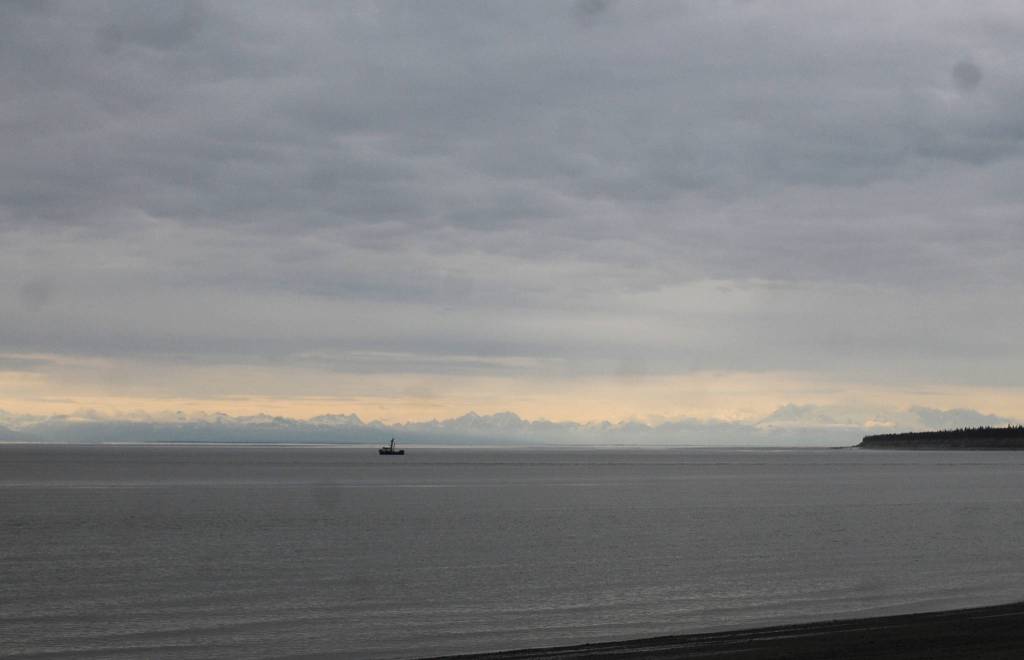
In this July 2016 photo, a drift gillnet fishing vessel floats in Cook Inlet just off the coast of the Kenai Peninsula near Kenai, Alaska. A thin season for sockeye and kings has led to restrictions in all fisheries, though drifters are seeing more chum salmon than usual in Upper Cook Inlet. (Photo by Elizabeth Earl/Peninsula Clarion, file)

In this July 2016 photo, a drift gillnet fishing vessel floats in Cook Inlet just off the coast of the Kenai Peninsula near Kenai, Alaska. A thin season for sockeye and kings has led to restrictions in all fisheries, though drifters are seeing more chum salmon than usual in Upper Cook Inlet. (Photo by Elizabeth Earl/Peninsula Clarion, file)

Commercial fishing slow for sockeye, good for chum

Commercial fishermen around the Gulf of Alaska are seeing weaker sockeye salmon runs, but Cook Inlet salmon fishermen at least are seeing more chum salmon than usual.

Drift gillnet fishermen in Upper Cook Inlet are reporting larger and more populous chum salmon showing up in their nets so far this season, even as sockeye salmon fishing remains relatively slow. The fishermen are seeing more chums than usual for the area, said Brian Marston, the area management biologist for the Alaska Department of Fish and Game in Soldotna.

As of July 9, commercial fishermen in Upper Cook Inlet had landed 55,959 chum salmon, with 55,910 of them coming in from the Central District drift fleet. That’s more even than last year, when fishermen had caught 50,786 chums as of July 12.

Chum aren’t typically a major commercial species in Upper Cook Inlet, either by number or by exvessel value. The average price for chum salmon — which can typically weigh anywhere from 10–12 pounds full-grown — in Cook Inlet in 2017 was 63 cents per pound, compared with $1.06 per pound for coho and $1.84 per pound for sockeye. Commercial drift fishermen in Upper Cook Inlet largely depend on sockeye and coho catches.

Chum salmon harvest statewide is about 25 percent behind last year’s, according to a harvest update through July 10 from the Alaska Seafood Marketing Institute and the McDowell Group. It’s particularly slow in Southeast, where commercial fishermen typically harvest mostly pinks and chums.

“Mainly due to slow pink and (chum) production, the overall (year to date) harvest of Alaska salmon is about a third lower than 2017 and about 40 percent below the adjusted 5-year average,” the summary states.

Sockeye harvest numbers are behind last year’s, though. As of July 9, commercial fishermen had landed 307,086 sockeye, a little more than half of the 587,452 that had been harvested on July 12 in 2017. Sonar estimates for sockeye on the Kenai River are significantly behind last year’s — as of Wednesday, 51,308 sockeye had passed the sonar on the Kenai River, compared with 104,147 on the same date in 2017. The Kasilof River sonar estimates are not far behind where they were in 2017, with 95,661 sockeye past the sonar as of Wednesday compared with 114,762 on the same date in 2017, according to Fish and Game.

As of July 9, commercial fishermen had harvested 1,816 king salmon, according to Fish and Game.

Commercial fishermen were fishing Thursday from 7 a.m.–7 p.m. Sportfishermen again objected to the opening, citing concerns about poor king and sockeye salmon returns to the Kenai River. The Kenai River Professional Guide Association’s board members wrote in a public letter that they had met with the sport fishery manager July 9 and agreed that the bait restriction in the river is reasonable based on the numbers of kings coming back “in hope the Department’s commercial management would use some common sense and not issue another ‘emergency order’ unless significant numbers of sockeye enter the river.” The board called for the public to “speak up” against the management of the fishery.

Reach Elizabeth Earl at eearl@peninsulaclarion.com.

More in News

David Ross is sworn in as Kenai Police Chief on Tuesday, May 31, 2016 at Kenai City Hall. The Alaska Association of Chiefs of Police named Ross the 2025 Police Chief of the Year, recognizing over two decades of service. Photo by Megan Pacer/Peninsula Clarion
Kenai police chief named 2025 Police Chief of the Year

The Alaska Association of Chiefs of Police recognized David Ross for his more than two decades of leadership.

The cast of Nikiski Middle School’s upcoming performance of “Alice in Wonderland” is pictured on Dec. 2, 2025. The upperclassmen-directed play opens on Friday, with additional showtimes Saturday and next weekend. Photo courtesy of Carla Jenness
Nikiski Middle School debuts student-led “Alice in Wonderland”

The show opens on Friday, with additional showtimes this weekend and next.

On Tuesday, the Kenaitze Indian Tribe unveiled Kahtnu Area Transit, a public transportation service open to the entire Peninsula Borough community. Photo courtesy of Kahtnu Area Transit
Kenaitze Indian Tribe unveils Kahtnu Area Transit

The fixed bus route offers 13 stops between Nikiski and Sterling.

The Kenai Chamber of Commerce and Visitor Center hosts the annual Christmas Comes to Kenai on Nov. 28<ins>, 2025</ins>. The beloved event began over 40 years ago, and this year over 1,000 attendees enjoyed hot chocolate, fireworks, pictures with Santa and shopping. Photo courtesy of the Kenai Chamber of Commerce
 Photo courtesy of the Kenai Chamber of Commerce
The Kenai Chamber of Commerce and Visitor Center hosted the annual Christmas Comes to Kenai on Nov. 28. The beloved event began over 40 years ago, and this year over 1,000 attendees enjoyed hot chocolate, fireworks, pictures with Santa and shopping.
Kicking off a month of holiday festivities

Last weekend’s holiday events, including the annual Christmas Comes to Kenai and the Soldotna Turkey Trot, drew folks from all over the Kenai Peninsula.

Starting Dec. 2, Aleutian Airways will offer roundtrip flights between Anchorage and Unalakleet every Tuesday, Friday and Sunday.
Aleutian Airways to offer roundtrip flights between Anchorage and Unalakleet

Starting Dec. 2, Aleutian Airways will offer three roundtrip flights per week.

The Trump administration’s “Big Beautiful Bill” act requires the Bureau of Ocean Energy management to hold at least six offshore oil and gas lease sales in Alaska between 2026-2028 and 2030-2032. The first of these sales — known as “Big Beautiful Cook Inlet 1,” or BBC1— is scheduled for March 2026. Photo courtesy of the Bureau of Ocean Energy Management
Cook Inletkeeper launches petition against federal government

The organization is calling for transparency in Cook Inlet offshore oil and gas sales.

Winter dining has always carried more weight than the menu might suggest. In the off-season, eating out isn’t just about comfort food or convenience; it’s a way of supporting local businesses as they hold steady through the slower months. Photo credit: Canva.
The ripple effect: How local spending builds stronger communities on the Kenai Peninsula

From cozy cafés to fine-dining bistros, purchases made close to home sustain local jobs and services

Courtesy Harvest
On the Kenai Peninsula, a dormant liquefied natural gas export plant could be repurposed to receive cargoes of imported LNG under a plan being studied by Harvest, an affiliate of oil and gas company Hilcorp. The fuel would be transferred from ships to the tanks on the left, still in liquid form, before being converted back into gas and sent into a pipeline.
Utilities say Alaska needs an LNG import terminal. Consumers could end up paying for two.

Planning for two separate projects is currently moving ahead.

A map shows the locations of the 21 Alaska federal offshore oil and gas lease sales proposed by the Trump administration. (Map provided by the U.S. Bureau of Ocean Energy Management)
Trump administration proposes offshore leasing in almost all Alaska waters

A new five-year offshore oil and gas leasing plan proposes 21 sales in Alaska, from the Gulf of Alaska to the High Arctic, and 13 more off the U.S. West Coast and in the Gulf of Mexico.

Most Read