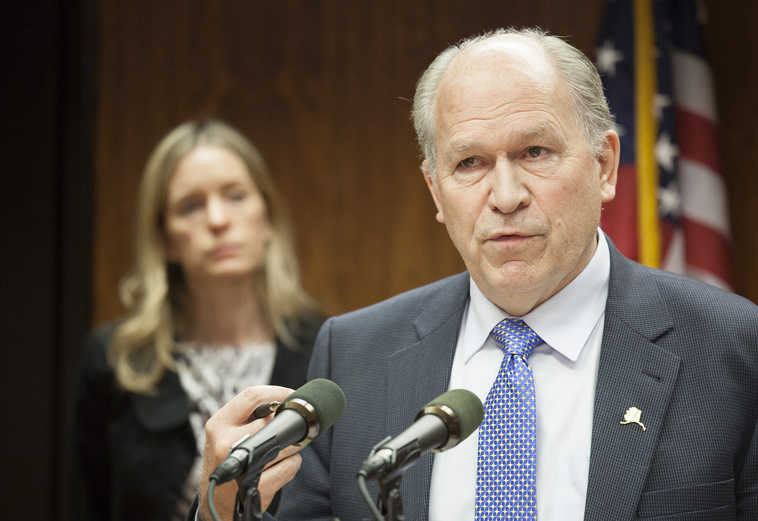
Alaska Gov. Bill Walker, with Assistant Attorney General Janell Hafner looking on, speaks during a news conference in Juneau, Alaska, about the U.S. Supreme Court decision siding with Alaska moose hunter John Sturgeon in his case against the National Park Service. The court on Tuesday unanimously threw out a lower court ruling that upheld enforcement of National Park Service rules banning the use of hovercraft on the river when it runs through the Yukon-Charley Rivers National Preserve. (AP Photo/Rashah McChesney)

Alaska Gov. Bill Walker, with Assistant Attorney General Janell Hafner looking on, speaks during a news conference in Juneau, Alaska, about the U.S. Supreme Court decision siding with Alaska moose hunter John Sturgeon in his case against the National Park Service. The court on Tuesday unanimously threw out a lower court ruling that upheld enforcement of National Park Service rules banning the use of hovercraft on the river when it runs through the Yukon-Charley Rivers National Preserve. (AP Photo/Rashah McChesney)

Supreme Court ruling praised as win for Alaska

Taking a break from the normal run of bad budgetary news, Gov. Bill Walker and four members of the Alaska Legislature held a press conference to announce some good news: The U.S. Supreme Court’s 8-0 ruling in favor of an Alaska moose hunter.

“It’s a good day,” Gov. Bill Walker said Tuesday.

On Tuesday morning, the U.S. Supreme Court issued its ruling in the case Sturgeon v. Frost, which pitted an Alaska man against the National Park Service.

At issue is who has jurisdiction over rivers running through national preserves and parks: the state or the federal government.

The Supreme Court declined to decide that core issue, but it still sided with John Sturgeon, the Alaska hunter, and ordered the U.S. 9th Circuit of Appeals to reconsider its decision in favor of the Park Service.

The Supreme Court opinion stated that “Alaska is often the exception, not the rule” when it comes to federal regulation, something Alaska’s public officials have stated for years.

“They’ve said Alaska is unique,” Walker said. “You can’t take a broad brush … and include Alaska in it.”

While the court’s decision is limited, the governor and lawmakers said they hope it will be an example for future cases in which federal and state interests conflict.

“I think this is going to be a precedent for us in many years to come,” said Sen. John Coghill, R-North Pole.

Rep. Craig Johnson, R-Anchorage, said that while the decision was good news, it’s important to view it in context.

He provided an analogy to sports: “This is like the first game in a very long season. … You celebrate today, but you prepare for the next one.”

U.S. Rep. Don Young, R-Alaska, also looked to sports for an analogy, but chose boxing. “Today’s ruling wasn’t the KO punch we were looking for in our fight against the massive overreach of the National Park Service, but it was a small victory for Alaska and the unique relationship we share with the federal government,” he wrote in a statement.

Democrats also had positive things to say about the decision. In a press release Tuesday, Sen. Bill Wielechowski, D-Anchorage, said, “I am pleased by the common sense, unanimous decision of the U.S. Supreme Court in the Sturgeon v. Frost case. … It is a victory for those living a subsistence lifestyle, hunters, and fishermen across Alaska.”

The 9th Circuit, the largest appeals court in the United States, is the conduit for federal cases coming out of Alaska but has a reputation for liberal decisions and having those decisions overturned by the Supreme Court.

The Western Governors’ Association and Alaska’s Congressional delegation have joined the national call for splitting the 9th Circuit and creating a 10th Circuit to handle demand.

“That has not gained legs much,” Walker said, “but we would certainly support that.”
More in News

Teresa Becher watches as beluga whales swim up the Kenai River on Saturday, April 24, 2021. She and her volunteer team monitor belugas in the Cook Inlet. (Photo by Camille Botello/Peninsula Clarion)
Beluga time

Get out your binoculars: The whales are frolicking in the Kenai River

The George A. Navarre Kenai Peninsula Borough building. (Peninsula Clarion file photo)
Borough to hire for 2 dispatch positions

Two state workers are expected to leave their positions at the center within the next month.

In the past, Gov. Mike Dunleavy's cuts to the Alaska Marine Highway System drew out protestors, like those seen here in Juneau in this Feb. 11, 2020, file photo, but the governor has backed off cuts, and even partnered with lawmakers to use federal funds to bolster the system. (Peter Segall / Juneau Empire File)
Lawmakers, governor propose using $76 million in federal relief for ferries

“That’s the direction we’re going unless something derails it.”

David Ross speaks before the Kenai City Council on Saturday, April 24, 2021 in Kenai, Alaska. (Ashlyn O'Hara/Peninsula Clarion)
Kenai police chief: Crime decreased amid pandemic

The total number of police service calls declined by more than 500.

COVID-19. (Image courtesy CDC)
Peninsula cases rising faster than vaccine rates

18.7% positive case increase from last week as CDC and FDA lift J&J pause

A vial of Pfizer’s COVID-19 vaccine is seen at Central Emergency Services Station 1 on Friday, Dec. 18, 2020, in Soldotna, Alaska. (Ashlyn O’Hara/Peninsula Clarion)
‘Encouraging’ vaccine data showing no safety concerns for pregnant women

Pregnant women were excluded from vaccine clinical trials early on.

The Swan Lake Fire can be seen from above on Monday, Aug. 26, 2019, on the Kenai Peninsula, Alaska. (Photo courtesy Alaska Wildland Fire Information)
Study analyzes wildfire impact on peninsula

Data suggest wildfires are going to be a persistent problem for Alaskans in the future.

Most Read