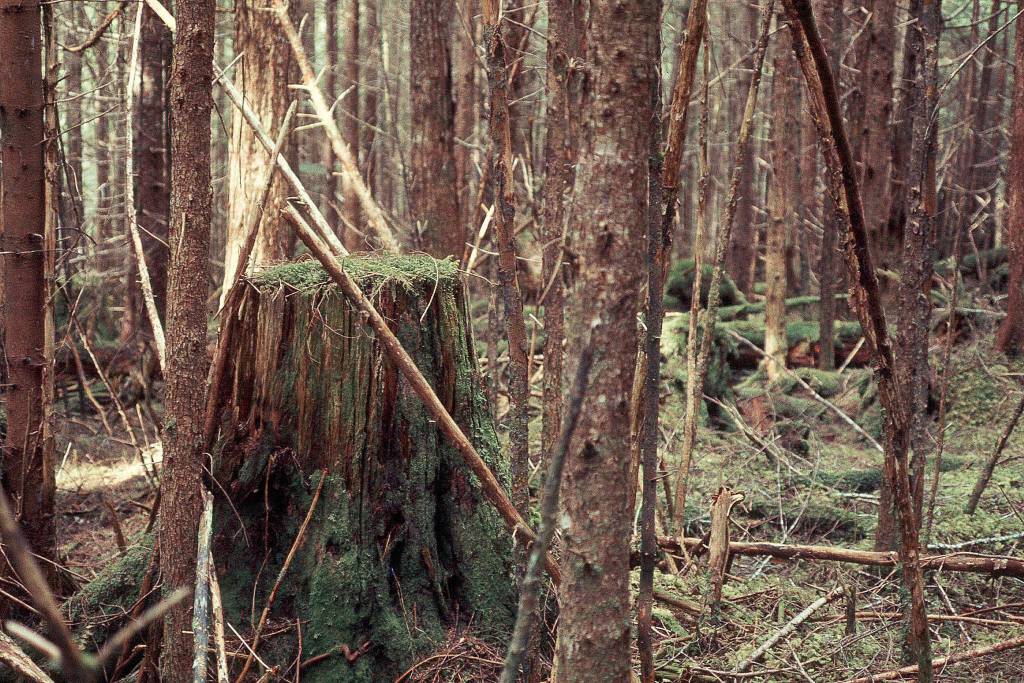
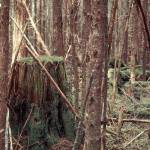
A 60-year-old second growth forest stand on Admiralty Island. John Schoen measured deer density here in comparison to an adjacent old-growth stand. This is a mixed hemlock-spruce stand in which all the trees are the same age and size. Few forest floor plants occur here because of low light levels. These dark, even-aged stands have low structural diversity and provide relatively poor habitat for most wildlife species. In Southeast, it takes two to three centuries before forests that are clear-cut develop the ecological characteristics of old growth. Note the old-growth stump in the left side of the image. (Photo by John Schoen)

A 60-year-old second growth forest stand on Admiralty Island. John Schoen measured deer density here in comparison to an adjacent old-growth stand. This is a mixed hemlock-spruce stand in which all the trees are the same age and size. Few forest floor plants occur here because of low light levels. These dark, even-aged stands have low structural diversity and provide relatively poor habitat for most wildlife species. In Southeast, it takes two to three centuries before forests that are clear-cut develop the ecological characteristics of old growth. Note the old-growth stump in the left side of the image. (Photo by John Schoen)

‘Tongass Odyssey’ explores decades of research, politics and change

‘What we learned is that old growth forest is very important’

By Mary Catharine Martin

The Salmon State

In 1977, John Schoen flew to Hood Bay on Admiralty Island. He’d been hired as the first Southeast Alaska research biologist to study deer and this was his first trip into the field.

“Flying into the bay, looking at humpback whales and all the bald eagles in the trees … we got out of the Beaver, stepped on the beach and saw these huge, enormous brown bear tracks. And listening to the blue grouse, and the geese on the beach, I just thought ‘Man, I’m getting paid to do this? Unbelievable!’” he recalled.

Forty-four years later, he’s made a career studying and working to conserve deer, mountain goats, brown bears and Alaska’s ecosystems, and he’s written a book about the journey: “Tongass Odyssey: Seeing the Forest Ecosystem through the Politics of Trees; A Biologist’s Memoir.”

“What we learned is that old growth forest is very important,” he said of research he did with U.S. Forest Service research biologist Charlie Wallmo and fellow Alaska Department of Fish & Game research biologist Matt Kirchhoff. “Clearcuts were used by deer in the summertime, when there was an abundance of food, but in the wintertime, when the snows came, the deer couldn’t use them. In the second growth, the deer would have to pack a lunch to make it through. There’s just nothing on the forest floor.

“One thing led to another. We published our results, and then we took tremendous flak from the Forest Service and the timber industry. I quickly realized that the science was hard to do without bumping into the politics.”

At times, that politics seemed to threaten his job. Twice in the 1980s, he was invited to testify before Congress about his research. Though his immediate supervisors and the then Deputy ADF&G Commissioner were supportive of his work, higher ups in state government were not. The State of Alaska first told Congress he was unavailable — then that there was no money to send him. That wasn’t true. He felt strongly enough about his duty to share what he had learned with the American public that he took annual leave to go testify each time, even taking out a loan to be able to afford the plane ticket.

“I just said, you know, if they don’t want me to go back that much and I have done this work on behalf of the public — it’s a public resource — I have to go back (to D.C.). It’s my responsibility,” he said.

As he branched out into researching brown bears and mountain goats and as his knowledge deepened, he began thinking about old growth forest a different way.

“The value of old growth isn’t (just) deer habitat. The value of old growth is as an ecosystem. A very unique ecosystem,” he said. “The old-growth forest is a patchwork quilt of all these different kinds of stands, from shore pine to mountain hemlock that may be six inches in diameter and two or three hundred years old. And (different kinds of forest) have a different understory, and they have different values to different species at different times of the year. My evolution has been from looking at the habitat of a single species to looking at the old-growth forest as a very rich, productive ecosystem. People say ‘We’re only logging a small portion of the old growth, so that’s not a problem.’ But they’re focusing that harvest on the rarest, most valuable fisheries and wildlife habitats … Old growth forests are not renewable. You cannot clearcut a forest that has 800-year-old trees in it and expect it to come back in a hundred years to have the same structure and function of an old growth ecosystem.”

Later in his career, he was the lead scientist for Audubon Alaska. In that role, he organized a letter from seven professional societies representing more than 30,000 scientists to then Secretary of Agriculture Tom Vilsack (whom President Joe Biden has appointed in the position once more) about the importance of transitioning out of old growth clearcutting on the Tongass. They never got a response. But he’s hopeful that the Forest Service policy of allowing clearcut old growth logging on the Tongass will change, especially since even more research is coming out, with a recent study estimating the Tongass stores 44% of the carbon in all U.S. national forests.

Schoen published “Tongass Odyssey” in September of 2020, inspired by people’s shifting idea of what was “normal,” the too-slow pace of change he had seen in 40 years of U.S. Forest Service management of the Tongass, and the endangered status of the Tongass’ remaining large-tree old growth, which represents just 3% of the forest.

“I wrote it because I feel it’s important to get this message out,” he said. “I wanted to put down a marker — here’s what’s happened since I started in 1977. And we still haven’t applied the science that we’ve learned to management. It’s been over 30 years, and we haven’t had the political will. … We still have an opportunity to keep the diversity of forest habitats on the Tongass National Forest. There’s no other national forest in the nation where we have this opportunity.”

“Tongass Odyssey” was published by University of Alaska Press and is available at your local bookstore, on Amazon, or at https://press.uchicago.edu/ucp/books/book/distributed/T/bo68374362.html.

The Salmon State is a free column provided by SalmonState, an Alaska-based initiative which works to ensure Alaska remains a place wild salmon and the people who depend on them thrive.
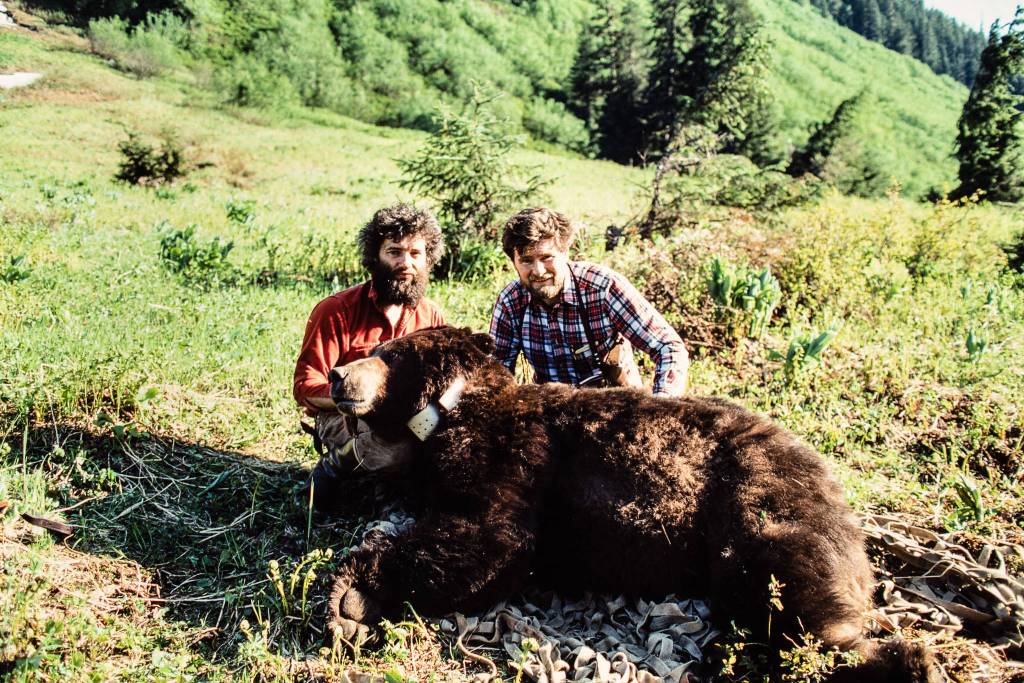
LaVern Beier (left) and John Schoen with a captured and radio-collared brown bear on a subalpine ridge on northern Admiralty Island above Greens Creek. This 547-pound eleven-year-old adult male bear (#46) was captured in June 1986.

LaVern Beier (left) and John Schoen with a captured and radio-collared brown bear on a subalpine ridge on northern Admiralty Island above Greens Creek. This 547-pound eleven-year-old adult male bear (#46) was captured in June 1986.

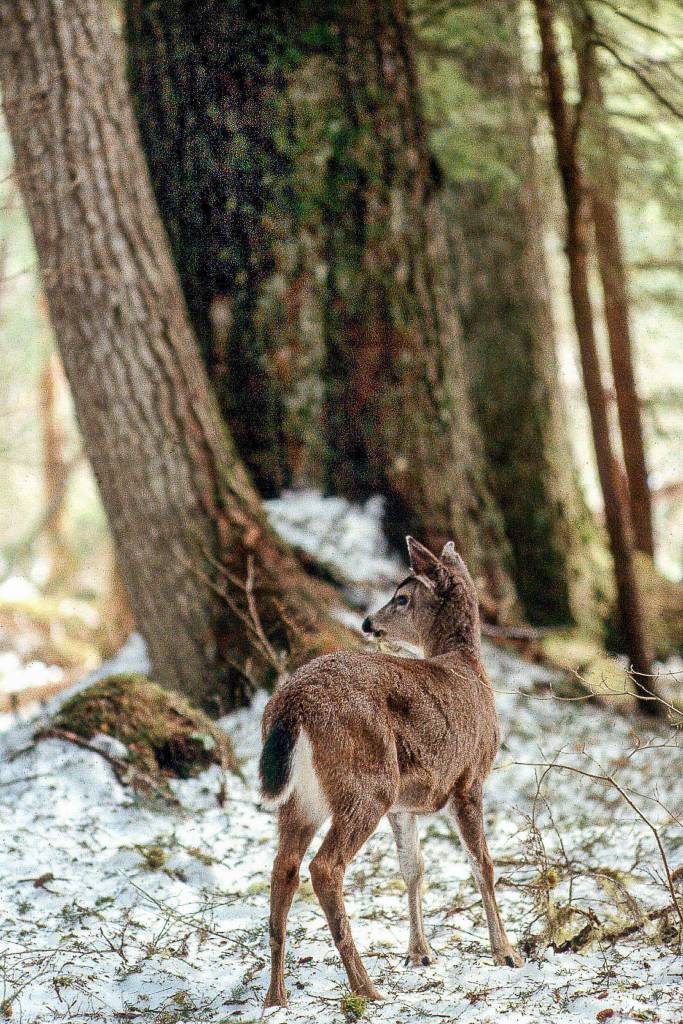
A Sitka black-tailed doe in a mid-to high-volume (large-tree) old growth stand on Douglas Island during a deep-snow winter. The tall forest canopy and big limb structure of the large trees intercept a significant amount of snow. Deer can travel easily through these stands and food is comparatively much more available than in the deep-snow conditions that occur in clear-cuts and muskegs as well as in small-tree old-growth stands. (Photo by John Schoen)

A Sitka black-tailed doe in a mid-to high-volume (large-tree) old growth stand on Douglas Island during a deep-snow winter. The tall forest canopy and big limb structure of the large trees intercept a significant amount of snow. Deer can travel easily through these stands and food is comparatively much more available than in the deep-snow conditions that occur in clear-cuts and muskegs as well as in small-tree old-growth stands. (Photo by John Schoen)

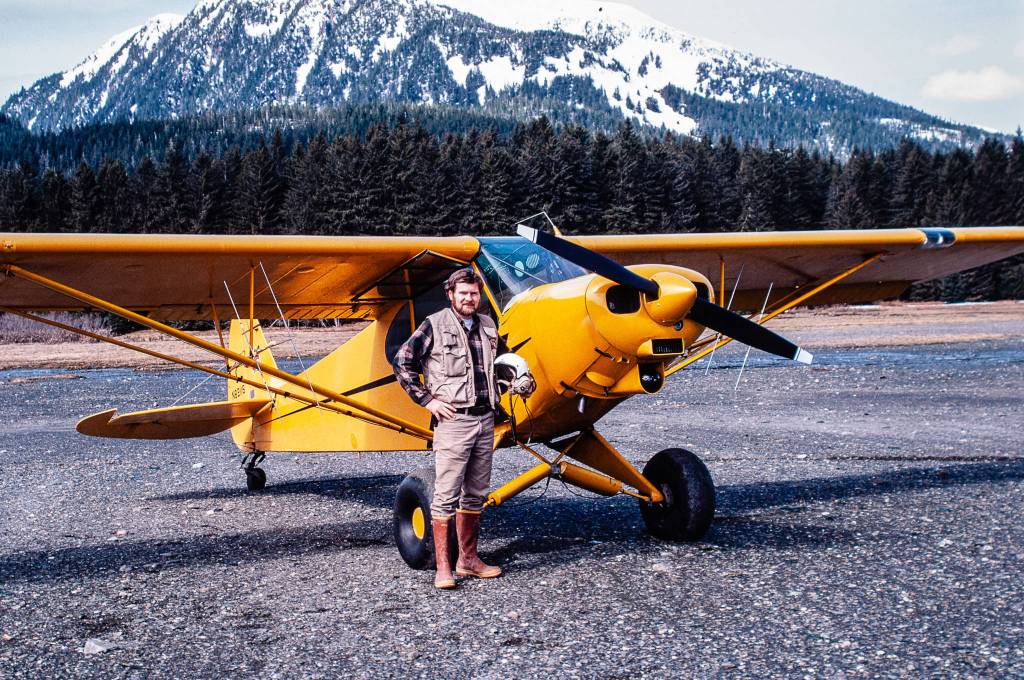
Biologist John Schoen with the Super Cub on a beach on Admiralty Island. The two antennas under each wing were used to determine which direction had the strongest signal from radio-collared animals. They then could locate the animals within an area about the size of an acre. (Photo by John Schoen)

Biologist John Schoen with the Super Cub on a beach on Admiralty Island. The two antennas under each wing were used to determine which direction had the strongest signal from radio-collared animals. They then could locate the animals within an area about the size of an acre. (Photo by John Schoen)

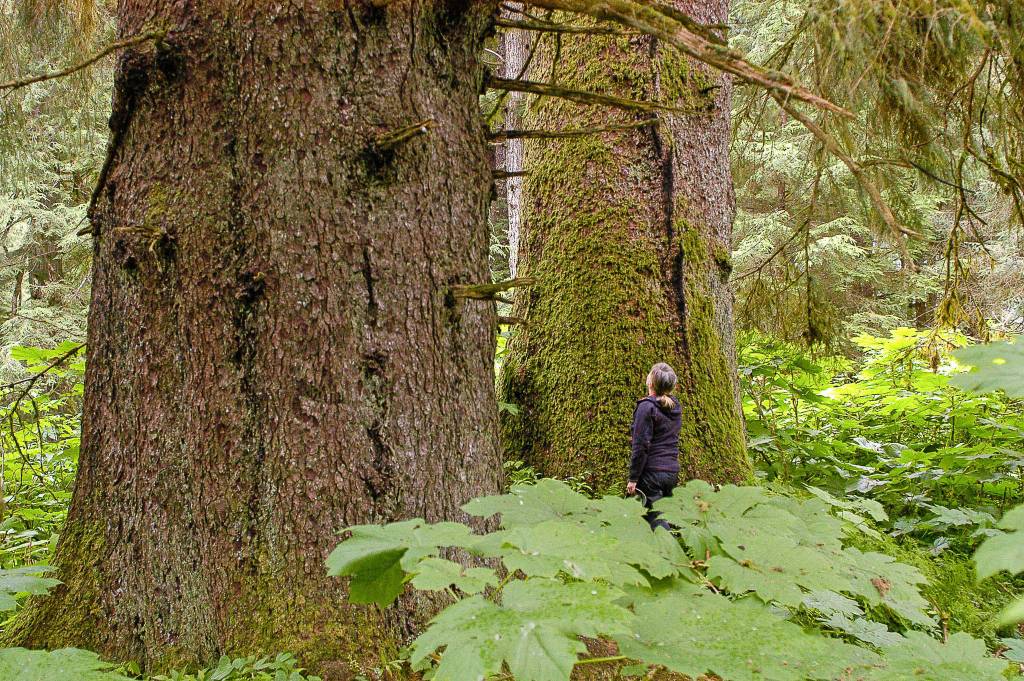
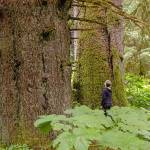
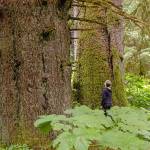
Mary Beth Schoen admiring a large-tree old-growth stand in Saook Bay on northeastern Baranof Island. Some individual trees were over six feet in diameter and many centuries old. This riparian area was adjacent to a salmon stream and was full of bear trails. Large-tree old growth stands are rare on the Tongass. (Photo courtesy John Schoen)

Mary Beth Schoen admiring a large-tree old-growth stand in Saook Bay on northeastern Baranof Island. Some individual trees were over six feet in diameter and many centuries old. This riparian area was adjacent to a salmon stream and was full of bear trails. Large-tree old growth stands are rare on the Tongass. (Photo courtesy John Schoen)

More in Life

File
Minister’s Message: God’s gift to us

Another Christmas in the bag. Another round of wrapped boxes deconstructed. Another… Continue reading

This yellow split pea curry is mild and rich with coconut milk and spices and makes a complete meal when paired with steamed rice. Photo by Tressa Dale/Peninsula Clarion
Food to fuel growing minds

This yellow split pea curry, paired with steamed rice, is a complete meal and the perfect fuel for any kind of marathon.

Prof. C.C. Georgeson, circa 1910s, inspects an apple tree on one of his Alaska agricultural experiment stations. (Image from the Rasmuson Library historical archives at the University of Alaska Fairbanks)
The experiment: Kenai becomes an agricultural test site — Part 5

AUTHOR’S NOTE: A presidential executive order in January 1899 had set aside… Continue reading

Community members enjoy skating at Kevin Bell Arena during the Christmas Eve community free skate on Wednesday, Dec. 24, 2025, in Homer, Alaska. (Delcenia Cosman/Homer News)
Out of the Office: A metaphor on ice

I went ice skating for the first time in years last week,… Continue reading

File
Minister’s Message: Love born to endure

I spend time with people in the final chapters of their lives.… Continue reading

In his 1903 report to the U.S. Department of Agriculture, Prof. Charles Christian Georgeson included this photograph of efforts to break recently cleared ground at Kenai’s agricultural experiment station. The man behind the bull was either station superintendent Hans P. Nielsen or his assistant Pontus H. Ross.
The experiment: Kenai becomes an agricultural test site — Part 4

AUTHOR’S NOTE: A presidential executive order in January 1899 had set aside… Continue reading

This recipe makes a boatload of soft and delicious cookies, perfect for sharing at Christmastime. Photo by Tressa Dale/Peninsula Clarion
Christmas cookies for a shared tradition

These cookies are so soft and delicious, it’s no wonder they’re part of a family Christmas tradition.

Daniel Craig (right), returning as Benoit Blanc, and Josh O'Connor are seen in this still from "Wake Up Dead Man: A Knives Out Mystery," released on Netflix on Dec. 12, 2025. (Promotional photo courtesy Netflix)
On the Screen: ‘Knives Out 3’ truly a film for our times

I often feel the need to watch a film twice. The first… Continue reading

Orange zest and extract bring this literary-inspired treat to life. Photo by Tressa Dale/Peninsula Clarion
Whimsy and magic

This literary-inspired treat is perfect for Christmastime festivities.

Most Read