Cook Inlet oil and gas lease sale receives no bids
Published 1:30 am Friday, March 20, 2026


An offshore oil and gas lease sale in the Cook Inlet mandated by the federal government closed earlier this month after receiving no bids.
The “One Big Beautiful Bill Act” passed by Congress last year mandated that the U.S. Department of the Interior hold 36 offshore oil and gas lease sales in the Gulf of Mexico and the Cook Inlet on a regular schedule through 2040. According to the U.S. Bureau of Ocean Energy Management website, “these sales will serve as the backbone of America’s offshore energy portfolio for years to come by ensuring there is a predictable stream of the new exploration and drilling needed to facilitate future production.”
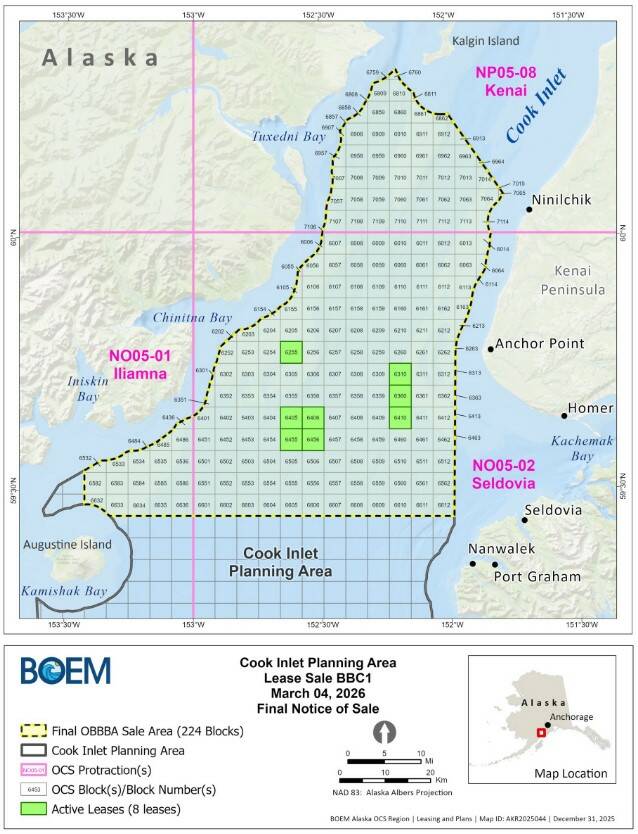
BOEM opened the Big Beautiful Cook Inlet 1 oil and gas lease sale on Feb. 2 as the first of six federally mandated Cook Inlet offshore lease sales, offering 216 blocks for leasing — approximately 1.05 million acres of the Cook Inlet area, stretching from near Kalgin Island in the north to Augustine Island in the south. The deadline for bid submission was March 3.
As of March 4, BOEM had received no bids from drilling companies on the BBC1 lease sale.
“In accordance with OBBBA, we will continue to hold leasing opportunities for Cook Inlet so that industry has a regular, predictable federal leasing schedule that ensures we achieve President Trump’s American Energy Dominance Agenda,” BOEM wrote on the BBC1 lease sale webpage.
The next Cook Inlet lease sale is scheduled for March 2027.
Cook Inletkeeper, a Homer-based environmental nonprofit organization, stated in a March 4 press release that lack of industry interest in the federal waters of Cook Inlet is not new. The last two Cook Inlet lease sales — held in 2017 and 2022 — only received bids by Hilcorp Alaska LLC, who owns the eight active leases in the federal waters of the inlet, including the controversial Lease Sale 258. In 2024, Hilcorp also relinquished the rights to seven of their previous Cook Inlet holdings which they had obtained in the 2017 lease sale.
According to the BOEM website, if a leaseholder wants to explore for or develop oil and gas resources, the leaseholder must first submit a plan to BOEM for approval. The Plans Section on the site shows that there are currently no exploration, development or production plans for oil and gas in the Cook Inlet.
BBC1’s outcome “once again revealed the lack of industry interest in lower Cook Inlet drilling and the continued political theater surrounding offshore drilling in Alaska,” Cook Inletkeeper co-executive director Bridget Maryott said in the release. “Continuing to hold lease sales with zero interest and strong local opposition to drilling is a blatant waste of taxpayers’ money.”
According to the release, Inletkeeper joined with a federally recognized Alaska Native tribal nation and several community and environmental health and justice groups to formally notify Interior Secretary Doug Burgum of their intent to sue if the sale proceeded without required consultation under the Endangered Species Act. The letter was submitted by nonprofit public interest environmental law organization Earthjustice and partners on behalf of Chickaloon Village Traditional Council, Cook Inletkeeper, the Alaska Community Action on Toxics, the Center for Biological Diversity and the Natural Resources Defense Council.
The groups asserted that the federal government failed to consult with the National Marine Fisheries Service and U.S. Fish and Wildlife Service to evaluate possible impacts of the lease sale on endangered and protected species in the Cook Inlet, including critically endangered Cook Inlet beluga whales, northern sea otters, Stellar’s eiders and other species protected under the Endangered Species Act.
“Beyond chronic harms like noise pollution and vessel strikes, a major oil spill in Cook Inlet would devastate already fragile species populations,” the release states. “BOEM itself has acknowledged that Cook Inlet — a stretch of sea known for its extreme tidal changes and central to southcentral Alaska’s ecology, economy and culture — is one of the most ecologically sensitive regions in the Outer Continental Shelf.”
Maryott confirmed Wednesday that a formal lawsuit was never filed and the notice of intent to sue was pulled after BBC1 failed to receive any bids.
“Cook Inlet is home to endangered wildlife, thriving coastal communities and economies, robust commercial and subsistence fisheries, and is not a political bargaining chip,” Inletkeeper co-executive director Loren Barrett said in the release. “We will continue to demand lawful process and public participation as long as these sales persist.”
According to the BOEM website, the agency is also evaluating whether to advance a competitive lease sale for minerals other than oil, gas or sulfur on the Alaska Outer Continental Shelf. A Request for Information and Interest comment period is open through 11:59 p.m. Eastern Time on Wednesday, April 1. To comment, go to www.regulations.gov and search for docket BOEM-2025-0318.
Following the comment period, based on interest received during the RFI, BOEM will announce areas on the Alaska OCS to be considered for potential leasing.