Bill prohibiting employers from mandating vaccine introduced
Published 10:30 pm Friday, April 16, 2021
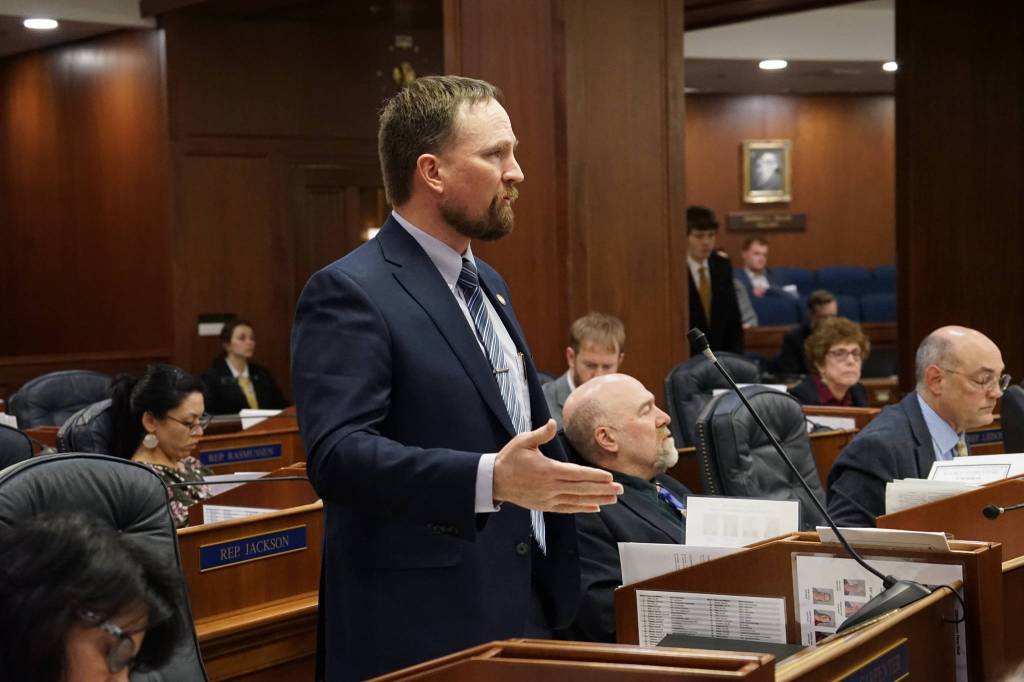
With fewer than 25 working days left in the 32nd Legislature’s First Regular Session, Rep. Ben Carpenter, R-Nikiski, introduced legislation Wednesday that would prohibit public and private employers in Alaska from requiring their workers to be vaccinated against COVID-19.
The proposed legislation, House Bill 175, has since been co-sponsored by Reps. Ron Gillham, R-Kenai; Sarah Vance, R-Homer; Christopher Kurka, R-Wasilla; and Ken McCarty, R-Eagle River.
A press release from Carpenter’s office described the legislation as “protecting immunization rights.”
“HB 175 preserves an individual right to determine whether COVID-19 vaccination is necessary,” Carpenter said. “House Bill 175 complements other legislation introduced this session that addresses COVID-19 vaccination liability issues while safeguarding Alaskan’s independent nature. There is concern among many Alaskans that the COVID-19 vaccines were rushed through the FDA approval process. Alaskans should not be forced to receive a vaccine that has not undergone the full approval process and all the risks are known.”
The legislation defines an employer as a person who employs one or more other persons, the state, the University of Alaska, the Alaska Railroad and municipalities, school districts or other units of local government.
Three sections of the legislation specifically address an individual’s access to “areas and services,” their “exercise of rights and access to benefits” and prohibits vaccination as a condition of employment.
According to the U.S. Centers for Disease Control and Prevention, vaccine mandates do not come from the U.S. Food and Drug Administration, but rather is a matter of state or other applicable law.
“Whether a state, local government, or employer, for example, may require or mandate COVID-19 vaccination is a matter of state or other applicable law,” the CDC said.
They say mostly the same of employer mandates.
“Whether an employer may require or mandate COVID-19 vaccination is a matter of state or other applicable law,” says CDC guidance. “If an employer requires employees to provide proof that they have received a COVID-19 vaccination from a pharmacy or their own healthcare provider, the employer cannot mandate that the employee provide any medical information as part of the proof.”
Alaska state officials have said previously said there are no plans to require individuals to receive the COVID-19 vaccine.
Multiple municipalities on the central Kenai Peninsula have heard a presentation from Dr. Kristin Mitchell, who works at Central Peninsula Hospital, about how mRNA vaccines, and the COVID-19 vaccines specifically, work to prevent people from contracting the virus.
In directly responding to concerns that vaccines were “rushed” through the approval process, Mitchell noted that one reason vaccines were approved so quickly is because clinical testing trials were allowed to happen concurrently instead of consecutively. The amount of money that was put into finding a COVID-19 vaccine also helped make the process move more quickly.
Mitchell has also worked to debunk myths surrounding the Pfizer and Moderna COVID-19 vaccine, noting that people cannot contract COVID-19 from the vaccine, as there is no live virus in them, they will not change a person’s DNA and they do not contain tracking devices or microchips.
“The mRNA in [the Pfizer and Moderna] vaccines only gets into the cytoplasm of the cell where it acts as a blueprint for your cells to read so they can manufacture spike proteins,” wrote Mitchell in a January op-ed submitted to the Clarion. “Once the mRNA teaches your cells how to make the spike protein, your immune system goes to work to destroy the spike proteins as well as the cells that make it.
COVID-19 vaccinations have plateaued on the Kenai Peninsula and across Alaska in recent weeks. Health officials estimate that between 70% and 80% of the population needs to be vaccinated in order to reach herd immunity. Kenai Peninsula Borough officials expect vaccine demand on the peninsula will drop off once about 50% of people are vaccinated. As of Friday, state data showed that about 34.6% of people eligible to be vaccinated on the peninsula were fully vaccinated.
Both the Pfizer and Moderna vaccines have efficacy rates of more than 90% and require two doses to be fully effective. Pfizer doses must be administered 21 days apart, while Moderna doses must be administered 28 days apart.
A map of vaccine providers can be found on DHSS’ COVID-19 vaccine website at covidvax.alaska.gov. Many providers are using the state’s program to schedule appointments, which can be accessed at myhealth.alaska.gov. Instructions on how to schedule an appointment with a provider that does not use the state’s scheduling system can be found on the provider map by clicking on the icon of the provider through which people would like to schedule an appointment. Appointments at Walmart can be scheduled at walmart.com/covidvaccine.
People who would like assistance with scheduling an appointment to be vaccinated can call the Kenai Peninsula Borough Office of Emergency Management call center. The center operates Monday through Friday from 9 a.m. to 12 p.m. The central peninsula call center can be reached at 907-262-4636. The Homer call center can be reached at 907-235-4636. The Seward call center can be reached at 907-224-4636.
Reach reporter Ashlyn O’Hara at ashlyn.ohara@cmg-northwest2.go-vip.net/peninsulaclarion.
Editor’s note: This story has been corrected to state that the bill number is 175, not 75.