Soldotna approves funds to gather input on annexation
Published 5:08 am Friday, December 16, 2016
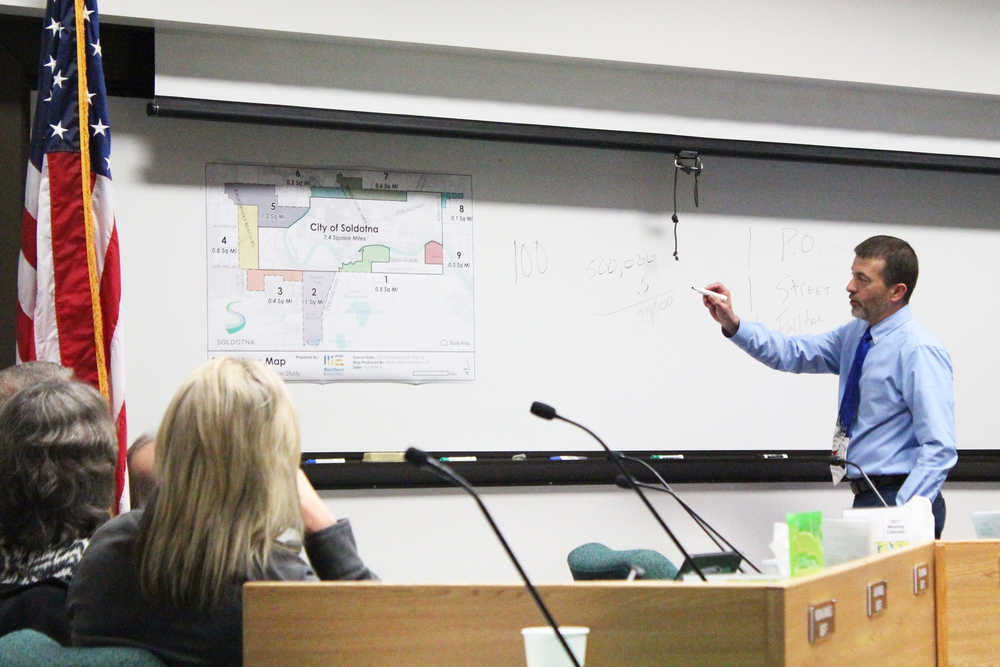
Soldotna now has $50,000 to spend on gathering public input on the potential annexation of some land directly surrounding the city.
The Soldotna City Council unanimously voted at its Wednesday meeting to approve an ordinance appropriating funds for the city to enter into a contract with a consultant, whom city staff will work with to engage with area residents and find out their opinions on the potential annexation of any of nine identified areas outside town. The appropriation was cut down from $100,000, the amount originally proposed in the ordinance, when council member Regina Daniels made a motion to halve the funding, saying the council can revisit the monetary issue later if the bid for a consultant comes back higher than $50,000.
The city of Soldotna has made several passes at annexation in the past, and it is a highly contested issue among borough residents who either own commercial property just outside the city or have homes that would stand to be annexed. City Manager Mark Dixson made a presentation to the council and public prior to the ordinance vote to explain his reasoning behind the latest foray. The charge to explore the feasibility of annexation is laid out in the city’s comprehensive plan, Dixson said.
Dixson said one of his goals as the city manager is to bring Soldotna’s property tax from the current .5 mills to zero, “so that, from a marketing standpoint, we can tell businesses, ‘Come here, there’s no city property taxes.’ Because the goal of any city manager is to shift the tax burden from its current residents to those people that are outside.”
Dixson said the city is looking to protect existing businesses and promote new ones.
“Being a responsible city who is busting out at the seams, (Soldotna) needs to look at itself and say, ‘Do we need to expand?’” Dixson said. “We’ve had a lot of issues with people, businesses wanting to move out of their current location because they’re growing, but they can’t find any place for them to move to. We’ve had developers who want to put in subdivisions but we really don’t have the … existing land in order to do that.”
City administrators came up with a seven-step process to explore annexation once the city decided to start looking into it again, Dixson said. The first three phases were to get input through a representative group, identify the nine areas the city could feasibly annex and contract with a consultant to do a fiscal impact study, the results of which are on the city’s website and identify some of the areas as less feasible for the city to annex than others.
Dixson explained, in reference to correspondence he has received from borough residents not included in the study areas who do not want to become part of the city, that the areas were chosen because they are the only ones fiscally feasible for the city to annex.
“We’re in agreement. I can’t afford you,” he said. “If everybody, all those hundred parcels signed a petition and said, ‘We want to come into the city,’ I would fight it tooth and nail, this council would fight it tooth and nail. We can’t afford you.”
The next step in the process is a public engagement process, which the funding ordinance stated will include “at minimum” meetings with residents, landowners and business owners located in the study areas, meetings with city residents and business owners, collecting and sharing information about the annexation process, and working with residents to “resolve concerns.”
Dixson said the study areas will begin to be shrunk down and eliminated based on the results of the public engagement.
“These (nine) areas are … the maximum that we’re ever going to look at, and these areas are slowly going to be whittled down to something that’s extremely small,” Dixson said. “At least that’s my hope.”
Some members of the public who commented took issue specifically with the original $100,000 proposed for the public engagement process, saying they saw no reason why city staff couldn’t do it on their own. Director of Economic Planning and Development Stephanie Queen said the majority of the funds appropriated will not be going to the expertise of the consultant, but rather toward the things that come along with physically holding the public meetings and sending out information to residents. She added that city staff would have to put their current projects on hold to take on the public input project on their own.
Alaska Berries owner Brian Olson, who has been an active opponent of annexation and whose business is not included in any of the study areas, commented against the dollar amount.
“You know, you are our community, you’re our neighbors, you’re our family, you’re our friends, and the idea that you have one of the best staffs for a city around here, because I know most of them,” he said. “They’re good at what they do. They can do this in-house with the right supervision and leadership.”
Others at the meeting cited concerns about the amount of communication the city has made with borough residents up to this point.
“The last time you appropriated money for doing the fiscal report, we said you got the cart ahead of the horse,” Olson said. “We said you should do the public (process) if you’re really sincere about what the people out in the areas think about this.”
Some said they feel they have not been able to weigh in sufficiently because they are not city residents or even own homes within the study areas. Patricia Patterson, who owns Lucky Raven Tobacco store, stressed the city should consider annexation from a standpoint other than a fiscal one.
“People like me, I have no say other than right here,” Patterson said. “And after you annex me, I have no say other than here, because somehow commercial property is not considered … I’m not a resident … I’m not a voting entity. I can’t vote one of you guys out because I’ve been living in Kenai for … almost 20 years. So it’s very frustrating because there’s so many of us that just have land and commercial property, yet somehow that’s different. I put my blood, my sweat, my tears, my life into my commercial property. I feel it just as much as I feel my home.”
Clinton Mott, whose family farm sits in one of the study areas, emphasized in his comments that while the city makes a distinction between commercial properties and residential neighborhoods, it ought to treat separately land that has been earmarked for agriculture.
“We’re large property owners. We’re ag property owners,” Mott said. “Nobody ever talks about us as a neighborhood, so we feel targeted as inside interests are wanting to go in and put commercial properties (there) or annex us until we can’t survive there anymore. I think all of that needs to be clarified, because we are different than residential (property owners) and we do not want to be annexed.”
Council members Lisa Parker — who served on the council previously when the issue of annexation came up — Linda Murphy, Tim Cashman, and Daniels voiced that they would not be interested in annexing areas where the majority of people did not want to be part of the city.
“I am interested in looking at commercial properties,” Murphy said. “That doesn’t mean that I would want to annex every commercial property outside of the city limits, but I think that that’s something we need to look at because, as the city manager said, their sales tax revenues could help us, perhaps, eliminate property taxes in the city.”
In her closing comments, Murphy proposed that city staff modify the map of identified areas for possible annexation to eliminate the sections they feel unlikely to ever be annexed, like the heavily residential Knight Drive area, before gathering public input on them.
“I know that Ms. Queen says that this is good information for the future but I think that continuing to look at those areas … if the administration is not ready to say that we should annex them, that it just continues … the bad feelings that people have, and I’d like to get beyond that as much as possible,” Murphy said. “And so I would hope that you would consider doing that.”
Council members Tyson Cox, Cashman and Daniels all addressed Mayor Pete Sprague before the vote to ask if they had conflicts of interest, as all of them own commercial properties within the areas identified for possible annexation and would thus be affected if the area containing their business became part of the city. Sprague, reading from a decision by the city’s legal department, found that none of them had conflicts at that point because the council was merely voting whether to fund a consultant and public input process. If and when it comes time to vote on whether to move forward in the process of annexing a specific area or areas, Sprague said the conflict of interest issue may be revisited with those council members.
Should the city decide after the public engagement process and narrowing down the areas identified for possible annexation that it wants to go through with the process, a petition would be sent to the Local Boundary Commission, which has the final say over whether a borough or city can annex additional land. The LBC has its own public input process.
Dixson said during his presentation that he was asked in his interview for the city manager position whether he would be willing to pursue annexation as an option.
“It’s a painful process, you know, it’s a word that is most vile,” he said. “It’s something that everybody hates to do.”
Reach Megan Pacer at megan.pacer@cmg-northwest2.go-vip.net/peninsulaclarion.