Dr. Gaede drops in, Part 2
Published 10:30 pm Monday, November 16, 2020


By Clark Fair
For the Peninsula Clarion
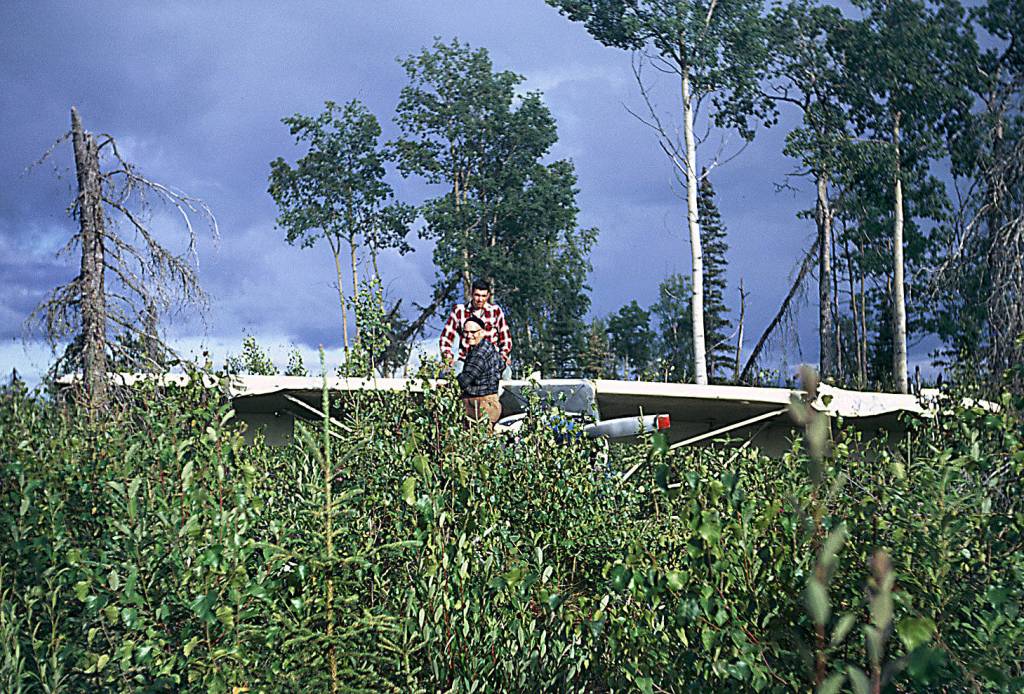
Author’s note: This is Part Two of a three-part story of an airplane crash more than a half-century ago. Dr. Elmer Gaede was at the controls of his single-engine Maule Rocket. His passengers were Soldotna pharmacist Lee Bowman and Bowman’s friend Dane Parks. They were returning to Soldotna from Seward when the plane’s engine died over the woods near the end of Forest Lane between Soldotna and Sterling. The plane began to fall from the sky.
This wasn’t Dr. Gaede’s first problem involving his four-seater Maule Rocket, with its 220-horsepower fuel-injection engine. Once, after volunteering to shuttle students to their village homes from the Mission Covenant High School in Unalakleet, he was flying on to Golovin to gas up his plane when a fuel gauge error nearly resulted in a plunge into the icy waters of Norton Sound.
Another time, he and his son Mark were flying the Maule back from a Missions Conference at Iliamna and were cruising directly over the mountains at 14,000 feet when the engine quit. “My understanding,” said Mark, “was that there was a problem with vapor lock in the fuel lines under certain conditions. (Over the mountains that day) I suspect it was the same sort of issue. Of course we were much higher, and he got the engine back up and running after a few seconds. I know he engaged the electric fuel pumps to force fuel to the engine, rather than just rely on gravity feed.”
Vapor lock occurs when liquid fuel that is changing to a gaseous state — while still in the fuel-delivery system of a gasoline-powered internal-combustion engine — vaporizes due to being heated by the engine, by the local climate, or by experiencing a lower boiling point at high altitude.
Gaede may have been perturbed or even rattled by these incidents, but he was a vastly experienced and competent aviator. He and his medical partner, Dr. Paul Isaak, who was also a pilot, each flew frequently between their regular patients in their clinic in Soldotna and performing rounds in the hospital in Seward. They also flew regularly to see patients in the medical clinic in Seldovia.
By early 1983, Isaak estimated that he had flown through Resurrection Pass at least 2,000 times, and Gaede’s own numbers must have been about the same.
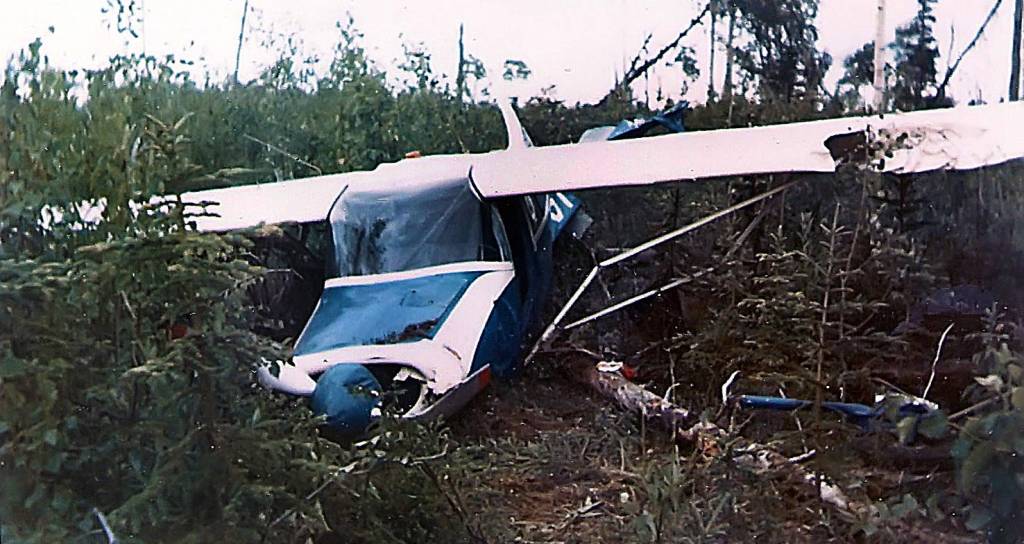
The cause of the crash of the single-engine Maule Rocket on Aug. 2, 1967, is still open for debate — despite the National Transportation Safety Board’s finding of “engine failure or malfunction (due to failure) to obtain/maintain flying speed” — but the result the crash remains irrefutable: The plane plummeted to the ground with its three occupants inside.
“It was like you turned off the switch,” said Bowman. “It was just humming along fine — and then nothing!” The propeller stopped turning, and there was nothing to be heard but the sound of air rushing past the wings and fuselage. They were still no more than 500 feet above the ground.
The plane’s nose dipped as their airspeed dropped. They had just passed over the dirt airstrip co-owned by Dan France and Dave Thomas, near the end of Forest Lane. Below them now was mixed foliage, head-high brush and isolated large trees — remnants of the 1947 Kenai Burn — and beyond that, a copse of mostly mature aspen and spruce.
“Elmer had to make a choice,” Bowman said. “Straight ahead into an absolute sure crack-up that was not very manageable because of the scattered trees and the crummy conditions, or try to turn — and if he turned, there was the airstrip and two different roads, potentially.”
“Even though we were flying too low and too slow to make a turn, he opted to try that. He made the turn, and it stalled. We dropped right out of the sky. Any expert that I ever talked to about it has said there was no way that plane should have been flying again before it hit the ground, but it did. Just before we hit, he got control again and he got the wings flat with the ground. Why it didn’t just auger straight in and kill us all is — well, the only answer I have is divine intervention.”
An instant before the Maule struck the ground, the left wing slammed into a spruce snag, and the plane pivoted 180 degrees even as the tree itself snapped off at ground level. The underside of the nose bashed into the brush-covered soil, and the occupants of the plane were tossed about violently inside.
Shoulder harnesses were not standard equipment in those days, so Dr. Gaede’s face slammed into the hard dash above the steering column, breaking out five of his teeth. The impact of the crash also caused a compression fracture in his upper lumbar area. He passed out and slumped over onto Lee Bowman, who had fared even worse.
Bowman’s head had also surged forward when the plane made its initial contact with the ground, his face smashing into the instrument panel, slicing his upper lip all the way to the left nostril. Fragments of glass and metal tore at his forehead, and a small piece of his scalp and a hank of his hair were caught by the equipment and ripped away. Like Gaede, Bowman also suffered a compression fracture to the lumbar area, and somehow he broke his left ankle.
In the backseat, as the gyro continued to wind down and the smell of smoke and hot oil permeated the air inside the cabin, Parks was bounced around, bruised and knocked cold, but at first appeared uninjured.
NEXT TIME: Part Three, the aftermath of the crash.