
When Jan Kanitz of Juneau and Antonia Lenard of Eagle River talk about personal responsibility related to the Alaska Permanent Fund, they’re talking about completely opposite things.
For Kanitz it means not relying on free dividend money every year for essential costs, and accepting that current state spending on functions such as schools, health care and ferries is woefully inadequate.
“I think a fixed, limited PFD as a symbolic thing helps people have buy-in to the state and I support that, but it should not bankrupt us,” she said. “I think we need a better sense of civic responsibility and personal responsibility in our state to go forward.”
For Lenard, a policy guaranteeing residents large dividends would allow them to exercise responsibility without having to rely on state-funded services.
“Probably a lot of our state-funded needs would go away because we’d have enough money individually to make decisions based upon schools and building new schools with our own money, because that’s a lot of money,” she said.
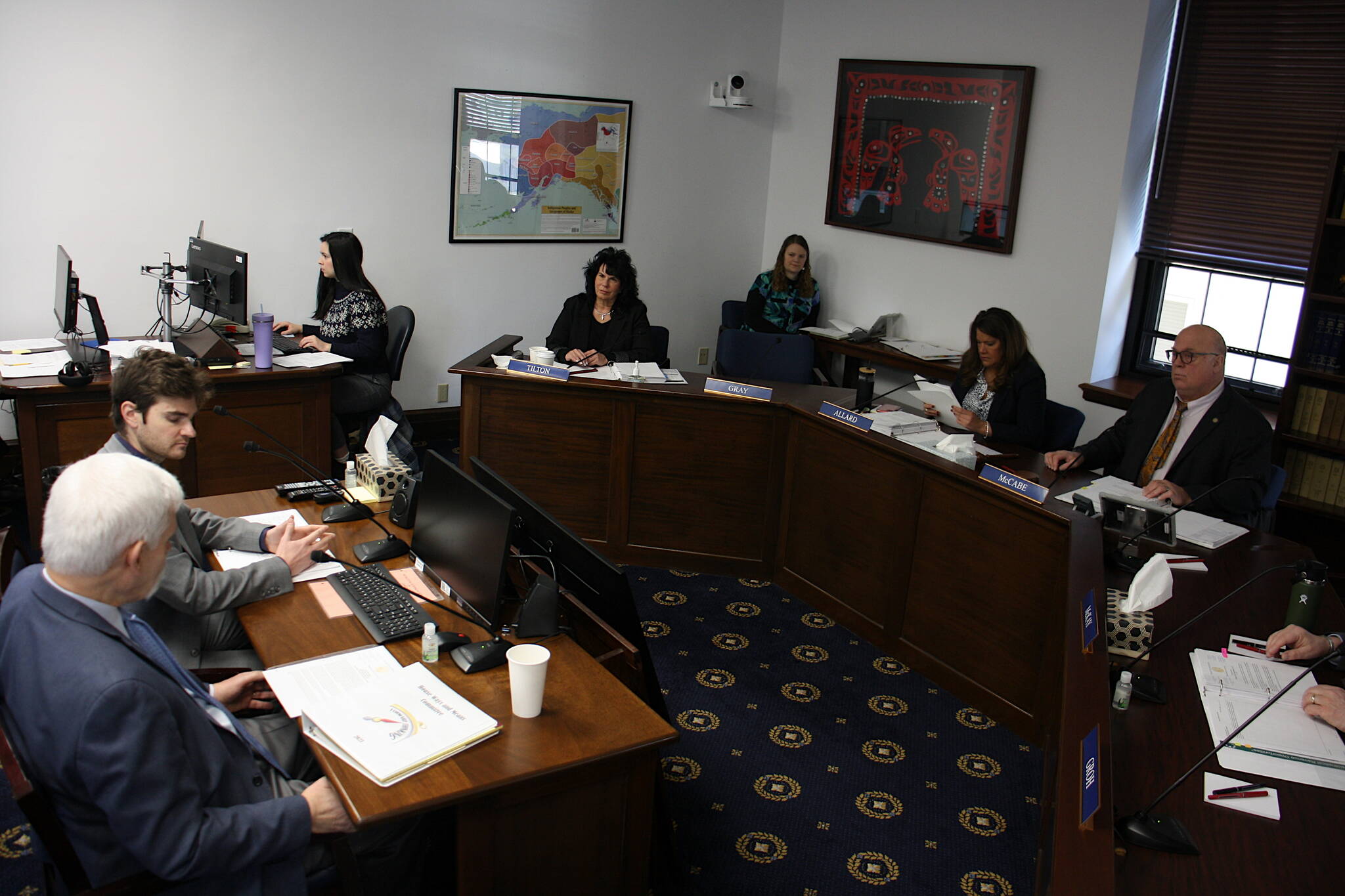
Their opinions were reflective of the polarizing comments offered during a two-hour hearing Saturday at the Alaska State Capitol on five legislative proposals affecting the management of the permanent fund and dividends. The hearing also frequently strayed into other policy areas and philosophies, and provoked accusations such as legislators “stealing” money from children and families.
The split opinions on prioritizing permanent fund earnings for dividends or state spending became something of a ongoing conversation thread during the hearing. For Rachel Lord of Homer, big dividend checks are of little use to people if streets aren’t plowed after heavy snowstorms. For Joel Sigman of Wasilla, the problem is government doesn’t know how to efficiently spend the money it gets and thus there’s no reason to give the state more that ought to go to dividends. And so on.
Two legislators chairing the meeting at different points frequently tried to redirect the conversation from such political topics to the five specific legislative proposals on the agenda — three defining calculation of PFDs and two altering the broader rules for permanent fund earnings.
In simple terms, under all of the proposals the annual money available for state spending and dividends would continue to be based on a five-year average of permanent fund earnings, after taking out what’s needed to protect the fund from inflation and pay management expenses. But there are significant and often complex variances, such as which past five-year period is used (one proposal begins six years ago instead of five, which over the long-term means a smaller earnings payout due to the fund’s overall size and inflation).
Also, two of the proposals make a drastic change to the structure of the permanent fund, which as of Jan. 31 had about $63 billion in its principal and about $14 billion in its earnings reserve account, the latter being where annual payouts from investments are deposited and accessible by a majority vote of the Legislature. The two proposals would eliminate the reserve account by redepositing it into the permanent fund, which supporters say would prevent a “spending spree” of the reserve by lawmakers.
The three proposals defining dividend calculations in ascending order of amount are:
House Bill 90: Caps the PFD at $1,000. Rep. Zack Fields, an Anchorage Democrat and the bill’s sponsor, said the amount is based on the original legislative intent when dividends were established in 1982, and it will allow state services to be funded without a tax increase or other major fiscal policy changes.
HB 72: Splits permanent fund earnings 75-25 between state spending and dividends. The bill would result in an expected dividend this year of about $1,300, with small and steady increases in future years. Rep. Dan Ortiz, a Ketchikan independent sponsoring the bill, also asserts it will guarantee annual dividends and fund state spending for at least the next decade.
House Joint Resolution 8: Combines the permanent fund and reserve accounts, and sets annual payouts at 5% of the permanent fund’s average value during the past five fiscal years. The payouts, after deducting inflation proofing and expenses would be split 50-50 between state spending and dividends, or set dividends according to the original statutory language in effect before 2016 — whichever amount is larger. This option, introduced by the Republican-led Ways and Means Committee, essentially fulfills the wishes of people seeing a “full” or “statutory” PFD, similar to the estimated $3,900 dividend proposed in Gov. Mike Dunleavy’s budget for next year. But a significant obstacle to it becoming reality is as a proposed constitutional amendment it would have to get a two-thirds vote from both the House and Senate, and then a majority in a public election.
The two proposals affecting management of permanent fund earnings, without specifying dividend calculations, are:
HJR 7: Modifies the constitution to guarantee an annual PFD. It is also sponsored by the Ways and Means Committee, which is promoting this and HJR 8 as a package.
HJR 9: Combines the permanent fund and reserve accounts, then makes the annual payout based on 5% of the permanent fund’s annual value during “the first five of the preceding six fiscal years.” Rep. Cliff Groh, an Anchorage Democrat, said his primary intent is to prevent lawmakers from overspending from the reserve account and establish a policy with long-term stability.
Many of the residents calling in to testify at Saturday’s hearing — who were given two minutes each to speak — said they had difficulty understanding the specifics of the legislation that’s just the latest skirmish in a seemingly perpetual and complex policy war.
Lenard said she wanted to address each bill separately, but was told by the teleconference host to offer a single general viewpoint.
“In attempting to read the legalese here that have been put down on the House bills and House joint resolutions, it’s a bunch of ‘blah, blah, blah,’” she said. “But what I can tell you is the original founder of the PFD was giving us a stake in land and the resources, and we were supposed to get paid from the funds generated by the people profiting.”
As for her preference in defining how PFDs are calculated, she offered a different option than the legislation on the agenda.
“It seems like there’s a little bit of dyslexia going on, I thought, with something like a 75-25 ratio,” she said. “I’m pretty sure you should flip that to a 25-75.”
Some residents complained about the hearing itself, with one inaccurately saying notice of it was only given two days ago (the committee announced it last Monday) and at least one other person calling a committee member’s office to protest the two-minute testimony limit. But committee members emphasized several times there will be many more such meetings during the weeks ahead and residents can also submit written testimony any time by email.
“The plans for this committee is to have lots of public testimony, lots of public input,” said Rep. Kevin McCabe, a Big Lake Republican, noting the committee is generally meeting during evenings and occasional weekends for that purpose.
Contact reporter Mark Sabbatini at mark.sabbatini@juneauempire.com.
