
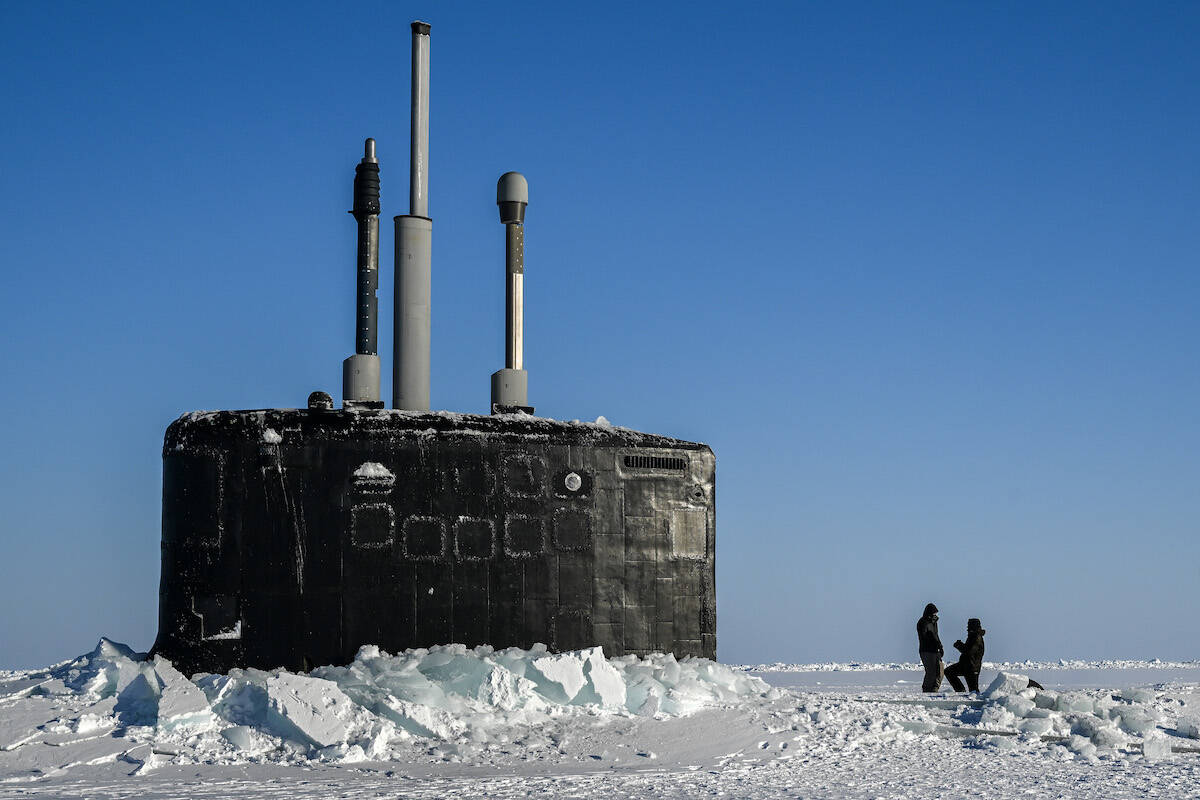
The Arctic is warming nearly four times faster than the rest of the planet and is one of the most rapidly changing places on Earth. And the United States’ approach to Arctic research has also begun shifting.
Instead of focusing largely on climate and environmental science, the Trump administration appears to be pivoting research efforts toward military and defense interests.
“It’s a radical shift,” said Michael Walsh, a senior fellow at the Foreign Policy Research Institute. “They frame everything through the lens of national security.”
President Donald Trump showed his interest in the Arctic region within his first months back in office. He has said the U.S. would go “as far as we have to go” to control Greenland and announced intentions to order new icebreaker ships.
He has also issued executive orders to fast track oil and gas developments in Alaska and to “ensure the security and leadership of Arctic waterways.”
In May, a government committee took the unusual step of editing a Biden-era planning document to “align with the current administration’s policies.” The revised version no longer included the words “climate change,” a main focus of work there for decades. It also appeared to downgrade the value placed on research contributions from nearby Indigenous communities.
Shortly after, the U.S. Arctic Research Commission, an independent federal agency, released a report on Arctic priorities that emphasized military, community, economic and energy security. “The Arctic region is critical to the defense of our homeland, the protection of U.S. national sovereignty, and the fulfillment of our nation’s defense commitments,” one section reads.
That report will inform the forthcoming national Arctic research plan, which would steer science in the region for five years beginning in 2027. It is “specifically aimed at national security,” Cheryl Rosa, the deputy director of the U.S. Arctic Research Commission, said at a September meeting.
John Farrell, the executive director of the commission, said its fundamental mission is to advance Arctic research and that it is “responsive to White House guidance, including a prioritization on security.”
The White House did not respond to requests for comment.
One of eight countries with territory in the Arctic, the U.S. has been a global leader in science in the region.
The National Science Foundation, a federal agency, has funded the Arctic Research Consortium of the United States for nearly 40 years. The consortium is a nonprofit organization that has coordinated Arctic research among an international network of scientists.
But after the Trump administration began cutting National Science Foundation grants, the consortium opted not to compete for the scarce remaining dollars and shut down on Sept. 30. Audrey Taylor, who served as director of the consortium, described that decision as “agonizing.”
The consortium had built support for places like the Toolik Field Station in Alaska, which is the United States‘ largest research outpost in the region. It provides scientists with transportation, equipment and lodging that make studying the remote region possible.
“We really need boots on the ground to study what’s happening,” said Brian Barnes, a professor at the University of Alaska Fairbanks and the co-science director at Toolik Field Station.
The National Science Foundation did not respond to a request for comment.
The United States has funded other large science centers and long term monitoring projects in the region, including the Barrow Atmospheric Baseline Observatory, which is one of four U.S. facilities that measure the concentration of greenhouse gases in the atmosphere. Trump’s proposed budget would close the observatory and cancel the lease for the longest running greenhouse gas measurement facility, the Mauna Loa Observatory in Hawaii.
But even as the administration steps away from climate science, it acknowledges environmental upheaval in the region.
Polar research is one of the government’s top budget priorities for 2027, according to a recently released memo by the U.S. Office of Management and Budget. It said the United States was affected by “rapidly changing conditions in the Arctic,” and that agencies should invest in research and development that “assures America’s uncontested navigation and strategic utilization of the Arctic.”
Sea ice, which in the past would block ships from passing through the region most of the year, has been declining for nearly a half-century as concentrations of greenhouse gases from the burning of oil and gas has heated the planet. In March, satellites observed the smallest amount of winter sea ice ever recorded.
As a result, commercial ships have begun taking shortcuts through the Arctic. Although the Biden administration emphasized the changing climate as a concern, both the Biden and Trump administrations have described the increasing navigability of Arctic waters as a security concern and emerging economic opportunity.
Polar ice on land and sea helps deflect the sun’s heat back into space. The disappearance of ice exacerbates warming and raises sea levels around the world.
At the same time, the frozen layer of soil that covers much of the Arctic, known as permafrost, is thawing. This releases more planet-warming greenhouse gases, such as methane, and causes the terrain to sink, collapse, and in some cases, explode.
“The Arctic is the proverbial ‘canary in the coal mine,’” said Mark Serreze, the director of the National Snow and Ice Data Center at the University of Colorado. “Let alone the impacts on the people who live there, what happens in the Arctic affects the rest of the world.”
Bonnie Scheele, an Inupiaq reindeer herder in Nome, Alaska, worked with U.S. scientists associated with the now-ended Arctic Research Consortium to track some of the environmental changes happening in the region that are disrupting her community’s traditional lifestyle and diet.
Scheele was “sad and frustrated” by the closure of the consortium and worried about a gap in Indigenous collaboration in research. Often, she said, knowledge built up over centuries by Indigenous cultures is used by outsiders without acknowledgment or benefit to Native communities. “But this was different,” she said. “That’s what made it so special.”
“Any research that’s related to the Arctic is going to impact us and we want to be part of it from the very beginning,” said Julie Raymond-Yakoubian, the director of the Social Science Program at Kawerak, a tribal consortia that represents 20 tribes in the region and worked closely with the Arctic Research Consortium. “We are part of the research community, we’re not just looking in at it.”
