
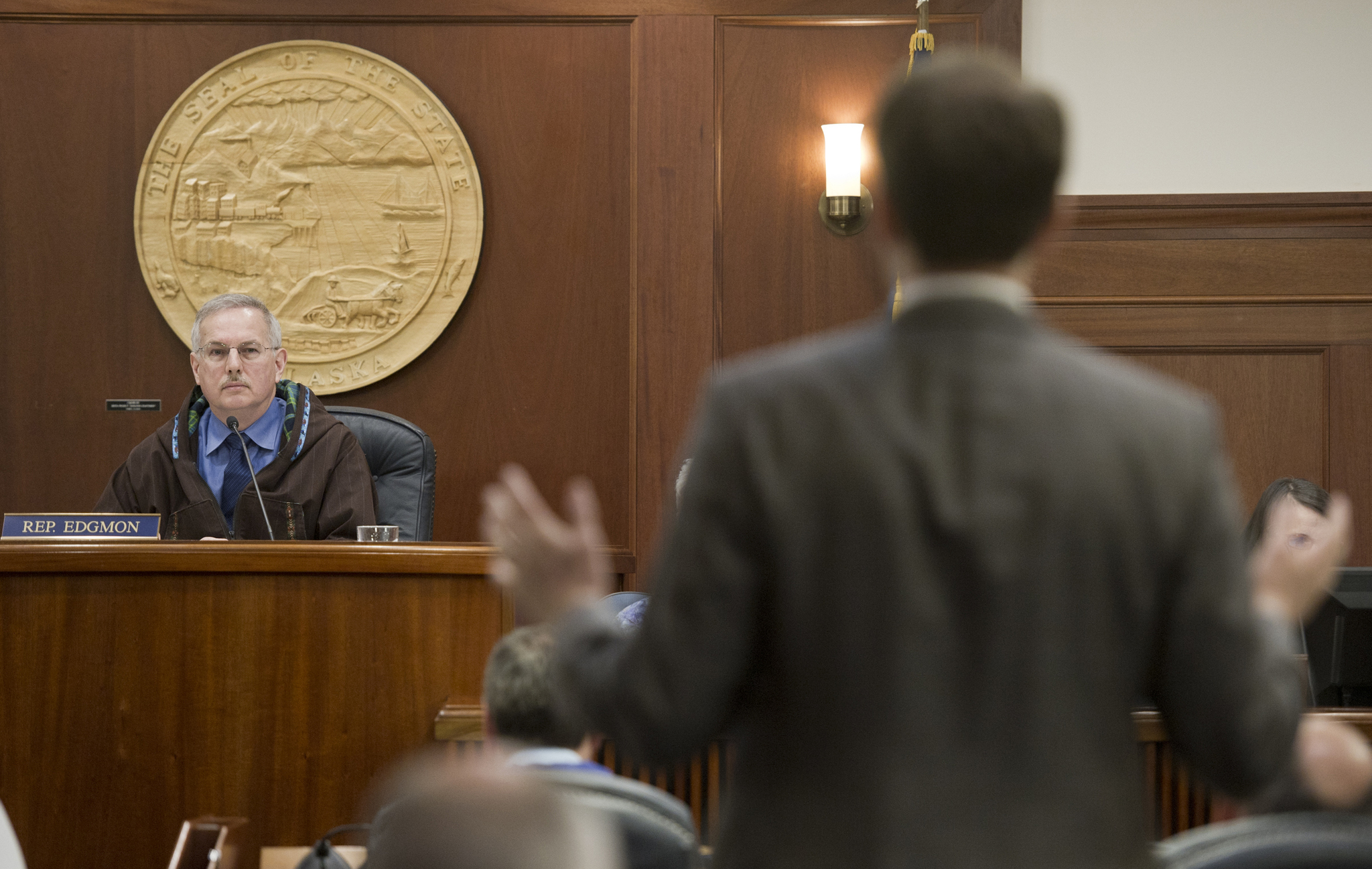
The coalition leading the Alaska House of Representatives has unveiled the core of its plan to erase Alaska’s $2.7 billion annual deficit.
On Friday, members of the House Finance Committee introduced House Bill 115, which includes a state income tax and a proposal to spend some of the earnings of the Alaska Permanent Fund.
“We need a stable Alaska, we need a thriving economy, and the only way that’s going to happen is by filling our budget hole,” said Rep. Paul Seaton, R-Homer and one of the bill’s backers. Seaton is co-chairman of the House Finance Committee.
Permanent Fund spending
If approved by the House and Senate, then signed into law by the governor, HB 115 would take about $2.3 billion per year from the Permanent Fund — 4.75 percent of the fund’s market value.
Of that money, $760 million would pay Permanent Fund Dividends.
According to an analysis provided by Seaton, that amount would ensure a dividend of about $1,100 for each Alaskan in 2017.
“Our bill protects that Permanent Fund Dividend better than we think other bills do,” Seaton said.
The Permanent Fund is expected to average 7 percent earnings, and taking just 4.75 percent of its earnings per year means money will still go back to the fund, growing it over time and (in the long run) compensating for any market downturns.
Income tax
HB 115 also includes an income tax equivalent to 15 percent of each Alaskan’s federal tax. There’s a minimum payment of $25 if you don’t pay federal taxes.
An unmarried, childless person earning $40,000 per year pays about $4,000 federal income tax per year with the standard deductions.
If HB 115 passes, that person would also owe $600 per year in state tax.
Altogether, Seaton and Rep. Neal Foster, D-Nome and co-chairman of the House Finance Committee, expect the income tax to raise $655 million per year.
Foster said having an income tax — Alaska’s first since 1980 — spreads the burden of balancing the budget.
“For the people back home in my district, in (Speaker of the House Bryce Edgmon’s) district … if you can spread this out, it means not everything hits on the Permanent Fund Dividend,” Foster said.
Economists have repeatedly testified that cuts to the Permanent Fund Dividend are regressive and fall more heavily on poorer Alaskans than wealthier ones.
If the dividend is cut in order to balance the budget, poor Alaskans pay proportionally more.
The income tax is progressive, Seaton said. It falls more heavily on rich Alaskans, and it will collect money from non-residents who work in Alaska.
If it sounds strange to give a dividend with one hand and collect a tax from the other, HB 115 accounts for that. It would add a simple check-box to the annual PFD application form. Click it, and any income taxes would automatically be deducted from the dividend.
Awaiting opposition
HB 115 was introduced Friday morning and promptly referred to the House Finance Committee, which has scheduled hearings Monday, Tuesday, Thursday and Friday to discuss and analyze it.
That scheduling puts it on the fast track to approval by the coalition House majority — which includes moderate Republicans, independents and Democrats.
The House Republican minority is rallying support to slow or derail the proposal.
“I totally oppose the new income tax bill introduced this morning. I will be a no vote in committee and on the floor,” tweeted Rep. Cathy Tilton, R-Wasilla and a member of the House Finance Committee, as the bill was introduced.
Speaking after Friday’s House floor session, Rep. Lance Pruitt, R-Anchorage and a member of the finance committee, criticized HB 115 as overly complicated and said it would harm middle-class Alaskans.
He favors an alternative approach.
“If we’re going to go with a tax, a sales tax would bring more money from outsiders than an income tax would,” he said. “I have to fight against that.”
Pruitt also said the Legislature needs to cut the state budget further before considering new taxes.
The Alaska Legislature has already cut the state budget 21 percent in the past three years, but members of the House minority and the leaders of the Senate majority have called for hundreds of millions in further reductions.
The House’s coalition majority agrees that further cuts are needed — those cuts are the fourth pillar of its plan — but it is targeting the state’s subsidy of oil and gas drilling. House and Senate Republicans have generally looked to formula programs, including education, health care and welfare, for further cuts.
If HB 115 is approved by the House without significant modifications, it will encounter stiff opposition in the Senate.
The Senate’s Republican-led majority proposes to balance the budget with a tight cap on future spending (Alaska already has a loose one), hundreds of millions in budget cuts, and a draw from the Permanent Fund’s earnings.
SB 21, created by Sen. Bert Stedman, R-Sitka, would allow an annual draw of between 2.25 percent and 4.5 percent, adjustable on an annual basis but always lower than the one proposed by HB 115.
The Senate proposal doesn’t include an income tax and it doesn’t immediately eliminate the deficit, but it stretches the state’s savings for years.
If all three parts of the Senate plan are approved, “We do the end zone dance if we do what you just described,” said Senate President Pete Kelly, R-Fairbanks.
Seaton isn’t satisfied with a partial solution, he said, and he thinks Alaskans are willing to pay.
“If people want to have an Alaska they want to live in with small enough classes and troopers on the street and streets that are plowed … then we’re going to have to figure out how to pay for it,” he said.
Contact reporter James Brooks at james.k.brooks@juneauempire.com or 419-7732.
