
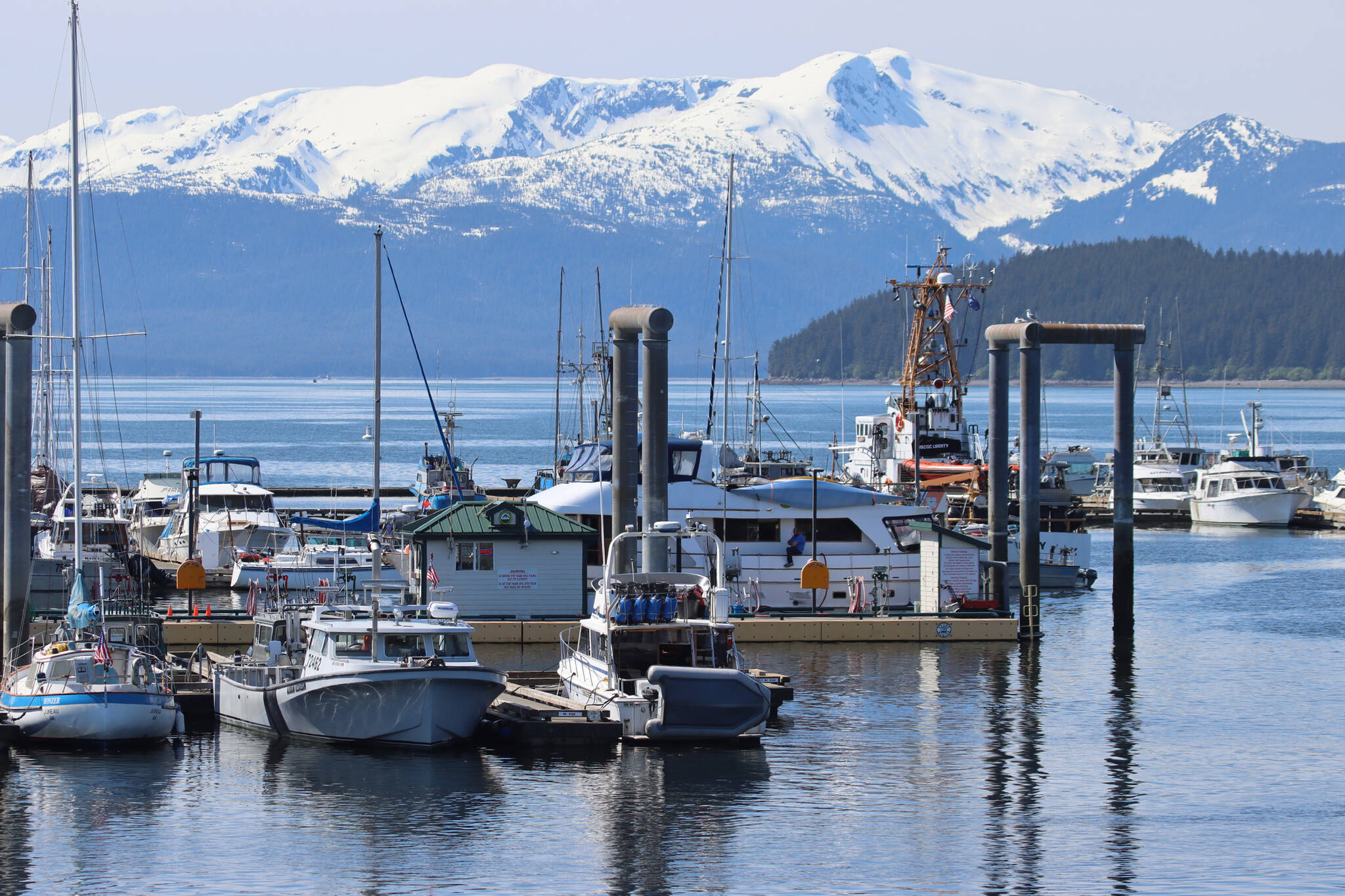
This photo shows boats moored at Don D. Statter Harbor on a recent sunny day. According to statistics recently release by the U.S. Coast Guard, boating accidents were down in Alaska in 2021.(Ben Hohenstatt / Juneau Empire)

This photo shows boats moored at Don D. Statter Harbor on a recent sunny day. According to statistics recently release by the U.S. Coast Guard, boating accidents were down in Alaska in 2021.(Ben Hohenstatt / Juneau Empire)

Boating fatalities trending down for 2021

Numbers met expectations, said safety instructors

Last year’s boating casualties were down from 2020’s nationwide spike, according to the Coast Guard’s 2021 Recreational Boating Statistics report.

Alaska, which doesn’t have a mandatory boating education requirement, is nevertheless seeing a lot of people learn safety voluntarily, said Joe McCullough, the state’s boating law administrator for the Division of Parks and Outdoor Recreation.

“We’re heading in the right direction. We’re seeing more people take classes,” McCullough said in an interview. “The partners, the attitudes — I think there’s a cultural shift and I hope people keep it up.”

There were only 14 boating fatalities in Alaska last year, said District 17 boating safety specialist Mike Folkerts in an interview. Five of those casualties were in the Southeast, according to the report.

“We don’t have high numbers of fatalities,” Folkerts said. “We have high percentages because we have a low population.”

Of the 658 deaths for recreational boaters in 2021 across the U.S. and its far-flung territories, the highest total was Florida with 61, followed by Texas with 58, according to the report.

“Our numbers are never that high. Anything in the 20s range is high for us. But that’s nothing for somewhere like Florida, California, Michigan,” McCullough said. “Overall we’ve seen a marked decrease from when the boating safety act was passed in 1998. We were averaging close to 30 fatalities a year. Now we’re closer to 15 a year.”

[Boating safety, better lake than never]

Through knowledge, seapower

Both McCullough and Folkerts pointed out how programs like Kids Don’t Float are reflected in Alaska’s flotation device use numbers and in declining casualties over the years.

“Our (life jacket) wear rate for 13-18 year olds is 4-5 times the national average. That was not the case in 2000,” McCullough said. “Now, we’re seeing it go to adults. Those kids are growing. It’s like seatbelts. We’re seeing a change in the culture.”

Casualties have been shifting from motorboats to more paddlecraft, such as stand-up paddleboards, kayaks and canoes, Folkerts said.

“I base our programs around our fatality demographics,” Folkerts said. “That’s why we’re shifting a little more toward paddlecraft.”

Paddlecraft are not required to be registered in the state of Alaska, which is also one of the only states without a mandatory boater safety education program, Folkerts said. However, many adults have voluntarily reached out for boater safety courses, McCullough said.

“Education isn’t mandatory but we have people begging for training. I was afraid we were going to lose staff this spring because we were so overworked. We were kind of prepared for the schools to reengage after two years,” McCullough said. “That was what put them over the top — all the requests for adult training.”

Alaska’s first recreational boater casualty of the year was a kayaker near Chitina, according to Folkerts — a very late date in the year for the first casualty, especially considering the number of people on the water.

“I was pleasantly surprised that was our first fatal, given how many people on the water,” McCullough said. “We’re seeing more boating in the last couple years than we saw before.”

Both the Coast Guard and the state try to train as many people as request training as possible, McCullough said, even if it’s in a hard-to-reach location.

“We don’t turn down any reasonable request. We don’t turn down these communities just because they’re small or expensive,” McCullough said. “We don’t show up uninvited. We’re always demand-based; we’re invited out there. So if Sand Point or Clark’s Point ask, we show up.”

The next major step would be a state regulation mandating boater education, Folkerts said.

“We’re doing what we can with what we have,” Folkerts said. “Once we get some mandatory education, that’s really going to make a difference.”

Page 63 of Recreational-Boating-Statistics-2021

Contributed to DocumentCloud by Ben Hohenstatt (Juneau Empire) • View document or read text

Contact reporter Michael S. Lockett at (757) 621-1197 or mlockett@juneauempire.com.

More in News

David Ross is sworn in as Kenai Police Chief on Tuesday, May 31, 2016 at Kenai City Hall. The Alaska Association of Chiefs of Police named Ross the 2025 Police Chief of the Year, recognizing over two decades of service. Photo by Megan Pacer/Peninsula Clarion
Kenai police chief named 2025 Police Chief of the Year

The Alaska Association of Chiefs of Police recognized David Ross for his more than two decades of leadership.

The cast of Nikiski Middle School’s upcoming performance of “Alice in Wonderland” is pictured on Dec. 2, 2025. The upperclassmen-directed play opens on Friday, with additional showtimes Saturday and next weekend. Photo courtesy of Carla Jenness
Nikiski Middle School debuts student-led “Alice in Wonderland”

The show opens on Friday, with additional showtimes this weekend and next.

On Tuesday, the Kenaitze Indian Tribe unveiled Kahtnu Area Transit, a public transportation service open to the entire Peninsula Borough community. Photo courtesy of Kahtnu Area Transit
Kenaitze Indian Tribe unveils Kahtnu Area Transit

The fixed bus route offers 13 stops between Nikiski and Sterling.

The Kenai Chamber of Commerce and Visitor Center hosts the annual Christmas Comes to Kenai on Nov. 28<ins>, 2025</ins>. The beloved event began over 40 years ago, and this year over 1,000 attendees enjoyed hot chocolate, fireworks, pictures with Santa and shopping. Photo courtesy of the Kenai Chamber of Commerce
 Photo courtesy of the Kenai Chamber of Commerce
The Kenai Chamber of Commerce and Visitor Center hosted the annual Christmas Comes to Kenai on Nov. 28. The beloved event began over 40 years ago, and this year over 1,000 attendees enjoyed hot chocolate, fireworks, pictures with Santa and shopping.
Kicking off a month of holiday festivities

Last weekend’s holiday events, including the annual Christmas Comes to Kenai and the Soldotna Turkey Trot, drew folks from all over the Kenai Peninsula.

Starting Dec. 2, Aleutian Airways will offer roundtrip flights between Anchorage and Unalakleet every Tuesday, Friday and Sunday.
Aleutian Airways to offer roundtrip flights between Anchorage and Unalakleet

Starting Dec. 2, Aleutian Airways will offer three roundtrip flights per week.

The Trump administration’s “Big Beautiful Bill” act requires the Bureau of Ocean Energy management to hold at least six offshore oil and gas lease sales in Alaska between 2026-2028 and 2030-2032. The first of these sales — known as “Big Beautiful Cook Inlet 1,” or BBC1— is scheduled for March 2026. Photo courtesy of the Bureau of Ocean Energy Management
Cook Inletkeeper launches petition against federal government

The organization is calling for transparency in Cook Inlet offshore oil and gas sales.

Winter dining has always carried more weight than the menu might suggest. In the off-season, eating out isn’t just about comfort food or convenience; it’s a way of supporting local businesses as they hold steady through the slower months. Photo credit: Canva.
The ripple effect: How local spending builds stronger communities on the Kenai Peninsula

From cozy cafés to fine-dining bistros, purchases made close to home sustain local jobs and services

Courtesy Harvest
On the Kenai Peninsula, a dormant liquefied natural gas export plant could be repurposed to receive cargoes of imported LNG under a plan being studied by Harvest, an affiliate of oil and gas company Hilcorp. The fuel would be transferred from ships to the tanks on the left, still in liquid form, before being converted back into gas and sent into a pipeline.
Utilities say Alaska needs an LNG import terminal. Consumers could end up paying for two.

Planning for two separate projects is currently moving ahead.

A map shows the locations of the 21 Alaska federal offshore oil and gas lease sales proposed by the Trump administration. (Map provided by the U.S. Bureau of Ocean Energy Management)
Trump administration proposes offshore leasing in almost all Alaska waters

A new five-year offshore oil and gas leasing plan proposes 21 sales in Alaska, from the Gulf of Alaska to the High Arctic, and 13 more off the U.S. West Coast and in the Gulf of Mexico.

Most Read