
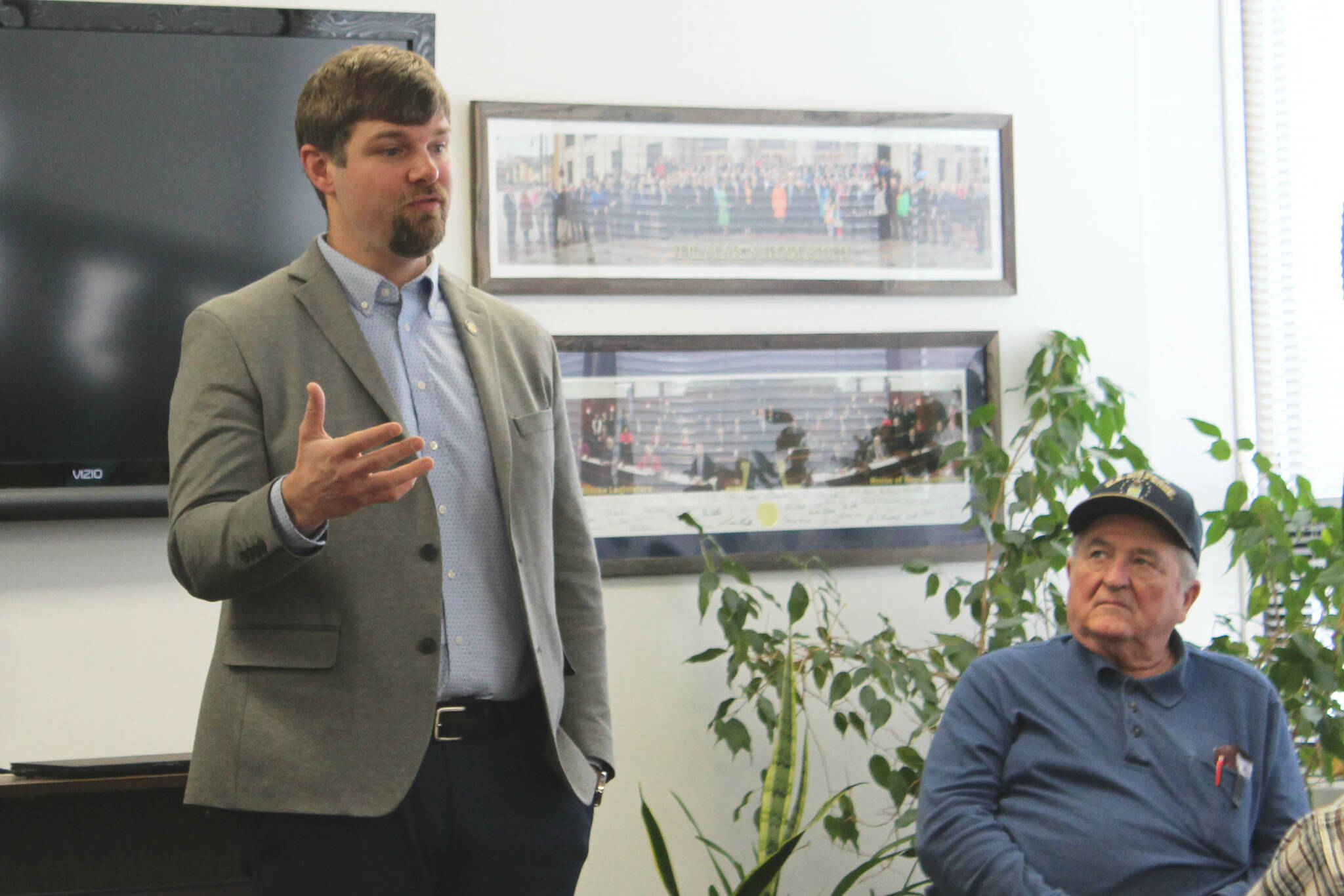
Sen. Jesse Bjorkman was well-represented on the list of bills prefiled by state lawmakers ahead of their upcoming session, which kicks off Jan. 16 in Juneau. The list, published Monday, includes 33 prefiled Alaska House bills, 30 prefiled Alaska Senate bills, four prefiled House Joint Resolutions and one prefiled Senate Joint Resolution.
Of those, Bjorkman, who represents the northern half of the Kenai Peninsula including Kenai and Soldotna, is responsible for four prefiled Senate bills.
The first, S.B. 161, would allow buildings used by farmers for production to be taxed at a lower, farm-specific rate set and collected by municipalities. Bjorkman said the idea for the exemption came out of Alaska’s Food Strategy Task Force, to which he was appointed last year, and that he’s connected with farmers on the Kenai Peninsula and in other parts of the state who’ve said they’d be interested in the exemption.
The next bill, S.B. 164, would expand the benefits afforded to disabled U.S. veterans regarding Alaska State Parks. Disabled veterans are currently allowed to camp recreationally for free in Alaska State Parks. Under Bjorkman’s bill, veterans would also be eligible for free parking in state recreation areas. The permits would also newly be valid for the veteran’s entire life and would not need to be renewed.
“Alaska has the highest per capita residency of veterans in the country and the Kenai Peninsula Borough has the highest per capita of veterans in the state, so I think it’s very appropriate that we honor our veterans, especially our disabled veterans, in this way,” Bjorkman said.
Another bill, S.B. 168, would change the way Alaska hunters are compensated by the State of Alaska when the state wrongfully seizes a hunter’s game. The state may seize game when it’s believed that the hunter obtained an animal illegally. When the state seizes game, Bjorkman said, the meat is disposed of, such as through a roadkill list.
“When those moose were taken, that meat got taken away and basically given to other people,” he said. “As compensation to the hunter for their wrongfully seized game, it used to be that those hunters were placed on the roadkill list. That’s really not fair compensation.”
Under the proposed legislation, hunters whose game is wrongly seized by the State of Alaska would be paid by the state the market price for beef in the hunter’s area of Alaska. Game eligible for the program would include bison, caribou, deer, elk, goat, moose, musk ox and mountain or Dall sheep.
“If a court finds that the state or an agent of the state wrongfully seized game from an individual, the department shall provide monetary compensation to the individual in an amount approximately equal to the weight in pounds of the wrongfully seized game meat multiplied by the current prevailing per-pound retail price of beef sold in the area the game was originally taken,” the proposed bill text says.
Bjorkman’s last prefiled bill seeks to strengthen the residency requirements associated with fishing licenses by aligning them with the same residency standards used to determine Alaska Permanent Fund dividend eligibility.
“We want to make sure that people who are getting hunting, fishing and trapping licenses in the State of Alaska as residents are actually residents,” he said.
Other topics on Bjorkman’s radar this session, he said, will be energy security and school funding. Bjorkman, who’s worked as a teacher at Nikiski Middle/High School since 2009, has been vocal about his support for an increase to the amount of money the State of Alaska gives school districts per student, also called the base student allocation.
“I plan to just speak the truth to what teachers and students and parents are seeing in schools across the state and what our education system is able to provide as far as educational opportunities and outcomes based on the current suite of resources that schools have,” Bjorkman said.
State funding for K-12 education is expected to be a top issue in Juneau this session as school districts around the state warn of deficits they say will require tough cuts without additional financial aid. The Kenai Peninsula Borough School District is facing a $13 million deficit for the upcoming fiscal year, and was one of many districts that lobbied lawmakers last year for a BSA increase.
Lawmakers ultimately approved $175 million in one-time funds, half of which Gov. Mike Dunleavy vetoed. Bjorkman said he’ll again push for a BSA increase this session over one-time funding, which he described as “a really bad, inefficient way to spend state dollars.“
When it comes to a pending shortage of natural gas in Cook Inlet, Bjorkman said he is “willing to consider all options.” Before deciding whether he supports a new energy security proposal, Bjorkman said he will first speak with natural gas producers and the companies who are exploring and drilling in the Cook Inlet.
“We have a lot of interesting ideas, but I think … we need to hear from producers of oil and gas about what it is that they need and how they’re interested in partnering with the state,” he said. “After we hear those ideas, I think we can move forward about what the best course of action will be.”
In addition to being the last chance state lawmakers have to get bills across the finish line, the second legislative session comes amid a busy election year. In addition to casting ballots in national races for president, senator and representative, Alaskans will cast ballots in 40 Alaska House races and 10 State Senate races. Bjorkman said election years usually affect the way things play out in Juneau.
“Certainly the pressure is intensified to complete bills and to pass bills because after this session is over, all of the bills that we’ve worked on that don’t pass — they have to start over again,” he said. “… The time is now for legislation to pass.”
Reach reporter Ashlyn O’Hara at ashlyn.ohara@peninsulaclarion.com.
