
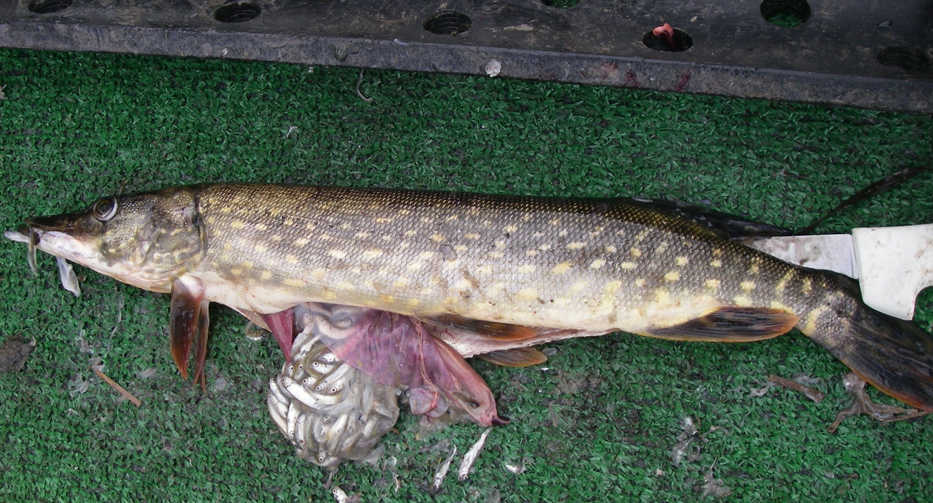
Loons calling through the morning mist … the cry of an eagle perched overhead… rainbow trout leaping from the water, and your children’s smiles as they reel one in. This tranquil image illustrates what once was commonplace for many lake residents in the Soldotna Creek drainage.
Clyde Mullican, a homesteader on Sevena Lake, recalls trout fishing from his property as “outrageous.”
“You couldn’t throw a hook in without having a rainbow on it. Big ones too!”
Unfortunately, today, those hooks go largely untouched.
In the 1970s, northern pike were introduced to the Soldotna Creek drainage through illegal stockings. Later more illegal introductions occurred in other area lakes from Kasilof to Nikiski. In most cases, native fish populations collapsed within a decade of pike establishment taking away fishing opportunities for prized native fish. For example, the quality rainbow trout fisheries in East and West Mackey Lakes and Derks Lake, which are in the Soldotna Creek drainage, were severely impacted by the introduction of northern pike. The stocked coho salmon fishery on Union Lake was also eliminated.
Northern pike are an invasive species in Southcentral Alaska, and they are the likely suspect in the decline of salmon populations in formerly productive drainages like Alexander Creek in the pike-plagued Susitna River basin. This infestation prompted concern by the Alaska Department of Fish and Game (ADF&G) that similar scenarios affecting local native fish populations would eventually play out on the Kenai Peninsula.
Stormy Lake and Soldotna Creek were of particular concern because of proximity to critical coho salmon and rainbow trout rearing areas that contain the densely vegetated calm water habitat pike prefer. For Stormy Lake, the fear was that pike would spread to the Swanson River drainage. For Soldotna Creek, the concern is primarily for Kenai River tributaries like the Moose River.
Although the fast-flowing glacial Kenai River is not optimal habitat for northern pike, the river can serve as a travel corridor for them. Up to 40 percent of the Kenai River’s coho salmon production occurs in the Moose River. If a reproducing population of northern pike ever establishes there, it could have devastating consequences for native fish and the fisheries that depend upon them. The good news is that this hasn’t happened yet and can still be prevented.
ADF&G is taking a very proactive approach in dealing with northern pike on the Kenai Peninsula with the goals of preventing their spread and protecting the area’s native fish populations and fishing opportunities. Along the way, native fish populations are being restored, but the primary goal is to eradicate northern pike from the Kenai Peninsula.
To eradicate invasive fish, there are few options. One is to drain an entire waterbody, which isn’t usually feasible. In rare cases intensive gillnetting can be effective, but only if the waterbody and pike population are both very small. The best option is to use a fish pesticide, an approach used on the Kenai Peninsula since 2008.
We typically use a plant-based product called “rotenone.” Rotenone kills fish because it is easily absorbed into the bloodstream via the thin tissue of the gills. Once in the blood, rotenone disrupts cellular respiration, and fish can’t metabolize oxygen. All organisms with gills can be affected by rotenone.
Fortunately, at the extremely low concentration needed for pike control of less than 50 parts per billion, rotenone-treated water is safe for birds and mammals (including humans) to contact because rotenone is poorly absorbed through the skin and is broken down by digestive enzymes if ingested. Regardless, in order to eliminate all risk of exposure, we advise the public to not contact rotenone-treated water until the rotenone has fully degraded. To that end, treatments usually occur just prior to ice up, when recreational use is at a minimum.
In preparation for rotenone treatments, ADF&G staff spend years planning the projects, collecting field data, coordinating with area residents, and acquiring permits. Many local residents have attended meetings or provided comments on projects. Tackling the problem of a northern pike infestation as a community is vital to the success of these efforts. ADF&G seriously reviews and considers all comments and feedback received before starting rotenone treatments.
Local pike eradication efforts began in 2008 and 2009 with rotenone treatments of Arc and Scout Lakes. In 2011, two very small pike populations of less than 30 individuals per lake were removed from Tiny Lake and Hall Lake following many months of intensive gillnetting.
In 2012, the department treated Stormy Lake with rotenone. This was the first project where native game fish still occurred in the lake. Prior to the treatment, native fish were relocated from Stormy Lake into holding pens in Wik Lake until the rotenone in Stormy Lake degraded. This project was also the first treatment of an open system as Stormy Lake drains directly into the Swanson River. Today the pike are gone, and the native fish are increasing their abundance in Stormy Lake. Catch rates of trout, char, and coho salmon during a single day-long survey in 2014 surpassed the total catch of these species following two months of intensive survey effort before the treatment.
This past October, ADF&G initiated a multi-year effort to rid the entire Soldotna Creek drainage of northern pike. This is the most extensive pike removal project to date. The drainage was divided into two areas by a series of fish barriers. The western branch (Area 1) only contained northern pike and was treated with rotenone in October. Area 2 (comprising the remainder of the drainage) still harbors native fish species and has not been treated with rotenone.
Next year, ADF&G will evaluate the success of the Area 1 rotenone treatments to ensure the pike are gone. If the evaluation indicates success, we will spend the summer relocating native fish from Area 2 to Area 1. This effort will provide a sanctuary for native fish that would otherwise perish after treatment of Area 2 in 2016 and 2017 and help restore native fish populations in Area 1. Once we can verify that the entire drainage is pike-free, fish barriers will be removed to allow unrestricted movement and recolonization of native fish.
This will be a milestone for pike eradication efforts on the Kenai Peninsula because the Tote Road lakes near Kasilof will be the only remaining water bodies containing northern pike. These efforts will restore wild fisheries on the Kenai Peninsula so that hooks cast out into Soldotna Creek lakes will again see the action they once did.
Contact Kenai Area Research Fishery Biologist Robert Massengill at 907-262-9368 or Southcentral Alaska Invasive Species Coordinator Krissy Dunker at 907-267-2889 for more information on northern pike eradication from the Kenai Peninsula. You can find more information about the Kenai National Wildlife Refuge at http://kenai.fws.gov or http://www.facebook.com/kenainationalwildliferefuge.
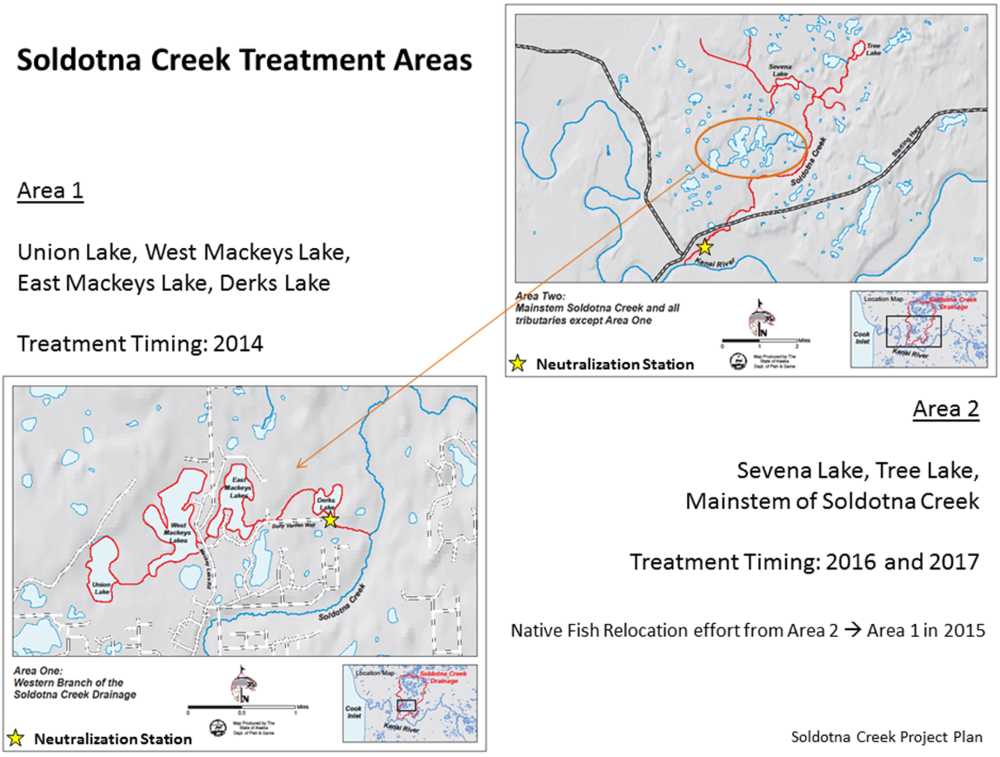
Phased application of rotenone to two treatment areas is part of a multi-year project to eradicate northern pike from the Soldotna Creek drainage.
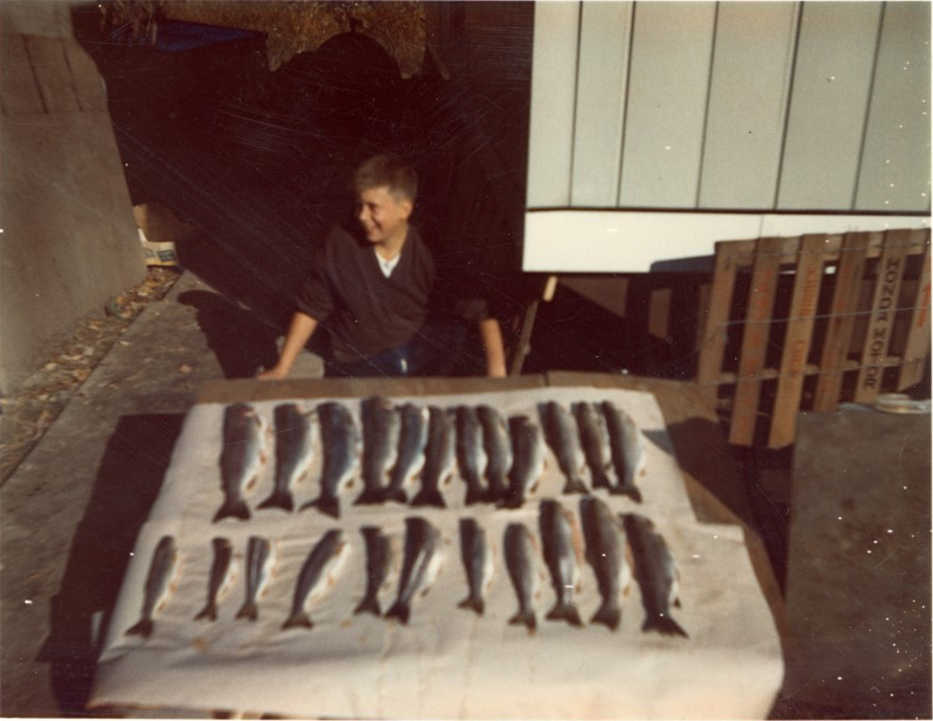
Clyde Mullican’s rainbow trout catch from Sevena Lake circa 1970s before introduced northern pike began to affect native fish populations. (Photo courtesy Clyde Mullican)
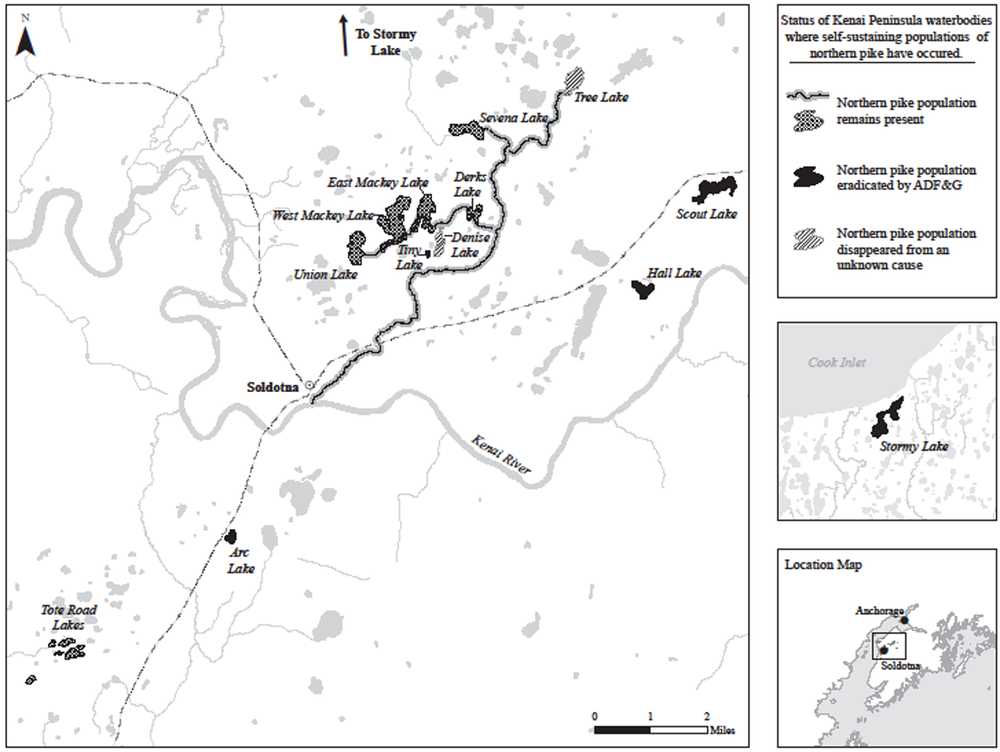
Northern pike distribution on the Kenai Peninsula.
