
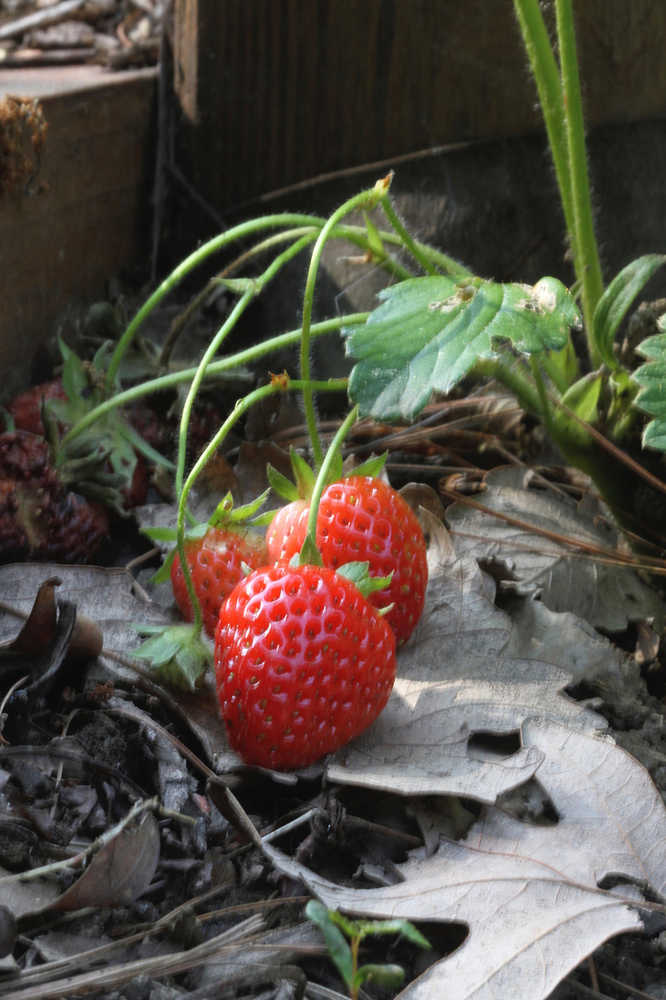
This May 28, 2012 photo shows second year strawberries thriving in an area of partial shade on a private residence in New Market, Va. Strawberries are an easy-to-grow alternative to turf in problem areas like around trees, pathways and slopes. (Dean Fosdick via AP)

This May 28, 2012 photo shows second year strawberries thriving in an area of partial shade on a private residence in New Market, Va. Strawberries are an easy-to-grow alternative to turf in problem areas like around trees, pathways and slopes. (Dean Fosdick via AP)

Edible landscaping can yield color, wildlife habitat, food

Why bother mowing thirsty lawns when you can grow edibles? Replace those sorry-looking patches of grass around trees, pathways and slopes with mint, thyme, strawberries, and a host of attractive and practical fruits, vegetables and herbs.

“Turf is sort of the lowest common denominator in ground covers,” said Weston Miller, a horticulturist with the Oregon State University Extension Service in Portland. “It takes more work, specialized timing and tools. The advantage with edibles is that they provide more (wildlife) habitat and they also look good.”

Edible landscaping includes more options than simply adding ground cover. Ornamental shrubs and trees can be attractive, practical and long-lasting, too.

“If you’re looking to eliminate trouble spots, the thing to keep in mind is that the bulk of herbs and a lot of the fruits do best in full sun,” Miller said. “Some will be just as colorful in partial shade, although they won’t bear as much.”

Good drainage also is important, he said. “Low-lying areas are not good places for growing edibles.”

Recommended food plants for lawns, slopes and problem areas include:

GROUND COVER:

— Herbs. “You get more for your money with perennial herbs over turf,” said Rhonda Ferree, a horticulturist with University of Illinois Extension. “Herbs don’t have a lot of pest problems, and make for a good alternative.”

— Edible flowers like viola, calendula, chives, nasturtiums and ferns. “I’ll add flowers to a dull-looking salad to add color,” Ferree said. “Or sometimes I just eat flowers right out of the garden.”

— Greens. “Highly recommended. Fast and easy to grow,” Miller said. “They also have a long harvest period. Rainbow chard is a great ornamental.”

— Fruit. “One good way to start is with strawberries,” Miller said. “Wild strawberries or Alpine strawberries do better in partial sun than garden varieties. Wildlife like them a lot.”

SHRUBS:

— Berries, including currants, raspberries and blueberries. “Use a raspberry fruiting shrub as a hedge,” Ferree said. “Hops, grapes, edible passion flowers, cucumbers or pole beans work well as vines.”

— Roses. “Rose bushes are beautiful and hold soil well on a slope,” Ferree said. “Wild roses develop hips with a lot of Vitamin C that often are used in teas and for making preserves.”

TREES:

— Fruit over ornamentals. “A hickory tree makes a great large shade tree while also providing delicious nuts,” Ferree said. “Instead of a spring-blooming tree like a redbud, consider an apple or cherry that not only have beautiful spring blooms but later provide delicious fruit.”

Dwarf varieties grown in containers or raised beds work well on small patios or balconies. The same is true for smaller varieties of tomatoes, raspberries, blueberries and many herbs, Ferree said. “Even a citrus tree houseplant can be moved outside during summer.” Food plants are better choices for the environment than a wide expanse of grass, she said: “You’re not going to have the output of emissions and mowing costs.”

Growing edibles, however, might not be best if you’re trying to find a labor-saving replacement for turf, Miller said.

“They require a different kind of maintenance: mulching, organic fertilizers, finding the right pH balance and things like that,” he said.

Online:

For more about edible groundcovers, see this Oregon State University Extension Service fact sheet: http://extension.oregonstate.edu/mg/metro/sites/default/files/Edible_Landscaping.pdf

More in Life

This 1903 photograph of mostly Kenai residents shows (back, far left) Hans Peter Nielsen, first superintendent of Kenai’s agricultural experiment station. Nielsen began work at the station in 1899 and resigned at the end of the 1903 season. (Photo from the Alaska State Library historical collection)
The experiment: Kenai becomes an agricultural test site — Part 2

AUTHOR’S NOTE: Presidential Executive Order #148, in January 1899, had set aside… Continue reading

Served together on a bed of greens, these pickled eggs and beets make a light but cheerful lunch. Photo by Tressa Dale/Peninsula Clarion
A wealth of eggs for good health

Pickled along with roasted beets and dill, these eggs have a cheerful hue and bright aroma.

File
Minister’s Message: Good grief

Grief doesn’t take a holiday, but it can offer you something the holidays can’t.

This dish, an earthy and herbaceous vegetarian reimagining of the classic beef wellington, is finished nicely with a creamy maple balsamic sauce. Photo by Tressa Dale/Peninsula Clarion
A special dish for a special request

This mushroom wellington is earthy and herbaceous, and its preparation comes with much less pressure.

File
Minister’s Message: Lifelong learning is a worthwhile goal

Lifelong learning. That’s a worthwhile goal. Schools have been in session for… Continue reading

This E.W. Merrill photograph shows Charles Christian Georgeson, special agent in charge of all agricultural experiment stations in Alaska, starting in 1898. (Photo from Alaska History Magazine, July-August 2020)
The Experiment: Kenai becomes an agricultural test site — Part 1

Individuals deciding to explore Kenai’s historic district might start their journey by… Continue reading

File
Minister’s Message: Being ‘thank full?’

As a young dad, I remember teaching my toddler children to say… Continue reading

This virgin blueberry margarita made with blueberry flavored kombucha is perfect for sipping while playing cards.  Photo by Tressa Dale/Peninsula Clarion
Sweet fruit for sober fun

Blueberry kombucha gives this virgin margarita complexity in flavor and a lovely purple hue.

John W. Eddy was already a renowned outdoor adventurer and writer when he penned this book in 1930, 15 years after the mystery of King David Thurman’s disappearance had been solved. Eddy’s version of the story, which often featured wild speculation and deviated widely from the facts, became, for many years, the accepted recounting of events.
King Thurman: An abbreviated life — Part 6

AUTHOR’S NOTE: The fate of King David Thurman, a Cooper Landing-area resident,… Continue reading

Public photo from ancestry.com
James Forrest Kalles (shown here with his daughters, Margaret and Emma) became the guardian of King David Thurman’s estate in early 1915 after Thurman went missing in 1914 and was presumed dead.
King Thurman: An abbreviated life — Part 5

AUTHOR’S NOTE: King David Thurman left his Cooper Landing-area home in late… Continue reading

These heart-shaped chocolate sandwich cookies go perfectly with a glass of milk. (Photo by Tressa Dale/Peninsula Clarion)
Chocolate cookies for a sweet treat

A healthy layer of frosting makes these sandwich cookies perfectly sweet and satisfying.